



Black Death in 14th Century Europe: Imagine waking up perfectly healthy, only to be dead by nightfall. The Black Death was terrifyingly contagious. People who were perfectly healthy when they went to bed at night could be dead by morning. Between 1346 and 1353, this devastating pandemic swept across Europe with unprecedented fury, leaving mountains of corpses and entire villages abandoned in its wake. As many as 50 million people died, perhaps 60% of Europe’s 14th century population.
- What Was the Black Death? Understanding Europe’s Deadliest Pandemic
- Origins and Spread: How the Black Death Arrived in Medieval Europe
- Death Toll Statistics: How Many People Died from the Black Death?
- Medieval Medicine and Failed Treatments for the Plague
- Social and Economic Consequences of the Black Death Pandemic
- Regional Variations: Black Death’s Uneven Impact Across Europe
- Long Term Legacy: How the Black Death Shaped Modern Europe
- The Black Death’s Enduring Lessons for Humanity
- Finding Deeper Meaning: From Historical Tragedy to Spiritual Enlightenment
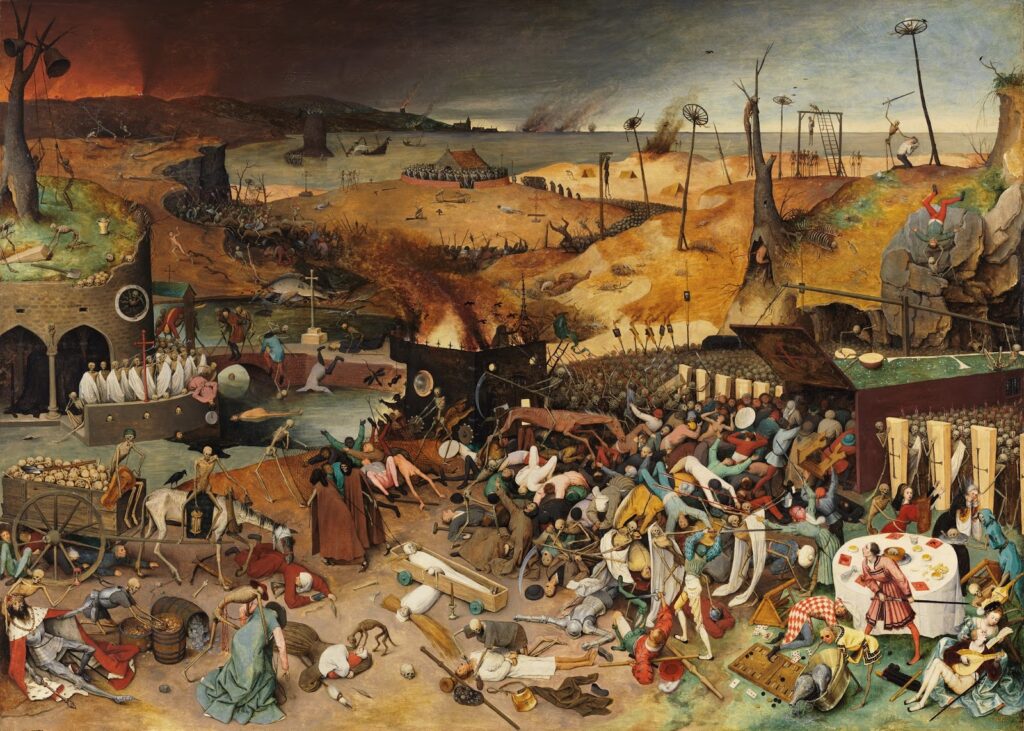
This was not merely an epidemic. It was an apocalyptic event that fundamentally restructured European society, economy, and culture. The plague’s shadow loomed over the continent for centuries, sparking religious upheaval, labour revolutions, and medical innovations that eventually laid the groundwork for the modern world. Understanding this cataclysmic event offers profound insights into human resilience, the fragility of civilisation, and the enduring quest for meaning in the face of mortality.
What Was the Black Death? Understanding Europe’s Deadliest Pandemic
The disease was caused by the bacterium Yersinia pestis. It spreads by fleas on rodents, usually rats, and also through the air. This scientific understanding was completely unknown to medieval Europeans, who attributed the catastrophe to supernatural forces such as the wrath of God, the work of the devil, the alignment of planets, or “bad air.”
There are three types of plague, and all three were likely present during the Black Death pandemic:
- Bubonic Plague: The best known symptom was one or more infected, enlarged, and painful lymph nodes, known as buboes. These were commonly found in the armpits, upper femoral area, groin, and neck region.
- Pneumonic Plague: This form attacked the lungs and could spread directly through respiratory droplets.
- Septicemic Plague: This form infected the bloodstream and caused rapid death.
Symptoms included fever, chills, vomiting, diarrhoea, and terrible aches and pains. Without treatment, plague resulted in the death of 30% to 90% of those infected, typically within 10 days, though many victims succumbed within just three days of the first symptoms.
Origins and Spread: How the Black Death Arrived in Medieval Europe
New research shows that the plague began in the spring of 1346 in the steppe region, where a plague reservoir stretched from the north western shores of the Caspian Sea into southern Russia.
The epidemic began with an attack launched by the Mongols on the Italian merchants’ last trading station in the region, Kaffa, known today as Feodosiya, in Crimea. In the autumn of 1346, plague broke out among the besiegers, who catapulted infected corpses into the city.
The Black Death entered Europe probably via Sicily, carried there by four Genoese grain ships sailing from Caffa in October 1347. From Crimea, flea infested rats on Genoese ships spread the disease through the Mediterranean Basin. It reached North Africa, West Asia, and the rest of Europe through Constantinople, Sicily, and the Italian Peninsula.
The plague spread to France and Spain in 1348, then to Germany, Switzerland, and Austria. It decimated London in 1349 and reached Scandinavia and northern England by 1350.
Death Toll Statistics: How Many People Died from the Black Death?
The mortality figures from the Black Death remain staggering even by modern standards:
| Region/City | Estimated Death Toll | Percentage of Population |
| Europe (Total) | ~50 million people | ~60% |
| Venice, Florence, Siena | Massive losses | Up to 66% |
| Damascus | 1,000 deaths daily at peak | 25 to 38% |
| Syria | 400,000 total | Significant |
| Middle East | Substantial | ~33% |
It may have reduced the world’s population from an estimated 450 million to between 350 and 375 million by 1400.
This is a truly mind boggling statistic. It overshadows the horrors of the Second World War and is twice the number murdered by Stalin’s regime in the Soviet Union. It took 200 years for the population of Europe to recover to pre plague levels.
Also Read: Unraveling the Intriguing History of the Boer War: Causes, Battles, and Lasting Impact
Medieval Medicine and Failed Treatments for the Plague
The physicians of the day had no idea how to cope with the outbreak. Nothing in their experience came anywhere close to this epidemic.
Common Medieval Plague Treatments
Doctors tried every possible cure and prevention. Physicians relied on crude techniques such as bloodletting and boil lancing, practices that were dangerous as well as unsanitary, and superstitious methods such as burning aromatic herbs and bathing in rosewater or vinegar.
Bloodletting and Leeching: The preferred method was leeching, in which a number of leeches were placed on the patient’s body to suck out the so-called bad blood. Leech collectors were highly paid professionals and not everyone could afford this treatment. For the less affluent, a small incision was made in the skin with a knife, and the bad blood was collected in a cup and disposed of.
Herbal Concoctions: Known as Four Thieves Vinegar, this cure is mixed vinegar with garlic, herbs, and spices. Legend holds that four thieves who ransacked the homes of dead victims protected themselves with this concoction while they looted.
Fecal Treatments: Human excrement was perhaps the foulest in a long line of revolting plague treatments. Feces were mixed with other substances into a paste consistency and smeared on buboes that had been cut open. One such recipe called for feces to be mixed with ground lily root and tree sap.
Mortality rates for the most virulent forms of the disease were reportedly as high as 95%.
Social and Economic Consequences of the Black Death Pandemic
The plague created religious, social, and economic upheavals with profound effects on the course of European history.
Labour Shortages and Economic Transformation
Many labourers died, devastating families through the loss of their means of survival. The labour shortage caused landowners to substitute wages or money rents in place of labour services in an effort to retain their tenants. Wages for artisans and other workers also increased.
Per capita shares of resources suddenly doubled. Real wages increased substantially, labour inputs into arable farming were reduced, and productivity per acre may have fallen.
From the perspective of many survivors, the effect may have been ultimately favourable. R. H. Hilton argued that the English peasants who survived found their situation much improved. For many Europeans, the 15th century became a golden age of prosperity and new opportunities. Land was plentiful, wages were high, and serfdom had all but disappeared.
Religious and Social Upheaval
Antisemitism intensified throughout Europe, as Jews were blamed for the spread of the Black Death. European Christians claimed that Jews were poisoning wells. At least 235 Jewish communities experienced mass persecution and destruction during this period.
In February 1349, 2,000 Jews were murdered in Strasbourg. In August that year, the Jewish communities of Mainz and Cologne were massacred.
| Consequence | Impact |
| Labour Market | Dramatic wage increases for survivors |
| Social Structure | Decline of feudalism and serfdom |
| Religious Life | Rise of flagellant movements and persecution |
| Art and Culture | Art became more preoccupied with mortality and the afterlife |
| Trade | Trade suffered for a time, and wars were temporarily abandoned |
Regional Variations: Black Death’s Uneven Impact Across Europe
A new study demonstrates that the Black Death’s mortality in Europe was not as universal or as widespread as long thought. An international team of researchers analysed pollen samples from 261 sites in 19 modern day European countries to determine how landscapes and agricultural activity changed between 1250 and 1450 CE.
Their results show that mortality varied widely. Sharp agricultural declines in Scandinavia, France, south western Germany, Greece, and central Italy support the high mortality rates recorded in medieval sources. Meanwhile, many regions, including much of Central and Eastern Europe and parts of Western Europe such as Ireland and Iberia, show evidence of continuity.
“There is no single model of the pandemic or a plague outbreak that can be applied to any place at any time regardless of the context,” says Adam Izdebski. “Pandemics are complex phenomena that have regional, local histories.”
Also Read: Ancient India: A Complete History from Prehistoric Times to Early Empires
Long Term Legacy: How the Black Death Shaped Modern Europe
There were further outbreaks throughout the Late Middle Ages, and the European population did not regain its 14th century level until the 16th century. The epidemic continued to strike roughly every 10 years, with its last major outbreak being the Great Plague of London from 1665 to 1666.
Medical Advances Born from Tragedy
Following the devastation of the Black Death, the practice of quarantine emerged and provided a gateway for more advanced medical practices to spread across the world. The science and technology that developed during and after the Black Death included advancements in medicine along with new ways of thinking that paved the way for the Renaissance.
While many treatments were ineffective or harmful by modern standards, this period marked a transition from a predominantly spiritual and humoral understanding of disease to one increasingly influenced by observation and empiricism. This shift laid the groundwork for future advancements in medical science.
Even without the plague, medieval life was accompanied by constant fear of death. The average life expectancy for women was about 29 years and for men only 28.
The Black Death’s Enduring Lessons for Humanity
The Black Death teaches us that even the mightiest civilisations remain vulnerable to the forces of nature. Because 14th century healers were unable to explain the cause, many Europeans believed that supernatural forces, earthquakes, and malicious conspiracies were credible explanations. No one considered rat control as a method to ward off the plague, and many believed that only God’s anger could produce such horrific suffering and death.
Finding Deeper Meaning: From Historical Tragedy to Spiritual Enlightenment
The Black Death confronted medieval humanity with the ultimate question: Why do we suffer, and what is the purpose of our existence? This profound crisis of mortality drove millions to seek answers beyond the material world. Today, as we reflect on such historical tragedies, the quest for spiritual understanding remains deeply relevant. Life’s brevity reminds us to seek true knowledge and divine connection rather than temporary worldly pursuits.
For those seeking genuine spiritual wisdom rooted in sacred scriptures, the books “Gyan Ganga“ and “Way of Living” by Saint Rampal Ji Maharaj offer profound insights into life’s deeper purpose, the path to salvation, and eternal peace. Just as humanity rebuilt after the plague, our souls too can find renewal through authentic spiritual guidance.