

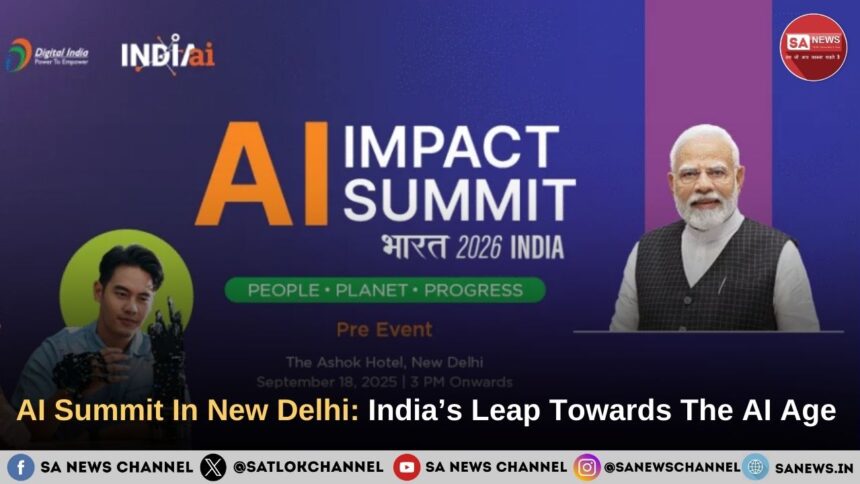
India AI Summit 2026: The global conversation on Artificial Intelligence (AI) has historically centered on safety, regulation, and theoretical risks, mostly led by Western nations. However, this week in New Delhi, the narrative has changed. The India AI Impact Summit 2026 is currently underway, and it marks a historic turning point. We are witnessing a shift from talking about AI policy to the actual industrialization of intelligence.
- The Atmosphere: The “Woodstock of AI”
- The Geopolitical Pivot: A Voice for the Global South
- The Economic Shockwave: Disruption and Investment
- “AI ka UPI”: Infrastructure as Destiny
- Sovereign Intelligence: The “Desi” Models
- Sectors in Action: Health, Agriculture, and Youth
- The Research Frontier and Regulation
- Building the “Indostack”
- India Leading Another Path
- FAQs on India AI Summit 2026
- Q: What is the India AI Impact Summit 2026?
- Q: Where is the 2026 AI Summit taking place?
- Q: Is the AI Summit open to the general public?
- Q: What are the dates and venue for the AI Summit 2026?
- Q: What is the core theme of the AI Impact Summit?
- Q: Which indigenous Indian AI models were launched at the summit?
The summit, themed “Sarvajan Hitaya, Sarvajan Sukhaya” (Welfare for All, Happiness for All), is not just a conference. It is a bold statement. India is declaring that it will no longer just consume digital services from abroad. Instead, the world’s most populous nation intends to become a sovereign manufacturer of intelligence. The following is a 2 day report of the event.
The Atmosphere: The “Woodstock of AI”
The sheer scale of the event has stunned observers. Government officials describe it as the largest AI gathering in the world. Over 250,000 delegates have registered, including 15 heads of state and CEOs from tech giants like Alphabet ( Parent Company Of Google ) , OpenAI, and Qualcomm. The energy in New Delhi is electric, though it borders on chaotic.
The first day, February 16, proved difficult. The organizers expected a large crowd, but they did not anticipate the “stampede-like” surge of 70,000 people. The Bharat Mandapam, designed for dignified diplomatic meetings, struggled to contain the enthusiasm of India’s tech ecosystem. Long queues formed under the sun, water supplies ran dry, and mobile networks crashed under the weight of thousands of simultaneous connections.
By the second day, operations stabilized. This incident served as a metaphor for India’s AI revolution: it is messy and massive, but it is also resilient and relentlessly optimistic. Unlike exclusive events in Davos, this summit features students and rural innovators standing shoulder-to-shoulder with global billionaires.
The Geopolitical Pivot: A Voice for the Global South
For years, the Global North has dominated the AI debate, focusing on how to protect proprietary technology. India has flipped the script. The Delhi summit focuses on the Global South developing nations that need AI to solve real problems like hunger, disease, and education gaps.
Prime Minister Narendra Modi introduced the “Three Sutras” (Three Principles) to guide this new vision:
- People: AI must respect human dignity and create jobs, not just replace workers.
- Planet: The world cannot afford the environmental cost of Western AI models. India advocates for “Green AI” that uses energy efficiently.
- Progress: AI must act as a tool to speed up development in healthcare and agriculture.
This philosophy has attracted powerful allies. Leaders like French President Emmanuel Macron and Brazilian President Luiz Inácio Lula da Silva are attending. They support India’s push for a “multipolar” AI world, where no single country controls all the data and technology.
The Economic Shockwave: Disruption and Investment
While the summit celebrates innovation, the financial markets are reacting with fear. In the week leading up to the event, Indian IT stocks suffered a massive crash, losing nearly $50 billion in value. Investors are worried about “Agentic AI” new software that can write code and automate complex tasks.
This technology threatens the traditional business model of Indian outsourcing giants like TCS and Infosys. If an AI agent can write software faster and cheaper than a human, the demand for human coding armies might vanish.
This created a strange tension at the summit. Dario Amodei, the CEO of Anthropic (a company leading this automation wave), is a guest of honor. Yet, Indian companies are adapting quickly. Infosys announced a partnership with Anthropic to integrate these new tools, and Air India is already using them to automate internal tasks. The message is clear: Indian companies must cannibalize their own old business models before someone else does.
“AI ka UPI”: Infrastructure as Destiny
The most radical idea emerging from the summit is a policy called “AI ka UPI.” India revolutionized finance with the Unified Payments Interface (UPI), which made digital money accessible to everyone. Now, the government wants to do the same for intelligence.
Currently, high-quality AI is too expensive for a rural developer or a small startup. The “AI ka UPI” initiative views artificial intelligence as a public utility, just like electricity or water. The plan involves creating a national grid of computing power. The government and private players like Yotta Data Services are importing tens of thousands of GPUs (the chips that power AI). They will offer this computing power to startups at heavily subsidized rates.
This means a developer in a small village will not need to buy expensive servers. They can simply “plug in” to the national grid and add voice or vision capabilities to their apps.
Sovereign Intelligence: The “Desi” Models
India is refusing to rely solely on foreign AI models, which often carry Western biases. The summit saw the launch of several “Sovereign” or indigenous models designed specifically for Indian needs.
BharatGen: Launched by IIT Bombay, this is the government’s flagship model. It speaks and understands 22 Indian languages. Unlike American models trained on the English internet, BharatGen is trained on Indian history, philosophy, and legal texts. It ensures that the AI reflects Indian cultural values.
Inya VoiceOS: Unveiled by the Prime Minister, this tool is a revolution for the “oral internet.” Most AI converts speech to text, processes it, and then turns it back to speech. Inya skips the text step entirely. It processes voice directly. This reduces delay and allows for natural conversations. For the hundreds of millions of Indians who may not be able to read or write fluently, this technology allows them to interact with the internet using only their voice.
Sarvam Kaze: In a surprise reveal, the startup Sarvam AI launched a pair of AI-powered smart glasses. This proves that India is not just building software; it is entering the hardware market to compete with global tech giants.
Sectors in Action: Health, Agriculture, and Youth
The summit moved beyond theory to show how AI helps common people through the “Seven Chakras” (Thematic Working Groups).
In healthcare, the government launched the SAHI (Secure AI for Health Initiative). This framework ensures that medical AI is safe for Indian patients. It prevents the use of foreign data that might not apply to Indian genetics or diseases.
In agriculture, companies showcased “soil intelligence.” These tools analyze the biology of the soil to help farmers use the right amount of fertilizer. Other sessions focused on using AI to predict hyper-local weather patterns. For a country dependent on the monsoon rains, accurate weather data can save billions of dollars in crop losses.
Also Read: Agentic AI and Moltbook: The New Frontier in Autonomous AI Interaction
The summit also highlighted the “YuvaAI” challenge, which celebrates young innovators. Teenagers presented projects that use AI to detect malaria, manage traffic, and help people with speech impairments communicate. These inventions highlight the “frugal innovation” mindset: solving big problems with limited resources.
The Research Frontier and Regulation
As the summit enters its third day, the focus shifts to science. A Research Symposium is currently hosting global heavyweights like Yann LeCun from Meta and Demis Hassabis from DeepMind. They are debating the future of AI alongside researchers from the Global South. These researchers are presenting papers on how to make AI work on cheap smartphones and how to train models on languages that do not have much data on the internet.
However, alongside the excitement, there is caution. The rise of deepfakes realistic fake videos is a major concern. The government is pushing for a “techno-legal” approach. They have warned platforms like Meta that they must follow Indian laws and cultural norms. New rules will likely force companies to watermark AI content so users can tell what is real and what is synthetic.
Building the “Indostack”
The India AI Impact Summit 2026 is revealing a new geopolitical asset class. India is building an “Indostack” for intelligence. This ecosystem includes green power from Adani, sovereign computing hardware from the government, indigenous AI models like BharatGen, and a public delivery network known as AI ka UPI.
This strategy carries risks. The collapse of IT stock prices shows that AI destroys old jobs as fast as it creates new ones. The logistical issues on the first day of the summit show that India’s physical infrastructure still needs work.
Yet, the ambition is undeniable. India is rejecting the binary choice between American corporate control and Chinese state surveillance. It is carving out a third path: Digital Public Goods for the world. If “AI ka UPI” succeeds, it could make intelligence cheap and accessible for everyone, not just the wealthy.
As the summit continues, the message from New Delhi is loud and clear: The Global South is no longer just watching the AI revolution. It is building it.
India Leading Another Path
While India asserts its dominance in the digital realm, its influence is not limited to silicon and software. The nation is simultaneously reclaiming its position as the “Vishwa Guru” (World Teacher) in the spiritual domain. Today, global interest in Indian spirituality is surging, with international participation growing rapidly in institutions like the Isha Foundation and ISKCON. This trend is driven by a fundamental human instinct: the need to decode the mysteries of our origins, our inevitable mortality, and the path to true salvation.
However, many seekers often find that traditional inquiries lead to dead ends or unanswered questions. Ancient scriptures across all religions suggest that these complex mazes of life can only be solved by a singular entity, a “Tatvadarshi Saint” or “Baakhabar” (The Supreme Knower).
Coinciding with the technological fervor of the AI Summit, another grand celebration was underway that was celebrating and commemorating the day a person meets this Saint, across 12 Satlok Ashrams as the Bodh Diwas of Saint Rampalji Maharaj. He is the only one that is truly capable of answering these undying questions once and for all. His teachings utilize the authority of religious scriptures to provide definitive answers that quench the thirst for truth.
To learn why Saint Rampalji is the True Guru and if the answers he has provided are full and final. Head on towards jagatgururampalji.org or access literature such as “Gyan Ganga” and “Jeene Ki Raah” to examine the proofs directly,by free ordering or downloading these books for free.
Where you will find the answers to these questions and much more definitively and eventual propel India towards being the true spiritual leader of the world.
FAQs on India AI Summit 2026
Q: What is the India AI Impact Summit 2026?
A: It is a landmark global conference in New Delhi dedicated to transforming India from a consumer of digital services into a sovereign manufacturer of artificial intelligence for the Global South.
Q: Where is the 2026 AI Summit taking place?
A: The summit is currently being held at the Bharat Mandapam complex in New Delhi.
Q: Is the AI Summit open to the general public?
A: Yes, the event is open to a wide range of attendees, including students and grassroots innovators, though the venue is currently experiencing extremely high visitor volumes.
Q: What are the dates and venue for the AI Summit 2026?
A: The event is scheduled from February 16–20, 2026, at the Bharat Mandapam in New Delhi.
Q: What is the core theme of the AI Impact Summit?
A: The summit operates under the theme “Sarvajan Hitaya, Sarvajan Sukhaya” (Welfare for All, Happiness for All), focusing on using AI to solve developmental challenges in healthcare, agriculture, and education.
Q: Which indigenous Indian AI models were launched at the summit?
A: Key launches include BharatGen (a multilingual sovereign model), Inya VoiceOS (a voice-first platform for the oral internet), and Sarvam Kaze (AI-powered smartglasses).