


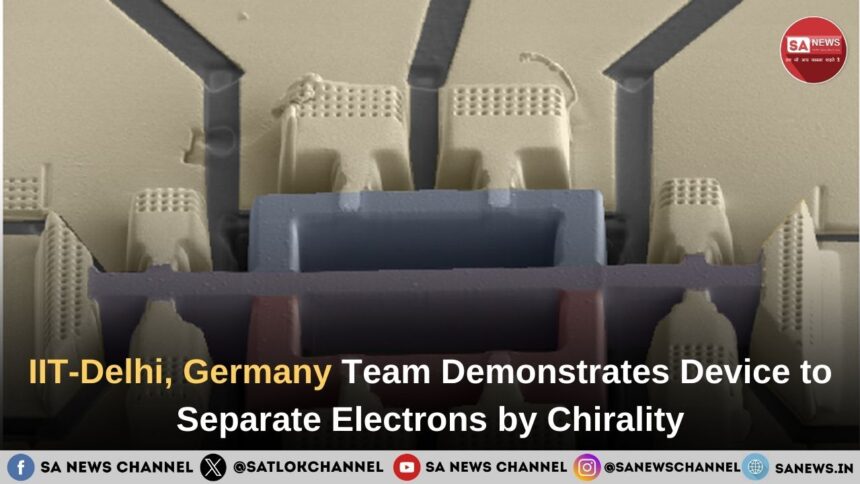
Scientists from IIT-Delhi and Germany have demonstrated a device that separates electrons based on their ‘handedness’ without using powerful magnetic fields, marking a step towards chiral electronics. Published in the journal Nature, the study shows how the quantum geometry of a palladium gallium (PdGa) crystal enables this separation. The work addresses a longstanding challenge in detecting and isolating chiral electrons, which are typically mixed with standard electrons. While practical hurdles remain, including ultra-low temperature operation and ion beam fabrication, researchers say the technology could contribute to low-power computing and new forms of magnetic memory in the future.
- Key Takeaways: IIT-Delhi and Germany Chiral Electronics Breakthrough
- Study Published in Nature Demonstrates Chirality-Based Electron Separation
- Role of Palladium Gallium (PdGa) Crystal and Quantum Geometry
- Three-Arm Device Design Enables Separation
- Why Previous Methods Were Impractical
- Technical Challenges Remain
- Potential Impact on Low-Power Computing and Memory Technologies
- A Step Towards Chiral Electronics
- Spiritual Perspective on Scientific Progress
- FAQs on IIT-Delhi and Germany Chiral Electron Device
Key Takeaways: IIT-Delhi and Germany Chiral Electronics Breakthrough
- Study published in Nature
- Conducted by scientists from IIT-Delhi and Germany
- Device separates electrons based on ‘handedness’ (chirality)
- No powerful magnetic fields or chemical doping required
- Utilises quantum geometry of palladium gallium (PdGa) crystal
- Three-arm device directs left- and right-handed electrons separately
- Fabrication requires ion beams; operation needs ultra-low temperature
- Potential applications include low-power computing and magnetic memory
Study Published in Nature Demonstrates Chirality-Based Electron Separation
In a new study published in Nature, scientists from IIT-Delhi and Germany have demonstrated a device capable of separating electrons according to their ‘handedness’, or chirality, without relying on powerful magnetic fields.
Chirality refers to a property where an object is a mirror image of another but cannot be perfectly superimposed. The human left and right hands are a common example. In certain complex materials known as topological semimetals, electrons possess a similar left or right chirality. The chirality represents a specific quantum state of an electron moving inside the crystal.
Also Read: IIT Delhi and Kendriya Vidyalaya Sign MoU to Revolutionize STEM Education for Students and Teachers
However, these special electrons are usually mixed with standard electrons that lack chirality. Detecting and isolating them has historically required either powerful magnetic fields or precise chemical doping, making practical applications difficult.
Role of Palladium Gallium (PdGa) Crystal and Quantum Geometry
The researchers addressed this challenge by exploiting the quantum geometry of a palladium gallium (PdGa) crystal.
According to the study, the single homochiral crystal made by Claudia’s group was crucial. Max Planck Institute of Microstructure Physics managing director and study co-author Stuart Parkin told The Hindu, referring to the work of fellow author Claudia Felser, that the crystal played a central role in the findings.
In this crystal, electrons behave like waves as they move through the lattice. The lattice structure restricts how much energy and momentum the wave can have. This set of constraints is called the band structure, described as similar to a road an electron travels on.
In conventional copper wiring, this “road” is flat and straight. If voltage is applied, electrons move in a straight line. In the PdGa crystal, however, the road is twisted. Even if the electron moves straight, its path drifts sideways. The direction of this drift depends on the electron’s handedness.
Three-Arm Device Design Enables Separation
The team fabricated a small device with three arms and passed an electric current through it. Beyond a threshold, PdGa’s quantum geometry pushed left-handed electrons into one arm and right-handed electrons into the other.
“Utilising quantum geometry as a new functional element, rather than an external magnetic field, was pivotal to achieving the valve functionality,” Dr. Parkin said. “It led us to fabricate our unique device geometry to demonstrate that we can control the separation of currents with opposite electronic chirality.”
The demonstration shows that electron currents with opposite chirality can be separated without the need for powerful magnetic fields, marking a step towards what researchers describe as chiral electronics.
Why Previous Methods Were Impractical
Before this development, separating chiral electrons was not easy. The process required:
- Very powerful magnetic fields, or
- Complex chemical doping methods
Both approaches increased technical complexity and energy consumption, rendering the technology impractical for daily use.
Also Read: Using Your Phone in the Bathroom? Scientists Warn of a Hidden Gut Health Danger You Shouldn’t Ignore
The present study instead uses the intrinsic quantum geometry of the PdGa crystal as the functional mechanism. This removes dependence on external magnetic fields and chemical modification.
Technical Challenges Remain
Despite the successful demonstration, the researchers acknowledged several roadblocks.
- Fabrication requires ion beams
- Operation requires ultra-low temperature
These requirements make practical use currently infeasible. The need for specialised fabrication methods and extreme operating conditions limits immediate commercial or consumer applications.
Potential Impact on Low-Power Computing and Memory Technologies
If the technical challenges can be overcome, the technology could contribute to:
- Low-power computing
- Faster electronic devices
- New forms of magnetic memory
The researchers suggest that utilising quantum geometry as a functional element could open pathways toward energy-efficient electronic systems. The ability to control and separate currents based on electronic chirality may form the basis for future device architectures.
A Step Towards Chiral Electronics
The demonstration marks progress in the field of chiral electronics, a domain that seeks to harness the chirality of electrons as a functional property in device engineering.
By showing that quantum geometry alone can enable separation of chiral currents, the IIT-Delhi and Germany team has provided experimental evidence supporting this approach.
While the device remains at a research stage due to fabrication and temperature constraints, the study published in Nature establishes a proof of concept that may shape future research in electronic materials and device physics.
Spiritual Perspective on Scientific Progress
Scientific discoveries that advance technology are often seen as milestones of human intellect, yet many spiritual traditions view knowledge itself as a gift of the Divine meant for the welfare of humanity. Such progress can make life easier, but it also invites reflection on the deeper purpose of human existence.
According to Tatvdarshi Sant Rampal Ji Maharaj, true peace and ultimate well-being come not only from material advancement but from understanding the purpose of human life and engaging in true devotion under the guidance of a Tatvadarshi Saint. He teaches that worldly achievements are temporary, while spiritual knowledge leads to lasting fulfillment and liberation.
For more information visit our
Website:www.jagatgururampalji.org
YouTube: Sant Rampal Ji Maharaj
Facebook: Spiritual Leader Saint Rampal Ji
X (Twitter): @SaintRampalJiM
FAQs on IIT-Delhi and Germany Chiral Electron Device
1. What did IIT-Delhi and Germany scientists demonstrate?
They demonstrated a device that separates electrons based on chirality without powerful magnetic fields.
2. Where was the study published?
The research was published in the international journal Nature.
3. What material was used in the device?
The device used a palladium gallium (PdGa) crystal exploiting its quantum geometry.
4. How does the device separate electrons?
PdGa’s quantum geometry directs left- and right-handed electrons into separate arms beyond a threshold.
5. What are the current limitations?
The device requires ion beam fabrication and ultra-low temperature operation, limiting practical use.