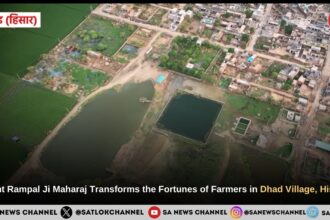


Dhana Kalan village in Hansi tehsil of Hisar district, Haryana, emerged as one of the worst-affected villages in this year’s floods. This was not ordinary waterlogging; it was a disaster that crippled farmers’ livelihoods, children’s education, religious spaces, and the entire social fabric of the village.
- Panchayat’s Appeal and the First Phase of Relief
- Crisis Beyond the Fields
- Voices from the Village: Pain, Fear, and Hope
- Key Points from Sant Rampal Ji Maharaj’s Letter to the Panchayat
- Second Phase of Major Relief: From Crisis to Solution
- Farmers at the Brink and Back
- Strengthening Hindu–Muslim Unity
- Faith in Him as the Incarnation of Paramshwar Kabir
- People’s Verdict: Government vs. Sant
- From Submersion to Symbol of Divine Grace
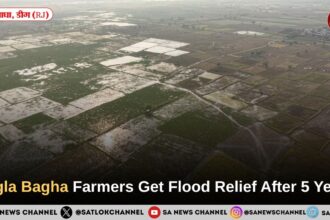
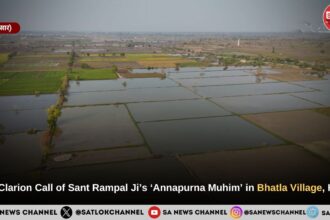
Between 1,200 and 1,500 acres of fertile land lay submerged. Fields had turned into lakes, roads disappeared, and floodwater reached houses. One farmer who had leased 90 acres reported a personal loss of nearly ₹40 lakh. The paddy crop was completely destroyed, and the upcoming wheat sowing was under serious threat.
The devastation was not limited to agriculture. The Muslim cemetery was fully inundated, making burials nearly impossible. The girls’ school building had water rising up its walls, creating a risk of collapse. Education came to a halt, fodder for cattle ran out, and even the village dispensary shut down. The entire village stood in silent despair.
In this moment of hopelessness, the Gram Panchayat decided to seek help from Sant Rampal Ji Maharaj. Seeing relief efforts He had extended to neighboring villages, Dhana Kalan nurtured a fragile hope.
Panchayat’s Appeal and the First Phase of Relief
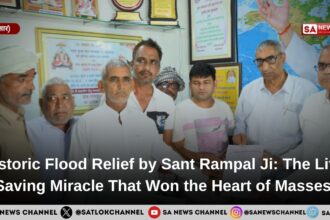
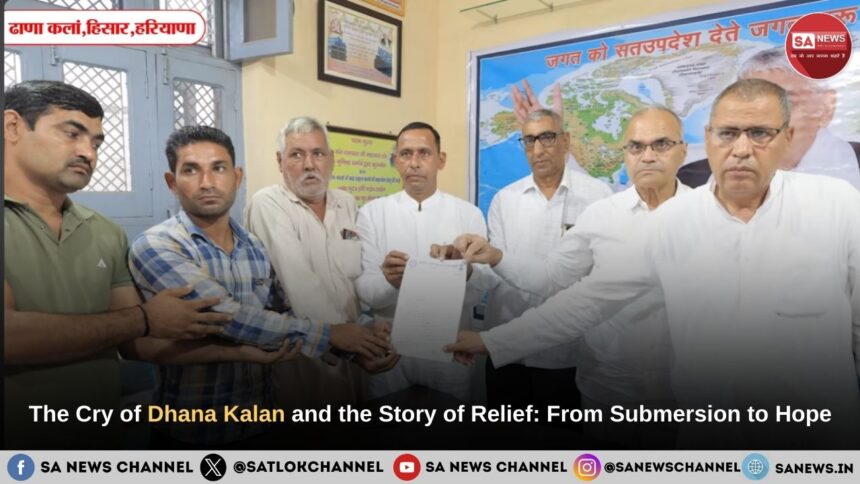
Sarpanch Bhup Singh Saini, along with panchayat members, traveled to the Barwala office and placed a request before Sant Rampal Ji Maharaj. They asked for a 5,000-foot, 8-inch pipeline and a 15 HP motor to drain floodwater.
The Panchayat did not expect such swift action. However, a rapid survey was conducted including drone inspection of the village and relief was sanctioned immediately.
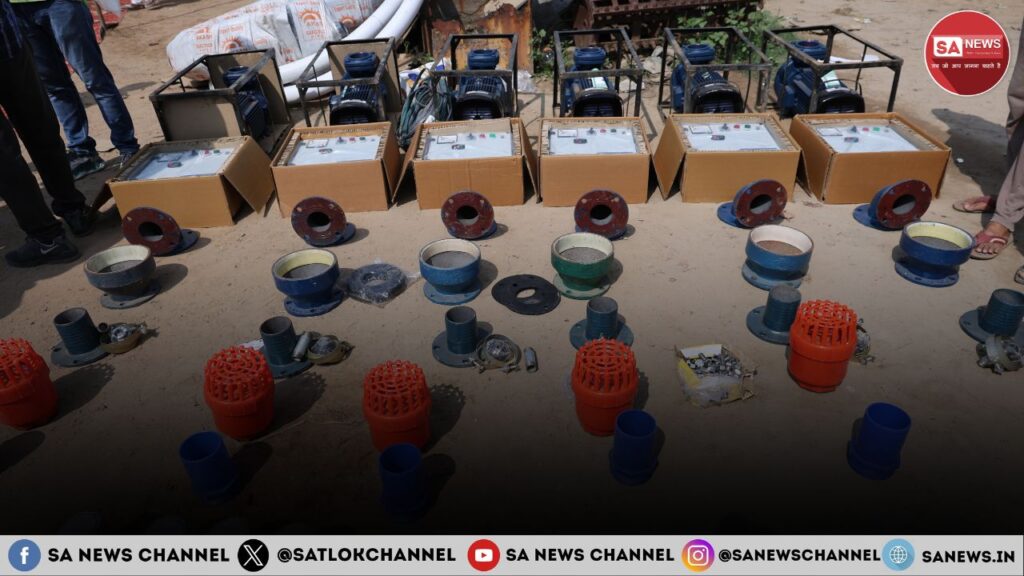
The first consignment arrived with:
- One 15 HP motor
- 5,000 feet of pipeline
- All necessary accessories
Once operational, water drained from 250–300 acres of land. For the first time, farmers saw relief on their faces and regained hope that the next crop could still be saved.
Crisis Beyond the Fields
Flooding had deeply affected religious and social life. With 1.5 to 2 feet of water in the Muslim cemetery, families feared they would not even be able to bury their loved ones with dignity.
Meanwhile, the girls’ school resembled a pond. Parents were anxious, children were out of classrooms, and villagers felt helpless. The dispensary remained closed, and cattle had no fodder.
Voices from the Village: Pain, Fear, and Hope
Farmers openly admitted that some were pushed to the brink of suicide. Many had taken loans for farming and now faced humiliation, debt, and starvation.
Also Read: A Story of Hope Rising from the Soil of Depal: Flood, Helplessness, and an Example of Humanity
An elderly farmer said: “We have never seen such devastation. Without this help, many families would have been destroyed. Today, for the first time, we felt someone truly heard us.” Members of the Muslim community were equally emotional. One resident stated: “We never imagined anyone would care so deeply about our cemetery. Draining this water is a huge relief for us.” Women, children, and elders gathered around the relief site the atmosphere mixed with fear, gratitude, and renewed hope.
Key Points from Sant Rampal Ji Maharaj’s Letter to the Panchayat
In His official letter to the Gram Panchayat, Sant Rampal Ji Maharaj clearly emphasized:
- The relief was not symbolic, but meant to fully drain water and save crops.
- If His motor-pump system failed to drain water in time for wheat sowing, the Trust would not provide future relief to the village.
- However, the Panchayat could request additional motors and pipes if needed, because “no matter how much equipment is required, the water must be removed.”
- A drone survey had already been conducted, and after water recedes and crops grow, another video would be recorded and shown in Satlok Ashrams to ensure transparency of donations.
- The relief was for the welfare of all 36 communities, including farmers, students, animals, and the cemetery.
- He urged collective village action, stating that unity and urgency were the true test of service.
Second Phase of Major Relief: From Crisis to Solution
Despite initial success, water remained in several areas. The Panchayat again appealed for help. This time, Sant Rampal Ji Maharaj sent a much larger relief package:
- Two 20 HP motors
- 10,000 feet of additional pipeline
- A separate motor and 5,600 feet of pipeline exclusively for the cemetery and girls’ school
In total, Dhana Kalan received:
- 4 motors
- 20,600 feet of pipeline
Relief teams personally delivered equipment by truck. Villagers called this a miracle. Youth joined in laying pipelines, laborers found work, and the Panchayat coordinated operations actively.
Farmers at the Brink and Back
Several farmers admitted that despair had driven them toward thoughts of suicide. Those who had leased large tracts of land faced massive losses.
Small farmers wept, saying they had no means to pump water and were drowning in debt. Many feared they would have to sell land, livestock, or household belongings.
But as soon as the first motor started working, farmers said they felt life return to their hearts. They now believed that paddy could be harvested and wheat could be sown on time.
Villagers stated clearly that Sant Rampal Ji Maharaj understood their suffering when government offices did not. They called this relief a “lifesaving intervention, not mere assistance.”
Strengthening Hindu–Muslim Unity
This relief effort strengthened communal harmony. Hindus and Muslims worked side by side without any discrimination. One young man remarked: “Here, we saw humanity — not religion.” Villagers felt that in times of disaster, compassion becomes the highest faith.
Through His Annapurna Mission and Flood Relief Service, Sant Rampal Ji Maharaj prevented thousands of families from collapsing under crisis. People saw Him not just as a spiritual leader, but as a true guardian of society.
For Dhana Kalan, He became not merely a helper, but a life-giving support.
Faith in Him as the Incarnation of Paramshwar Kabir
Many villagers expressed their belief that Sant Rampal Ji Maharaj is the incarnation of Paramshwar Kabir. They linked His actions to Kabir’s teachings of truth, equality, and compassion. For them, this belief was strengthened not by words, but by His real service.
Women wiped tears with their dupattas, saying: “This cannot be the work of an ordinary human being.” Muslim families also called Him “God-like,” saying that anyone who cared for their cemetery could not be discriminatory.
Young people said they had seen heroes in films, but witnessed a real hero in their village.
People’s Verdict: Government vs. Sant
Villagers stated that despite years of running to government offices, they never received motors or pipelines. Yet, Sant Rampal Ji Maharaj delivered relief within days. A farmer summed it up: “The government had machinery but no heart. Sant had the heart.” This was not political criticism just lived reality.
From Submersion to Symbol of Divine Grace
Dhana Kalan is no longer just a flood-stricken village. It has become a symbol of faith, unity, and compassion. Water is receding. Fields are drying. Smiles are returning. What began as a desperate cry for help has transformed into a story of collective survival, humanitarian action, and spiritual inspiration. For the people of Dhana Kalan, this relief was not just aid it was proof that when hope was lost, help arrived. And in their eyes, that help came through Sant Rampal Ji Maharaj.