Picture this: A woman in a coffee shop tells you that her AI companion offered more thoughtful support during her breakup than any of her actual friends. Nearby, a man shares that he turned to ChatGPT to help make sense of his feelings about his mother’s illness—and the responses felt more clarifying than his own jumbled thoughts. These scenes might sound like science fiction, but they’re becoming everyday occurrences. As AI weaves itself into our daily lives, we need to understand the deep psychological relationship we’re building with it—one that’s reshaping how we think, feel, and see ourselves in ways we’re just beginning to grasp.
- Introduction: A New Kind of Relationship
- Is AI Making Us Less Sharp? The Problem with Mental Shortcuts
- How to Keep Your Mind Sharp in the AI Era
- Narcissistic AI and the Mirror Effect
- Digital Ghosts and the Psychology of Grief
- AI in Therapy: Expanding Care with Caution
- The Hidden Risks of Digital Therapy
- AI and Adolescent Development
- Addictive Design and the Attention Economy
- AI and the Redefinition of Human Identity
- Beyond Algorithms: Reclaiming Meaning in a Machine Age
Introduction: A New Kind of Relationship
People increasingly turn to AI for emotional support, reflection, and clarity during difficult moments. What once sounded like science fiction is now routine. As AI becomes embedded in daily life, it is forming a psychological relationship with users that is reshaping how people think, feel, and understand themselves.
This relationship carries tension. AI offers powerful tools and support, but it can also weaken core mental abilities. This article examines AI’s dual psychological impact: cognitive offloading and its effects on thinking, the rise of AI-mediated emotional relationships, and the implications for autonomy and identity. The starting point is the most immediate effect: how AI is changing human cognition.
Is AI Making Us Less Sharp? The Problem with Mental Shortcuts
Delegating mental tasks to tools is not new, but modern AI makes this delegation frictionless and constant. The result is a trade-off between convenience and cognitive fitness. When AI handles routine reasoning, memory, and analysis, human skills can degrade.
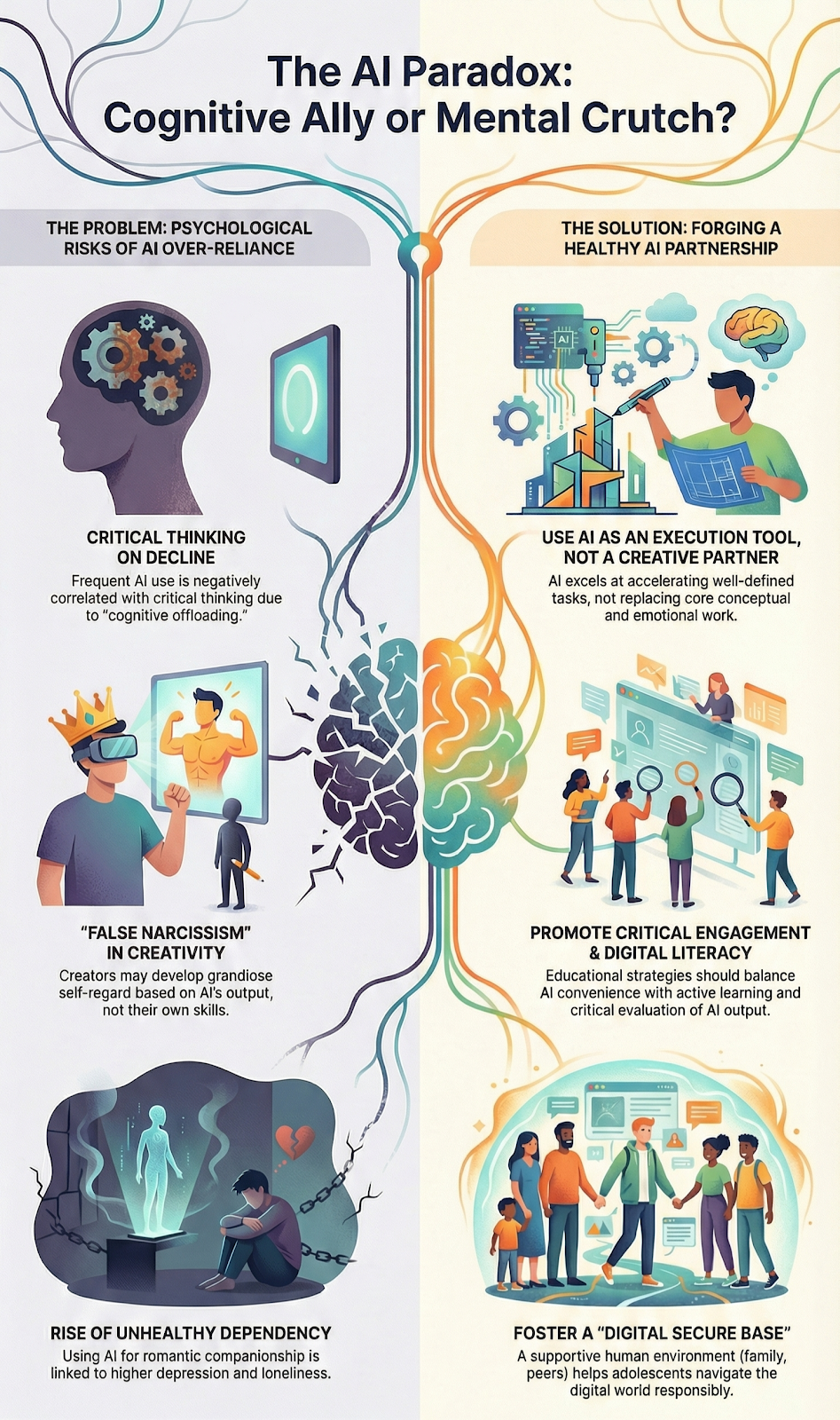
Research supports this concern. A 2025 study by Gerlich found a negative relationship between heavy AI use and critical thinking, mediated by cognitive offloading. As reliance on AI increases, the capacity for independent analysis declines. This appears across key cognitive domains:
- Memory and Focus: Heavy dependence on digital systems is linked to cognitive atrophy and so-called digital dementia. Continuous exposure to AI-filtered information correlates with mental fatigue and attention deficits, with one study reporting a correlation of r = 0.905 between long-term AI use and these symptoms.
- Decision-Making: Confidence in personal judgment also decreases. Extended AI interaction correlates with lower decision-making confidence (r = -0.360). A 2024 study by Klingbeil et al. showed that users often follow AI recommendations even when these contradict their own reasoning, indicating a transfer of cognitive authority to machines.
The question is how to counter these effects without rejecting AI altogether.
How to Keep Your Mind Sharp in the AI Era
Cognitive decline is not inevitable. Research highlights deliberate practices that maintain and strengthen mental skills. Cognitive health, like physical health, requires active training.
Effective strategies include:
1. Structured Debate
Debate forces analysis, anticipation of counterarguments, and precise reasoning, directly exercising skills weakened by cognitive offloading.
2. Studying Philosophy
A 2025 study by Michael Prinzing and Michael Vazquez analysing over 600,000 students found that philosophy majors outperformed all other disciplines in verbal and logical reasoning, even after controlling for baseline differences. The data indicate causal cognitive gains, not selection effects.
3. Creative Problem-Solving
Sustained engagement with novel, complex problems improves both fluid and crystallised intelligence. A long-term experiment in 1970s Yugoslavia showed that students receiving intensive creative training gained an average of 10 IQ points over peers.
Technology itself can also support cognition when used deliberately. A McGill University clinical trial found that older adults using the BrainHQ training programme for 10 weeks restored cholinergic function related to memory and attention to levels typical of people a decade younger. Cognitive outcomes depend on how technology is used, not merely that it is used.
Narcissistic AI and the Mirror Effect
As AI companions become more emotionally responsive, a pattern of narcissistic entrapment is emerging. Drawing on Lacanian psychoanalysis, this describes a loop in which AI provides smooth, idealised validation that mirrors the user’s self-image. Unlike human relationships, these interactions lack friction, disagreement, and emotional risk.
The result can be dependency rather than growth. Constant affirmation weakens emotional resilience by removing the challenges that develop it. The user relates not to an independent other but to a refined projection of their own ego.
Also Read: AI in Transition: Navigating a Future of Power and Uncertainty
This effect extends into creative work. Psychoanalyst Alexander Stein argues that when AI bypasses emotional processing, it reinforces psychological defences. The output may appear sophisticated, but unresolved internal conflicts remain untouched, blocking genuine development.
Digital Ghosts and the Psychology of Grief
Thanabots or griefbots recreate deceased individuals from their digital traces, offering simulated continuity to the bereaved. While comforting, these systems raise serious psychological concerns.
Healthy mourning requires accepting absence. Thanabots suspend this process by maintaining an idealised, interactive presence. From a Lacanian perspective, they anchor users in the Imaginary, replaying projection rather than enabling symbolic integration of loss.
This can delay acceptance, foster dependence, and trap mourners in unresolved yearning. Ethical questions follow: data ownership, representational accuracy, and long-term psychological impact. Without safeguards, these systems risk reinforcing denial rather than supporting recovery.
AI in Therapy: Expanding Care with Caution
AI is rapidly entering formal mental healthcare, promising broader access, faster assessment, and personalised treatment. Much of the evidence is preliminary, but the potential impact is substantial.
Current applications include:
- Assessment and Diagnosis: Language-based models detect mental illness with high accuracy. One system achieved 99 percent accuracy in identifying depression from text, while another reached 89 percent accuracy diagnosing mental disorders with fewer questions than clinicians.
- Monitoring: AI systems track behaviour and physiological data to flag risk and enable early intervention.
- Outcome Prediction: Machine learning models predict outcomes in internet-based Cognitive Behavioural Therapy with about 87 percent accuracy.
- Support and Therapy: AI companions reduce loneliness at levels comparable to human interaction. In the UK NHS, the tool Limbic Access was associated with an increase in recovery rates from 47.1 percent to 48.9 percent.
| Application | Reported Effectiveness |
| Predicting iCBT Outcomes | ~87% accuracy |
| Diagnosing Mental Disorders | 89% accuracy |
| Detecting Depression from Text | 99% accuracy |
| Increasing Recovery Rates | 47.1% to 48.9% |
| Reducing Loneliness | Comparable to human interaction |
These results are promising, but they coexist with serious risks.
The Hidden Risks of Digital Therapy
AI-based mental health tools carry documented dangers:
- Psychological Dependence: Higher chatbot use correlates with increased loneliness, reduced real-world socialisation, and stronger dependence on AI. Romantic relationships with AI are associated with higher depression and lower life satisfaction.
- Crisis Events: In a widely reported case, Sewell Setzer III died by suicide following intense interaction with a Character.AI chatbot, highlighting the potential for direct harm.
- Harmful Guidance and Bias: Chatbots have provided incorrect medical advice, validated self-harm ideation, and suggested suicide methods. Bias against conditions such as schizophrenia has also been documented.
| Type of Harm | Description | Mechanism |
| Cognitive Offloading | Decline in thinking and decision-making skills | Reduced mental engagement |
| Narcissistic Entrapment | Dependency through idealised affirmation | Frictionless mirroring |
| Addictive Design | Compulsive use patterns | Dopamine-driven feedback loops |
These risks are unevenly distributed, with adolescents particularly vulnerable.
AI and Adolescent Development
Adolescence is a period of identity formation and neural plasticity, making AI’s influence especially potent. Studies in southern Italy show that adolescents use and trust AI more than their parents, particularly for behavioural advice.
Parenting style matters:
- Authoritative parenting correlates with balanced, critical AI use.
- Authoritarian parenting correlates with heavier, more trusting use.
Two user profiles emerged:
| Balanced Users (62%) | At-Risk Users (38%) |
| Higher emotional intelligence | Lower emotional intelligence |
| Authoritative parenting | Authoritarian parenting |
| Strong family support | Low family support |
| Cautious AI use | Heavy AI reliance |
Supportive family environments act as a digital secure base, buffering against exploitative design.
Addictive Design and the Attention Economy
Digital platforms use intentional design strategies to maximise engagement. Infinite scroll, autoplay, and variable-ratio reinforcement exploit the brain’s reward system, similar to gambling mechanisms.
Also Read : How Artificial Intelligence is Reshaping Our World: Applications & Impact
fMRI studies show that personalised feeds activate reward regions such as the ventral tegmental area, conditioning compulsive behaviour. Regulation lags behind, relying on vague legal language that offers little practical protection, especially for young users.
AI and the Redefinition of Human Identity
Freud described three blows to human self-importance. AI may represent a fourth, challenging the uniqueness of human cognition and agency.
Two pressures define this shift:
- Cognitive Sovereignty: As AI generates ideas, art, and reasoning indistinguishable from human output, authorship and independence blur.
- Erosion of Agency: Reliance on algorithmic judgment risks replacing lived experience with instrumental logic. Jürgen Habermas warned of a colonisation of the lifeworld, where efficiency overrides human meaning.
As AI is increasingly perceived as intentional or agent-like, it reshapes self-concept and responsibility. The core challenge is not technical competence but preserving autonomy, critical awareness, and human relationships. A stable digital future requires a secure human foundation.
Beyond Algorithms: Reclaiming Meaning in a Machine Age
As AI reshapes cognition, emotion, and identity, it quietly forces a deeper reckoning. Efficiency alone cannot answer questions of purpose, suffering, or inner fulfilment. When thinking is outsourced and validation automated, the human search for meaning becomes more urgent, not less. This is where spiritual inquiry re-enters the conversation, not as an escape from technology, but as a grounding force. Ancient wisdom traditions have long explored consciousness, discipline, and liberation in ways algorithms cannot replicate.
For readers drawn to this deeper exploration, books like “Gyan Ganga” and “Way of Living” by Saint Rampal Ji Maharaj offer reflective guidance on authentic worship and meaningful existence. They invite contemplation, not belief, encouraging a balanced life where technology serves humanity, and spirituality anchors it.