

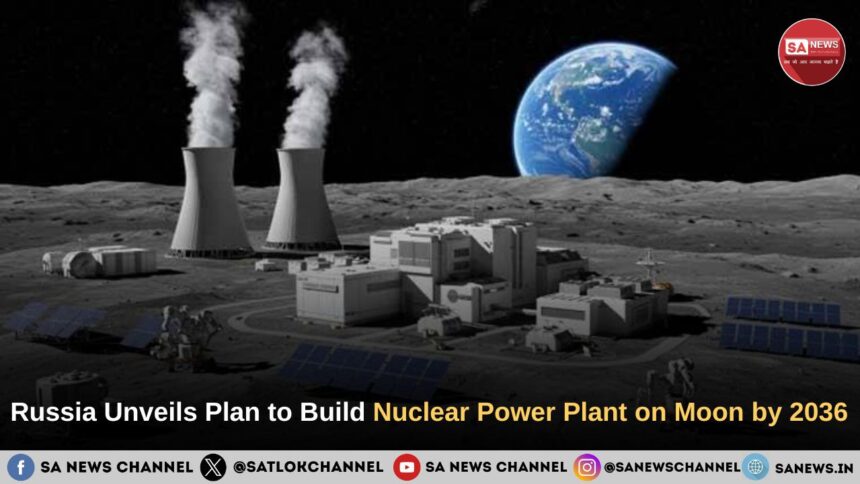
In a bold move to reclaim its stature in space exploration, Russia has announced plans to build a nuclear-powered energy station on the Moon by 2036 to support its lunar exploration programme and a joint Russian-Chinese International Lunar Research Station (ILRS).
- Russia’s Plan to Build Nuclear Power Plant on Moon: Key Highlights
- Ambitious Lunar Power Project
- Background: Russia’s Space Ambitions and Setbacks
- Global Lunar Nuclear Race: U.S. and China Also in Play
- Why Lunar Nuclear Power Matters
- Legal and Strategic Context
- From Earth to the Moon: Nuclear Power, Geopolitics, and the Future of Space Dominance
The announcement marks a significant escalation in the modern space race as major global powers compete to establish a long-term human and scientific presence on Earth’s only natural satellite.
Russia’s Plan to Build Nuclear Power Plant on Moon: Key Highlights
- From Earth to Moon: Russia’s Bold Lunar Power Plant Plan Signals New Space Race
- Russia’s Lunar Ambitions: From Yuri Gagarin’s Legacy to Nuclear Power on the Moon
- Moon Power Battle Heats Up: U.S. and China Join Russia in Lunar Nuclear Race
- Lunar Nuclear Power: The Energy Backbone of Moon Bases and Mars Missions
- Peaceful Nuclear Technology in Space: Legal Framework and Strategic Implications
- Race to the Moon: Nuclear Energy, Superpowers, and the Future of Space Exploration
Ambitious Lunar Power Project
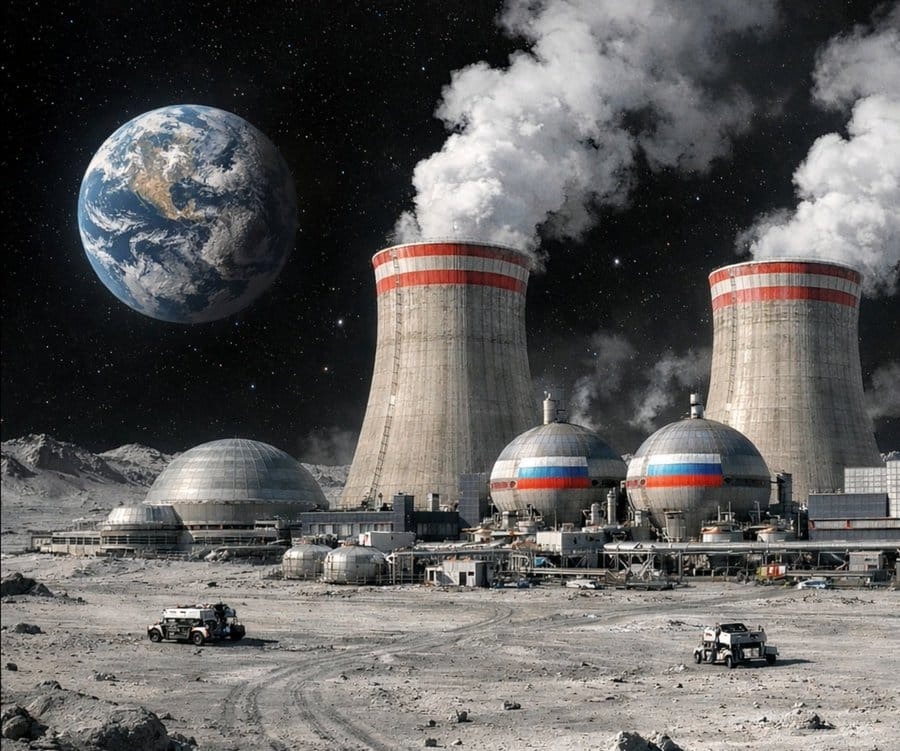
Russia’s state space agency ‘Roscosmos’ signed a contract with aerospace firm Lavochkin Association to begin the development of the lunar power plant infrastructure, aiming to deploy it on the Moon’s surface by 2036.
While Roscosmos stopped short of explicitly stating that the plant will be nuclear, the involvement of ‘Rosatom’-Russia’s state nuclear corporation-and the prestigious “Kurchatov Institute” strongly indicates that nuclear fission technology will be used to generate sustained, reliable energy for lunar operations.
Also Read: The Five States of Matter Explained: Solids, Liquids, Gases, Plasma & Bose–Einstein Condensate
According to Roscosmos, the power facility will energise lunar rovers, an observatory, and critical infrastructure for the ILRS, supporting continuous scientific and exploration activities that are expected to shift from one-off missions to “long-term lunar habitation and research programmes.”
Background: Russia’s Space Ambitions and Setbacks
Russia’s cosmic legacy dates back to 1961, when Yuri Gagarin became the first human to orbit Earth. However, in recent decades, Moscow has trailed behind the United States and China in lunar exploration.
A notable setback occurred in August 2023 when Russia’s unmanned Luna-25 lander crashed during its Moon landing attempt, highlighting challenges within its space programme.
Roscosmos head Dmitry Bakanov has repeatedly stressed that establishing nuclear energy infrastructure on the Moon is key to sustaining a permanent scientific presence and could even pave the way for ambitious missions to Venus and Mars.
Global Lunar Nuclear Race: U.S. and China Also in Play
Russia is not alone in this high-stakes endeavour. The United States, through NASA and the Department of Energy (DOE), is aggressively pursuing a nuclear reactor deployment on the Moon by 2030.
NASA’s reactor plans are designed to provide continuous, reliable power-especially during the Moon’s two-week-long nights when solar power is ineffective-making it a critical component for long-duration lunar bases and deep-space exploration.
Separately, earlier agreements between Russia and China outlined cooperation to build an ILRS by the 2030s, including shared nuclear power technology to support research stations near the lunar south pole-a region of high strategic interest due to water ice deposits that could be used for life support and fuel production.
Why Lunar Nuclear Power Matters
Experts say nuclear power on the Moon is crucial for several reasons:
- Reliable energy during long lunar nights when solar panels are ineffective.
- Support for advanced life-support systems, habitats, scientific instruments, and mining operations.
- Enables deeper space missions such as journeys to Mars, where continuous energy will be indispensable.
Legal and Strategic Context
International space law, including the Outer Space Treaty of 1967, prohibits the placement of nuclear weapons in space but does not prevent nuclear energy sources like reactors, provided they meet safety and environmental standards.
This legal framework allows countries to pursue nuclear power technology for peaceful exploration and scientific advancements.
From Earth to the Moon: Nuclear Power, Geopolitics, and the Future of Space Dominance
As Russia, the United States, and China pursue lunar nuclear power systems, the competition is shaping into a 21st-century space race with implications far beyond Earth’s orbit.
The success of these projects could influence geopolitical power balances, resource extraction strategies, and humanity’s future footsteps on Mars and beyond-making the Moon not just a celestial neighbour but a strategic frontier for global space leadership.