


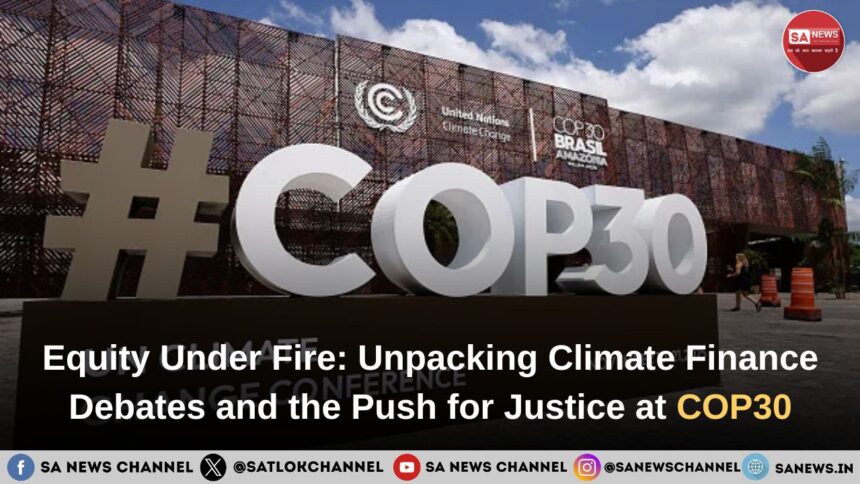
COP30 in Belém, 2025, dubbed the “implementation COP,” exposed raw tensions over climate finance equity. Developing nations, led by India, demand $1.3 trillion annually by 2035-public, grant-based funds to honor Paris Agreement obligations. Yet, Global North obstruction risks shifting burdens via loans and trade measures. Adaptation finance lags at $40 billion against a $187-359 billion gap, per UN reports. With Brazil’s “Global Mutirão” text under scrutiny for weakening principles, this blog dissects debates, highlights wins like Article 9.1 scrutiny, and ties to real impacts like vulnerable communities’ survival. 10 years post-Paris, it’s time to measure delivery against ambition-equity isn’t optional; it’s the bedrock of global resilience.
The Core Debates: From Pledges to Predictable Flows
COP30’s finance talks centered on scaling to $1.3T/year, with UNGA President Annalena Baerbock urging quick, transparent delivery to the needy. India sharpened demands for Article 9.1 compliance-public, concessional aid-not private loans that burden the poor. The draft text operationalizes this but faces criticism. Equity invokes CBDR-RC: Developed nations owe reparations for historical emissions. Yet, volumes remain “insufficient and unpredictable,” per UNEP’s Simon Stiell.
Adaptation and Loss: The Widening Gap
Adaptation finance is pivotal, with a proposed $120-150B/year goal by 2030-tripling current $40B. UN Gap Report 2024 pegs needs at $187-359B, growing with impacts. LDCs call for grants; without, local solutions falter. India showcased 200GW renewables, proving development-climate synergy, but warns trade measures erode trust.
Wins and Stalls: Mutirão and Beyond
A breakthrough: Formal Article 9.1 implementation space, grounding equity.1ce7c6 The uneasy deal boosts poor nations’ aid but skips fossil fuels.d434a4 Civil society slams evasion, pushing feminist transitions. Espírito Santo’s dialogue stressed governance for just transitions. GGA indicators must track real impact, not boxes.
Finance as Justice
COP30’s debates signal progress, but delivery defines success. Prioritize equity for a resilient planet.
The Inequity of COP30 Climate Finance and the Principle of Divine Justice: Through the Spiritual Lens of Sant Rampal Ji Maharaj
The ongoing debate concerning this demand is not just an economic question, but a matter of spiritual balance. Sant Rampal Ji Maharaj, drawing from the Vedas, illuminates equity as a form of divine justice, stating that wise stewards, instead of hoarding wealth, channel it impartially for the welfare of all. This wisdom criticizes the accumulation of resources by developed nations, as it reflects spiritual imbalance.
The huge $187-359 billion gap in adaptation finance directly threatens the survival of vulnerable communities. Sant Rampal Ji Maharaj’s Annapurna Muhim offers a model of how unconditional aid should be provided to those in need. Therefore, the Global North must follow the dharma by providing grant-based reparative aid instead of loans. Only by doing so will trust be restored and the global debate will be transformed into an act of “universal brotherhood” and universal service, which are the foundation of a resilient and just planet.
FAQs
What’s the $1.3T target?
Annual climate finance by 2035 for developing nations, per COP30 draft.
Why focus on adaptation equity?
Gap at $187-359B; needs grants for local solutions.
Did COP30 deliver?
Yes on Article 9.1 space, but stalls on quantified goals.
India’s role?
Pushed public finance, highlighted 200GW renewables as a model.
Trade measures’ impact?
Unilateral ones erode trust, per India; link to climate needed.