


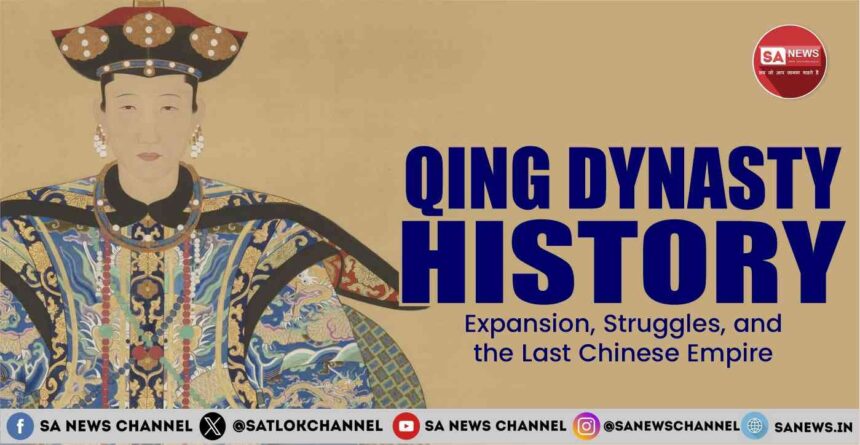
The Qing dynasty holds a unique place in Chinese history as the last imperial dynasty of the nation. Established in the mid-seventeenth century and lasting until the early twentieth century, it shaped the political, cultural, and social development of China for nearly three centuries. Its story is one of conquest and expansion, flourishing arts and literature, but also internal struggles, foreign pressures, and eventual decline. To understand modern China, one must first look carefully at the history of the Qing.
- Origins of the Qing Dynasty
- The Fall of the Ming and Rise of the Qing
- Consolidation of Power
- The Height of the Qing: The Qianlong Emperor
- Society and Culture under the Qing
- Foreign Relations and Trade
- The Opium Wars and Western Encroachment
- Internal Rebellions and Decline
- Attempts at Reform
- The Boxer Rebellion and Final Years
- The Fall of the Qing Dynasty
- Legacy of the Qing Dynasty
- The End of the Qing Dynasty and Its Lasting Impact
- Spiritual Perspective: From Qing Beliefs to True Devotion
- Frequently Asked Questions (FAQs) on the Qing Dynasty
Origins of the Qing Dynasty
The Qing dynasty did not arise from the Han Chinese majority but from the Manchu people of northeast Asia. The Manchus were originally part of a confederation of tribes known as the Jurchens, who lived in the region that is today’s Manchuria. In the early 1600s, Nurhaci, a powerful tribal leader, consolidated these tribes under his leadership. By uniting the Jurchens and organizing them into a disciplined military and administrative system known as the “Eight Banners,” Nurhaci laid the foundation for what would become the Qing dynasty.
After his death in 1626, his son Hong Taiji continued the expansion and renamed the people as “Manchu,” to give them a distinct identity. Hong Taiji also proclaimed the new dynasty as the “Great Qing” in 1636, setting his ambitions firmly on ruling not just Manchuria but also China itself.
The Fall of the Ming and Rise of the Qing
The Ming dynasty, which had ruled China since the fourteenth century, was already in decline by the early seventeenth century. Mismanagement, corruption, peasant uprisings, and external threats weakened the Ming court. In 1644, rebel leader Li Zicheng captured Beijing, forcing the last Ming emperor, Chongzhen, to commit suicide.
At this critical moment, Ming general Wu Sangui opened the gates of the Great Wall to the Manchus, seeking their assistance against Li Zicheng. The Manchus swiftly took control of Beijing and declared it the new capital of the Qing dynasty. From this foothold, they gradually extended their power over the rest of China, completing the conquest by the late seventeenth century.
Consolidation of Power
The early Qing emperors worked carefully to consolidate their rule over a vast and diverse empire. They adopted elements of Chinese political traditions to legitimize themselves in the eyes of the Han Chinese majority, while also preserving their own Manchu identity.
One of the most notable rulers was the Kangxi Emperor (r. 1661–1722), who ruled for more than sixty years. Kangxi proved to be an able administrator and military strategist. He quelled internal rebellions, defeated Mongol threats, and expanded the empire’s borders. Kangxi also promoted Confucian scholarship, supporting the compilation of major encyclopedias and dictionaries that became important cultural achievements.
Following Kangxi, the Yongzheng Emperor (r. 1722–1735) strengthened central authority and improved taxation systems. His reign prepared the ground for the next emperor, Qianlong, under whom the Qing dynasty would reach the height of its power.
The Height of the Qing: The Qianlong Emperor
The reign of the Qianlong Emperor (r. 1735–1796) marked the golden age of the Qing dynasty. During this period, the Qing controlled the largest territorial extent in Chinese history. Their empire stretched from Tibet and Xinjiang in the west to Taiwan in the east, and from Manchuria in the north to the borders of Vietnam in the south.
Qianlong was not only a skilled military leader but also a patron of arts and culture. His reign saw the flourishing of literature, painting, porcelain-making, and architecture. The emperor commissioned the Siku Quanshu, a vast collection of Chinese knowledge and literature, one of the largest works of its kind in world history.
However, behind the prosperity lay seeds of decline. The immense costs of military campaigns, extravagant court expenditures, and growing corruption weakened the foundations of Qing governance. Moreover, Qianlong’s later years were marked by excessive reliance on officials such as Heshen, whose corruption drained state finances.
Society and Culture under the Qing
Life in the Qing dynasty was shaped by both continuity and change. The Qing emperors maintained traditional Confucian values, placing strong emphasis on hierarchy, filial piety, and social order. The civil service examination system, inherited from earlier dynasties, continued to be the main route to official positions, though the Manchu rulers also reserved some posts for their own people to safeguard their dominance.
The population of China grew rapidly during the Qing period, thanks in part to the introduction of new crops such as maize and sweet potatoes from the Americas. Agricultural productivity increased, leading to population growth that eventually put pressure on land and resources.
Culturally, the Qing era saw advances in literature, with novels such as Dream of the Red Chamber becoming classics of Chinese literature. The dynasty also encouraged the blending of Manchu and Han traditions, though tensions between the two groups never completely disappeared.
Foreign Relations and Trade
During its early centuries, the Qing dynasty maintained a confident stance toward foreign powers. The “tributary system” continued, whereby neighboring states acknowledged the superiority of the Chinese emperor in exchange for trade benefits.
European contact, however, posed new challenges. Initially, the Qing allowed limited trade with European merchants, confined to the port of Canton (Guangzhou). The British East India Company was especially active, trading tea, porcelain, and silk. The Chinese, however, demanded payment in silver, creating an unfavorable balance of trade for the British. To address this, Britain began exporting opium to China, leading to widespread addiction and social problems.
The Opium Wars and Western Encroachment
The Qing government, recognizing the dangers of opium, attempted to ban the trade. This led to confrontation with Britain, resulting in the First Opium War (1839–1842). China’s defeat exposed the weakness of the Qing military compared to Western powers. Under the Treaty of Nanjing, China ceded Hong Kong to Britain, opened several ports to foreign trade, and granted extraterritorial rights to foreigners.
Also Read: History of the Han Dynasty: China’s Golden Age
A second conflict, the Second Opium War (1856–1860), further humiliated China. Foreign powers gained more concessions, including the right to station diplomats in Beijing and the legalization of the opium trade. These “unequal treaties” eroded Qing sovereignty and marked the beginning of what many Chinese historians call the “Century of Humiliation.”
Internal Rebellions and Decline
The nineteenth century was a period of immense turmoil for the Qing dynasty. Internal uprisings shook the empire, reflecting both popular discontent and weakening central authority.
One of the largest was the Taiping Rebellion (1850–1864), led by Hong Xiuquan, who claimed to be the younger brother of Jesus Christ. His movement sought to establish a new “Heavenly Kingdom” with radical social reforms. The rebellion caused massive destruction and loss of life, with estimates of over twenty million deaths. Though the Qing eventually suppressed the rebellion with the help of regional armies, the conflict severely weakened the dynasty.
Other uprisings, such as the Nian Rebellion in northern China and the Muslim rebellions in the northwest, further destabilized the empire. Each conflict drained resources and eroded the government’s authority.
Attempts at Reform
Recognizing the need to modernize, some Qing leaders initiated reforms. The Self-Strengthening Movement (1861–1895) aimed to adopt Western technology and military practices while preserving traditional Confucian values. Shipyards, arsenals, and schools teaching foreign languages and science were established. However, these reforms were limited in scope and hampered by conservative opposition at court.
The First Sino-Japanese War (1894–1895) highlighted the failure of these efforts. Japan, having rapidly modernized during the Meiji Restoration, defeated China decisively. The Treaty of Shimonoseki forced China to cede Taiwan to Japan and recognize Korea’s independence. This loss shocked Chinese society and exposed the urgent need for deeper reform.
The Boxer Rebellion and Final Years
At the turn of the twentieth century, anti-foreign sentiment erupted in the Boxer Rebellion (1899–1901). The Boxers, a secret society, sought to expel foreigners and missionaries from China. With tacit support from some Qing officials, the movement spread rapidly. However, an international coalition of foreign powers intervened, crushed the rebellion, and imposed even harsher terms on the Qing government.
In the aftermath, calls for reform grew louder. The Qing court attempted constitutional reforms and promised the establishment of a parliament, but these measures came too late. Revolutionary groups, inspired by nationalism and republican ideas, mobilized against the dynasty.
The Fall of the Qing Dynasty
The decisive moment came in 1911 with the Wuchang Uprising, which sparked a nationwide revolution. Provincial assemblies declared independence from Qing rule, and within months, the dynasty collapsed. In February 1912, the last emperor, Puyi, a child at the time, formally abdicated. This ended over two thousand years of imperial rule in China and ushered in the era of the Republic of China under Sun Yat-sen and later Yuan Shikai.
Legacy of the Qing Dynasty
The Qing dynasty left behind a complex legacy. On one hand, it oversaw a period of immense territorial expansion, cultural achievements, and economic growth in its early centuries. Its emperors, particularly Kangxi and Qianlong, are remembered as enlightened rulers who brought stability and prosperity.
On the other hand, the dynasty’s later centuries were marked by decline, humiliation at the hands of foreign powers, and inability to adapt to a rapidly changing world. Its fall signaled not only the end of imperial rule but also the beginning of modern struggles that would shape China in the twentieth century.
The Qing story reminds us of the challenges empires face in balancing tradition with reform, and the dangers of ignoring the forces of change, both internal and external.
The End of the Qing Dynasty and Its Lasting Impact
The Qing dynasty’s nearly three-hundred-year history encapsulates the grandeur and difficulties of China’s imperial past. Rising from the northern frontiers, the Manchu rulers built an empire that became one of the largest and most sophisticated in the world. Yet, as centuries passed, the pressures of population growth, corruption, rebellions, and foreign encroachment undermined their rule.
The fall of the Qing was not simply the end of a dynasty but a turning point in Chinese history. It paved the way for republicanism, nationalism, and eventually the search for new systems that could restore China’s strength and unity. Understanding the Qing dynasty is thus essential not only for grasping China’s past but also for appreciating its continuing efforts to define its future.
Spiritual Perspective: From Qing Beliefs to True Devotion
During the Qing dynasty, Chinese society drew heavily from Confucian ethics, Taoist philosophy, and Buddhist practices. Confucianism emphasized social order, loyalty, and respect for hierarchy, while Taoist masters sought harmony with nature, and Buddhist monks pursued meditation to escape suffering. These traditions shaped everyday life, offering moral discipline and cultural cohesion. Yet, despite their wisdom, they did not reveal the path to complete liberation of the soul. The focus remained largely on maintaining worldly balance and temporary relief from sorrow rather than attaining eternal salvation.
Ancient Taoist hermits, who sought immortality, and Buddhist monks, who renounced worldly attachments, were unknowingly searching for the same eternal truth. What they could not discover through rituals, austerities, or philosophies is now clearly revealed through the teachings of the Chyren Saint Rampal Ji Maharaj Ji. By referring to authentic scriptures, He explains that the Supreme God is Kabir Saheb Ji, the eternal Creator who alone can grant liberation.
Just as the Qing emperors once tried to preserve their dynasty against rebellion and foreign threats, modern people too search for stability in the chaos of life. According to the Sant Rampal Ji Maharaj Ji, real peace comes not from political power or material progress but from true devotion, Naam initiation from a Tatvdarshi Saint. For China and its people, the timeless message is this: salvation lies not in rituals, but in connecting with the Supreme God Kabir Saheb Ji.
For true spiritual guidance, I request all the readers to please download the free Sant Rampal Ji Maharaj App and begin their path toward eternal peace.
Frequently Asked Questions (FAQs) on the Qing Dynasty
1. Who founded the Qing dynasty?
The Qing dynasty was founded by the Manchus, originally Jurchen tribes from northeast Asia. Under the leadership of Nurhaci and later his son Hong Taiji, they organized themselves into the Eight Banners military system. In 1644, after the fall of the Ming dynasty, the Manchus captured Beijing and formally established the Qing as China’s ruling dynasty.
2. How long did the Qing dynasty rule China?
The Qing dynasty ruled from 1644 to 1912, making it the last imperial dynasty of China. It lasted for nearly three centuries, overseeing both a period of prosperity and expansion as well as decline under internal rebellions and foreign pressure.
3. What were the main achievements of the Qing dynasty?
The Qing dynasty presided over the largest territorial expansion in Chinese history, reaching Tibet, Xinjiang, Taiwan, and Mongolia. It also oversaw major cultural achievements, such as the compilation of the Siku Quanshu (a vast encyclopedia of Chinese knowledge), flourishing literature including Dream of the Red Chamber, and advancements in porcelain and art.
4. Why did the Qing dynasty decline?
The decline was caused by multiple factors: corruption in government, population pressures, peasant uprisings, natural disasters, and defeats in the Opium Wars against Western powers. Rebellions such as the Taiping Rebellion further weakened the state, and failed reforms made it unable to cope with the challenges of modernization.
5. What marked the end of the Qing dynasty?
The Qing dynasty officially ended in 1912 when the last emperor, Puyi, abdicated after the 1911 Revolution (also called the Xinhai Revolution). This revolution was driven by nationalist movements and growing demands for modernization, leading to the establishment of the Republic of China.
6. What spiritual beliefs did people follow in the Qing dynasty, and what guidance does Sant Rampal Ji Maharaj Ji give today?
During the Qing dynasty, people followed Confucianism, Taoism, and Buddhism, focusing on morality, rituals, and harmony. However, these paths did not reveal the Supreme God or the way to true salvation. Sant Rampal Ji Maharaj Ji teaches that the eternal Creator is Kabir Saheb Ji, and real liberation comes through Naam initiation from a Tatvdarshi Saint, not rituals or austerities.