

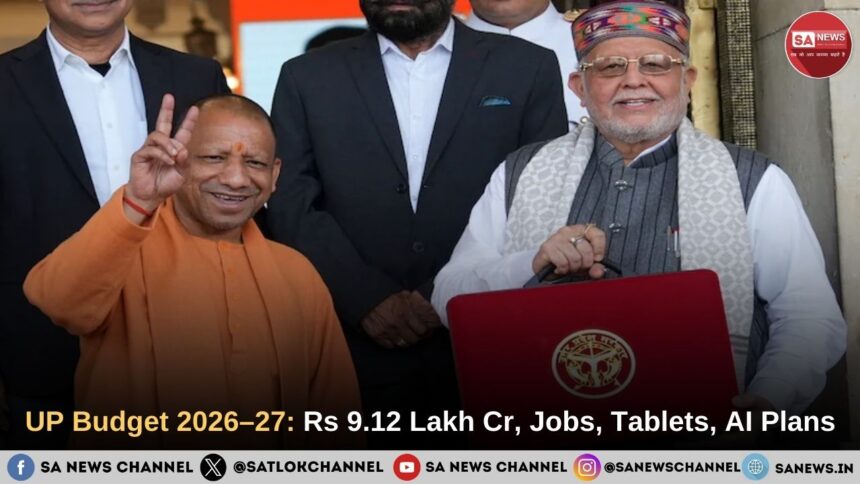
UP Budget 2026–27: Uttar Pradesh presented its biggest-ever Budget for 2026–27 at more than Rs 9.12 lakh crore, the state government’s 10th consecutive budget under Chief Minister Yogi Adityanath and tabled by Finance Minister Suresh Khanna in the Assembly. Cleared in a Cabinet meeting chaired by the Chief Minister before being introduced at 11 am, the Budget outlined plans for free tablets and smartphones for 40 lakh youth, AI missions and data clusters, new medical colleges, major health and infrastructure spending, MSME support, clean-energy targets and employment-linked investment projections. Comparisons were also drawn with neighbouring countries’ budgets ahead of the upcoming Assembly elections.
- Key Takeaways: UP Budget 2026–27
- Biggest-Ever Budget and Legislative Process
- Comparisons With Neighbouring Countries
- Technology, AI and Youth-Focused Announcements
- Industrial Development and MSME Push
- Roads, Corridors and Urban Infrastructure
- Health, Medical Education and Welfare
- Clean Energy and Urban Projects
- Pensions, Contract Workers and Other Expectations
- What the Budget Signals for Uttar Pradesh
- The Illusion of Financial Security
- Securing Your Eternal Account
- FAQs on UP Budget 2026–27
Key Takeaways: UP Budget 2026–27
- Total Budget size: over Rs 9.12 lakh crore
- 40 lakh tablets and smartphones for youth with Rs 2,374 crore allocation
- AI Mission, State Data Authority and data centre clusters announced
- 14 new medical colleges with Rs 1,023 crore provision
- Medical education allocation: Rs 14,997 crore
- MSME sector allocation: Rs 3,822 crore
- Roads and bridges: Rs 34,468 crore
- Namami Gange and rural water supply: Rs 22,676 crore
- IT and electronics: Rs 2,059 crore
- Clean-energy production target of 22,000 MW over five years
- Defence corridor investment estimate of Rs 35,280 crore with 53,263 job potential
- Budget compared with Pakistan, Bangladesh, Nepal and Sri Lanka
Biggest-Ever Budget and Legislative Process
The Uttar Pradesh government presented a record Budget exceeding Rs 9.12 lakh crore for the financial year 2026–27. Finance Minister Suresh Khanna tabled the proposals in the Assembly, while Deputy Chief Minister Keshav Prasad Maurya presented them in the Legislative Council.
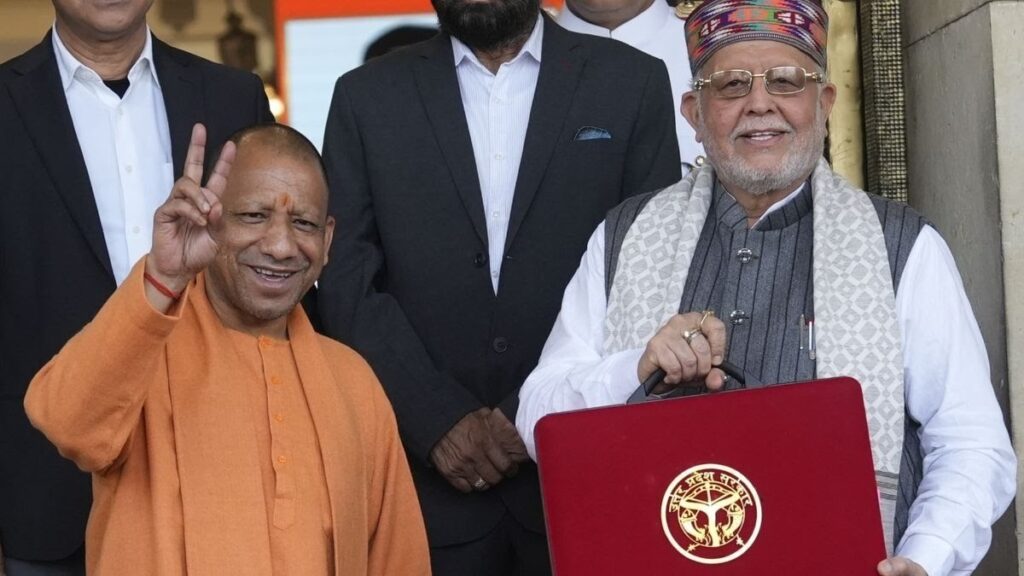
The Cabinet, chaired by Chief Minister Yogi Adityanath, approved the Budget before it was introduced at 11 am. The government said this was its 10th consecutive Budget, with the Chief Minister stating in a press conference that the outlay had tripled over the years and that no new taxes had been imposed in the last nine years.
According to the Chief Minister, 12.4 per cent of the Budget would be spent on education, six per cent on health and nine per cent on agriculture-linked schemes.
Comparisons With Neighbouring Countries
During the presentation, comparisons were made between Uttar Pradesh’s Budget and those of neighbouring countries. The state’s population was cited at about 25 crore, nearly equal to Pakistan’s.
Officials noted that Pakistan’s budget for 2025–26, converted into Indian rupees, stood at Rs 5.65 lakh crore, while Uttar Pradesh’s crossed Rs 9 lakh crore. The UP Budget was also said to be larger than those of Bangladesh, Nepal and Sri Lanka.
The government pointed out that in 2025–26, Uttar Pradesh had presented an Rs 8.7 lakh crore Budget, followed by two supplementary budgets, and that the size had increased in view of the upcoming Assembly elections.
Technology, AI and Youth-Focused Announcements
The Budget proposed setting up a State AI Mission, a State Data Authority and data centre clusters. It also announced new technology initiatives and youth-focused programmes.
Key allocations and plans included:
- Rs 2,059 crore for IT and electronics, 76 per cent higher than 2025–26
- Rs 225 crore for the Uttar Pradesh AI Mission
- Rs 32.82 crore to convert 49 ITIs into AI labs in coordination with the India AI Mission
- Distribution of 40 lakh tablets and smartphones, backed by Rs 2,374 crore
- Rs 1,000 crore for the Chief Minister’s Youth Entrepreneur Development Campaign
- Rs 225 crore for the Chief Minister’s Youth Self-Employment Scheme
Finance Minister Khanna said 10 lakh employment opportunities had already been provided.
Industrial Development and MSME Push
The government earmarked Rs 27,103 crore for infrastructure and industrial development, along with:
- Rs 5,000 crore for the industrial area expansion scheme
- Rs 2,000 crore for the Atal Infrastructure Mission
- Rs 1,000 crore under the FDI promotion policy
The Defence Corridor was projected to attract Rs 35,280 crore in investment, with potential employment for 53,263 people.
For MSMEs, Rs 3,822 crore was allocated—19 per cent higher than in 2025–26. The sector was said to employ around 3.11 crore people. A new Sardar Vallabhbhai Patel Employment and Industrial Zone scheme was proposed with Rs 575 crore.
Khadi and village industries were also covered:
- Under the Chief Minister’s Village Industries Employment Scheme, 800 units would be supported with Rs 40 crore in bank loans to create jobs for 16,000 people
- Rs 10 crore was set aside for interest waivers under the Deendayal Village Industries Employment Scheme
Roads, Corridors and Urban Infrastructure
Large allocations were announced for transport and urban development:
- Rs 34,468 crore for roads and bridges
- Rs 400 crore for the North–South Corridor
- Rs 1,500 crore for bypasses, ring roads and flyovers
- Rs 26,514 crore for urban development
Metro-related provisions were expected for Lucknow, Noida, Greater Noida, Ghaziabad and the Delhi Metro extension, as well as proposed systems in Varanasi, Gorakhpur, Prayagraj, Bareilly, Jhansi, Aligarh, Ayodhya and Mathura.
Twelve expressways under construction were referenced, including Vindhya, Chitrakoot Link, Jhansi Link and Jewar Link expressways, along with the Varanasi–Kolkata corridor. The Ganga, Lucknow–Kanpur and Ghaziabad–Kanpur expressways were described as nearing completion.
The Budget also mentioned expansion plans for the rapid rail project and the next phase of Jewar airport, noting that the Namo Bharat train was currently operating between Ghaziabad and Meerut.
Health, Medical Education and Welfare
Health received major attention, with Rs 37,956 crore allocated for medical, health and family welfare—15 per cent higher than 2025–26.
Other provisions included:
- Rs 14,997 crore for medical education
- 14 new medical colleges with Rs 1,023 crore
- 81 existing medical colleges in the state, across 60 districts
- 16 more colleges planned under the PPP model
- MBBS seats increased to 12,800
- PG seats raised to 4,995
- Rs 315 crore for the Lucknow cancer institute
- Rs 8,641 crore for the National Rural Health Mission
Schemes such as Janani Shishu Suraksha for cashless deliveries and block-level child health teams under the National Child Health Programme were highlighted.
Also Read: Endless Reels Scrolling: Hidden Impact on Mental Health
Namami Gange and rural water supply received Rs 22,676 crore, while the Jal Jeevan Mission was allocated Rs 22,452 crore. The government said 2.67 crore rural families would be connected through the “Har Ghar Nal” programme, and that 74 sewage projects had been approved, with 41 already operational.
Clean Energy and Urban Projects
Under the state’s solar, bio-energy and green hydrogen policies, a target of 22,000 MW of power generation over five years was outlined.
Additional measures included:
- Rs 1,500 crore for the PM Kusum Suryaghar scheme
- Ayodhya and Mathura among 17 municipal corporations to be developed as solar cities
- Installation of about 5.20 lakh solar street-light systems in rural areas
Energy-sector spending was pegged at Rs 65,926 crore, while Ayodhya alone was allocated Rs 100 crore for development.
Pensions, Contract Workers and Other Expectations
Sections of the Budget coverage also referred to expectations ahead of the elections, including:
- A new corporation for outsourced contract workers to provide insurance and fund benefits
- Possibility of around 50,000 contract recruitments
- Potential increases in widow, old-age and disability pensions from Rs 1,000 to Rs 1,500 per month
- Prospective honorarium hikes for about 1.5 lakh Shiksha Mitras and over 27,000 instructors
The government had recently approved up to Rs 5 lakh in cashless treatment for teachers, Shiksha Mitras, instructors and non-teaching staff.
What the Budget Signals for Uttar Pradesh
The 2026–27 Budget laid out a wide-ranging financial blueprint spanning technology, healthcare, infrastructure, clean energy, industry, welfare and urban development, while highlighting international comparisons and election-year context. With allocations stretching across youth programmes, medical education, water supply, transport corridors and industrial zones, the government positioned the record-size outlay as a comprehensive fiscal plan for the coming year, while retaining the same tax structure and emphasising sector-wise spending priorities.
The Illusion of Financial Security
The UP Budget 2026 focuses on infrastructure and a trillion dollar economy. But while money builds hospitals, can it buy a single extra breath when time runs out? We plan for the state’s future, yet often ignore the inevitable decline of the physical body. Can any amount of government funding truly erase the root cause of human suffering?
Securing Your Eternal Account
Jagatguru Tatvdarshi Sant Rampal Ji Maharaj reveals that our true status is defined by a karmic account, not a bank balance. This world is a temporary exile where even the most advanced infrastructure eventually decays.
True prosperity lies in seeking the path to Satlok—an eternal realm of abundance beyond birth and death.
Discover the spiritual wealth that no finance bill can offer.
Website: www.jagatgururampalji.org
YouTube: Sant Rampal Ji Maharaj
Facebook: Spiritual Leader Saint Rampal Ji
‘X’ handle: @SaintRampalJiM
FAQs on UP Budget 2026–27
1. What is the total size of UP’s 2026–27 Budget?
It is over Rs 9.12 lakh crore, the largest ever for the state.
2. How many tablets and smartphones will be distributed?
The Budget targets distribution of 40 lakh devices to youth.
3. How much is allocated for medical education?
Rs 14,997 crore has been earmarked for medical education.
4. What is the allocation for roads and bridges?
Rs 34,468 crore has been provided for roads and bridges.
5. What is the clean-energy generation target?
The state set a target of 22,000 MW over five years.