

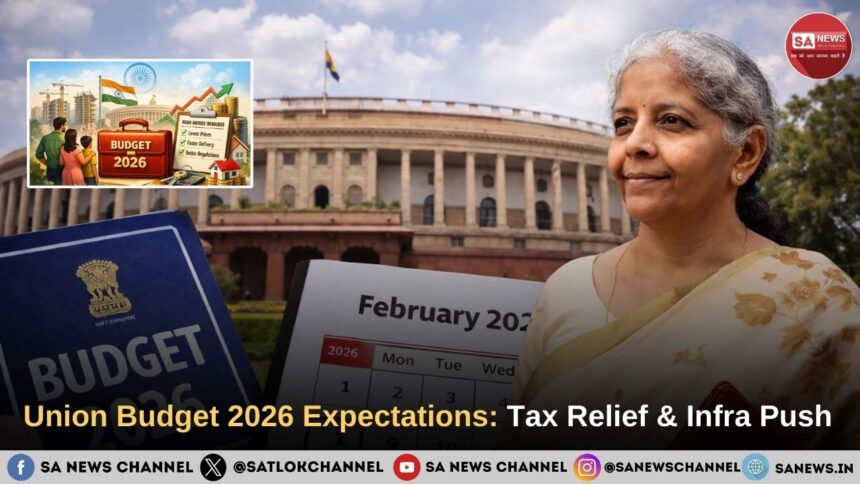
Union Budget 2026 is poised to be one of the most significant financial statements in India’s recent history, scheduled for presentation on 1st February 2026 by Finance Minister Nirmala Sitharaman in Parliament.
- Union Budget 2026 – When & Why It Matters
- Tax Relief Expectations
- Infrastructure Push – The Core of Growth Strategy
- Reviewing Reforms Over the Last 5 Years
- Fiscal Policy & Investor Confidence
- Market & Citizen Expectations
- Strengthening India’s Roots Through Farmer Welfare and Social Reform
- FAQs on Union Budget 2026 Expectations
As citizens and markets await key announcements, widespread expectations include income tax relief, revision in tax slabs, increased infrastructure spending, and policy continuity supporting growth. Analysts believe this Budget could reinforce India’s economic resilience amid global headwinds while addressing core issues affecting the middle class, businesses, and strategic sectors. This article examines what to expect, the push for reform over the last five years, and how Budget 2026 may shape India’s economic trajectory.
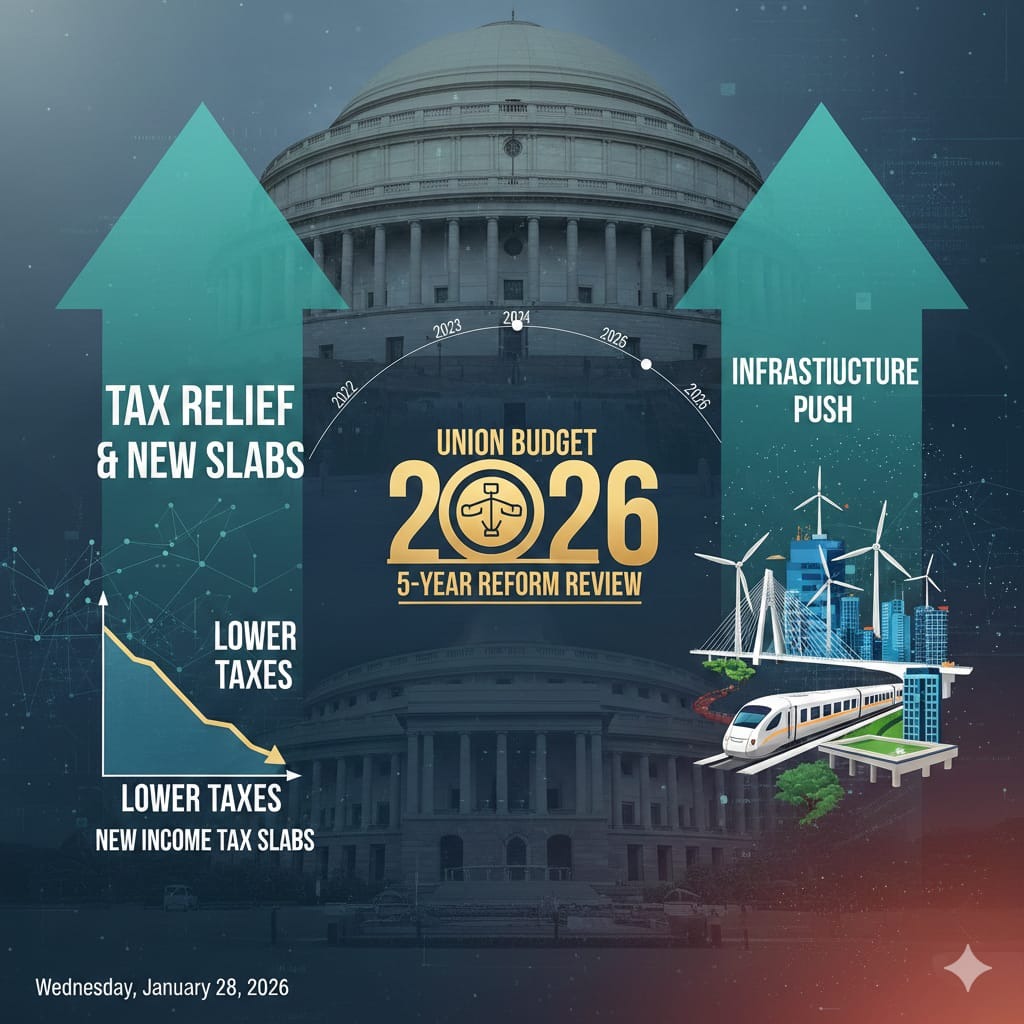
Union Budget 2026 – When & Why It Matters
Budget Session 2026 Begins: President Murmu’s Address Sets the Tone
The much-awaited Budget Session of Parliament commenced on January 28, 2026, with President Droupadi Murmu addressing a joint sitting of the Lok Sabha and Rajya Sabha, marking the official start of pre-Budget proceedings ahead of the historical Sunday Budget on February 1. During her speech, President Murmu emphasised priorities such as economic growth, India-EU FTA benefits, social justice, inclusive development, and employment generation, while referring to pivotal milestones in infrastructure and strategic sectors. Following the address, both Houses were adjourned till Thursday.
The Union Budget of India is the annual financial blueprint outlining government revenue and expenditure priorities, influencing every citizen from taxpayers to business owners. The 2026 Budget arrives at a time when India’s economy is navigating global uncertainties, slowing revenue growth, and balancing fiscal consolidation with growth aspirations.
Tax Relief Expectations
Income Tax Slab Discussions
One of the most discussed aspects ahead of Budget 2026 is whether there will be additional income tax relief or tax slab restructuring for taxpayers. After last year’s significant relief – where incomes up to ₹12 lakh were effectively exempt under the new tax regime – expectations this year are cautious.
Some experts predict:
- Potential increase in standard deduction from ₹75,000 to ₹1,00,000 to offset inflation.
- Slight adjustments in slab thresholds to reduce tax burdens on the middle class.
- Rationalisation of capital gains tax to spur investments.
However, major tax relief may be limited this year due to fiscal consolidation goals.
New vs Old Tax Regime – What Could Change
The current new tax regime slabs begin at:
- Up to ₹4 lakh: Nil
- ₹4–8 lakh: 5%
- ₹8–12 lakh: 10%
- ₹12–16 lakh: 15%
- ₹16–20 lakh: 20%
- ₹20–24 lakh: 25%
- Above ₹24 lakh: 30%
Incremental tweaks for middle-class relief are expected, such as additional deductions and tax rebates.
Infrastructure Push – The Core of Growth Strategy
Infrastructure is expected to be at the heart of Budget 2026. With capital expenditure projected to reach record highs, the government plans to accelerate economic momentum through roads, railways, urban development, and tourism.
Key Sector Focus
Tourism & Heritage Sites: Development funding to boost connectivity and conservation.
EV & Charging Infrastructure: Subsidies and GST rationalisation for EV adoption.
Hospitality & Rural Credit: Incentives and input tax credit restoration.
Reviewing Reforms Over the Last 5 Years
India’s economic policy agenda has undergone several key reforms:
Tax reforms: simplified regimes, higher exemptions.
Capital expenditure surge: physical and digital infrastructure.
Ease of Doing Business measures: attract investment and support innovation.
Fiscal Policy & Investor Confidence
Despite GDP growth above 7%, fiscal space is constrained by past tax cuts and borrowing needs. Maintaining fiscal deficit targets while supporting growth remains critical.
Market & Citizen Expectations
Markets look for startup incentives, GST clarity, and fiscal discipline. Citizens hope for broader tax relief and simpler compliance.
Strengthening India’s Roots Through Farmer Welfare and Social Reform
As India gears up for Union Budget 2026, a major focus remains on the agricultural sector-the backbone of the nation’s growth. While the government plans a significant infrastructure push, the real economic resilience of India lies in supporting its farmers and the poor.
This mission is exemplified by the humanitarian work of Sant Rampal Ji Maharaj. During severe floods, He provided heavy-duty motors and pipes to villages to drain fields, saving crops and preventing widespread hunger. His Annapurna Muhim further boosts the economy by providing the five essentials of life: food, clothing, education, healthcare, and housing.
His vision for a self-sufficient India is captured in the slogan:
“Roti, Kapda, Shiksha, Chikitsa aur Makaan,
Har Gareeb ko de raha Kabir Bhagwan”
By addressing these core needs, Sant Rampal Ji’s initiatives complement the national goal of inclusive development and social justice.
FAQs on Union Budget 2026 Expectations
Q1: When will the Union Budget 2026 be presented?
A: 1st February 2026 by FM Nirmala Sitharaman.
Q2: Will there be income tax relief?
A: Likely incremental relief like higher standard deduction; major slab shifts are limited.
Q3: Key infrastructure expectations?
A: Roads, railways, EVs, tourism, and rural development.
Q4: How will fiscal discipline be maintained?
A: Balancing capital expenditure with deficit control.
Q5: How will the middle class benefit?
A: Additional deductions, slab tweaks, and incentives to increase disposable income.