
The Two-Day Rule: Ever felt excited to begin a new habit – waking up early, journaling, walking, meditation – only to stop after a few days? Most of us blame ourselves, thinking we lack discipline. But the real issue isn’t motivation – it’s unrealistic expectations. The Two-Day Rule has become a trending lifestyle concept because it acknowledges that humans are imperfect. Life gets busy. Schedules change.
- What Is the Two-Day Rule?
- Why the Two-Day Rule Works
- Why 2 days?
- Why Humans Struggle With Consistency
- Why the Two-Day Rule Works So Well
- The Psychology Behind Consistency
- How to Apply the Rule in Daily Life
- Step 1: Choose ONE Small Habit
- Step 2: Track Only the Gap, Not the Performance
- Step 3: Create a Backup Version of Your Habit
- Step 4: Track It Visually
- Best Habits to Try With the Two-Day Rule
- Morning walk
- Drinking water mindfully
- Reading spiritual or motivational text
- Budget control
- Studying 20 minutes
- Practicing a skill (coding, drawing)
- Sleeping before 11 PM
- Cleaning one corner a day
- Planning tomorrow’s tasks
- Gratitude journaling
- Benefits of the Two-Day Rule
- No More Guilt – You Stay Motivated Instead of Quitting
- Builds Gentle Discipline – Consistency Without Pressure
- Practical for Real Life – Habits That Survive Busy Days
- Improves Mental Well-Being – Small Wins Boost Self-Confidence
- Long-Term Transformation – Small Steps That Change Your Life
- A Real-Life Example Everyone Can Relate To
- How to Stay Motivated When You Don’t Feel Like It
- Small Habits That Create Big Life Shifts
- Avoid This Habit-Building Mistake
- Success Comes From Small Daily Actions – Not Perfection
- How Spiritual Practice Strengthens Discipline
- FAQs on The Two-Day Rule
We get tired. This rule offers flexibility while keeping you on track. It’s about never letting a gap expand longer than two days. This small, manageable rule can radically change the way you approach success, health, and personal growth.
What Is the Two-Day Rule?
The Two-Day Rule is a simple consistency framework. Never skip a habit more than two days in a row. Unlike strict routines that demand perfection, this rule understands real-life struggles – illness, emotional lows, unexpected work pressure, social commitments. Missing a day is normal. Missing two days sometimes happens. But missing three days means losing momentum completely. This rule prevents that from happening.
Why the Two-Day Rule Works
Human habits are shaped by repetition. Every time you show up, even a little, your brain reinforces that identity:
- “I’m someone who exercises.”
- “I’m someone who reads.”
- “I’m someone who takes care of my body.”
Skipping too long breaks that belief.
The Two-Day Rule protects consistency by giving flexibility without letting things slip away permanently.
Why 2 days?
Because one skipped day is normal.
Two skipped days happen.
But when the gap reaches three days, motivation collapses and restarting becomes harder.
This rule protects your progress without demanding perfection.
Why Humans Struggle With Consistency
We like comfort. Our brain prefers what is familiar.
That’s why starting something new – waking up early, reading daily, exercising – feels hard.
- Motivation is temporary.
- Willpower is limited.
- Systems create results.
The Two-Day Rule is a system – one that supports humans, not superheroes.
Why the Two-Day Rule Works So Well
Every time you show up – even for a few minutes – your mind records it.
That tiny action reinforces your identity.
Soon, habits stop feeling like chores and start feeling like normal life.
This happens because:
- Repetition builds neural pathways
- Consistency increases self-belief
- Visible progress boosts motivation
- Small steps reduce overwhelm
The rule gives room for bad days, sick days, travel days, and low-energy phases.
It turns discipline into something gentle, not painful.
The Psychology Behind Consistency
Research shows habits stick when:
- They are easy to start
- They don’t feel punishing
- They offer daily rewards
- They become part of identity
Example:
“I am a person who walks daily.”
This identity, once formed, is stronger than any alarm clock.
The Two-Day Rule helps habits merge into identity naturally.
How to Apply the Rule in Daily Life
Step 1: Choose ONE Small Habit
Don’t begin with five things at once.
Choose one tiny action that matters.
Examples:
- Walk for 10 minutes
- Read 1 page of a book
- Say a gratitude prayer
- Drink 1 extra glass of water
- Stretch for 3 minutes
- Journal one sentence
Starting tiny guarantees you don’t resist doing it.
Step 2: Track Only the Gap, Not the Performance
Most people quit because they think: “30 minutes or nothing.”
But the rule says: find the small version and do it.
Your goal is NOT daily perfection.
Your only goal is: don’t miss it three days in a row.
Step 3: Create a Backup Version of Your Habit
A backup version is the minimum form of the habit.
Life will interrupt – be ready.
- If your habit is a 30-minute gym… your backup is 3-minute stretching.
- If your hobby is journaling… Your backup is a one-sentence entry.
- If your habit is prayer or meditation… Your backup is 30 seconds of silence.
The hero is not the effort – the hero is the continuity.

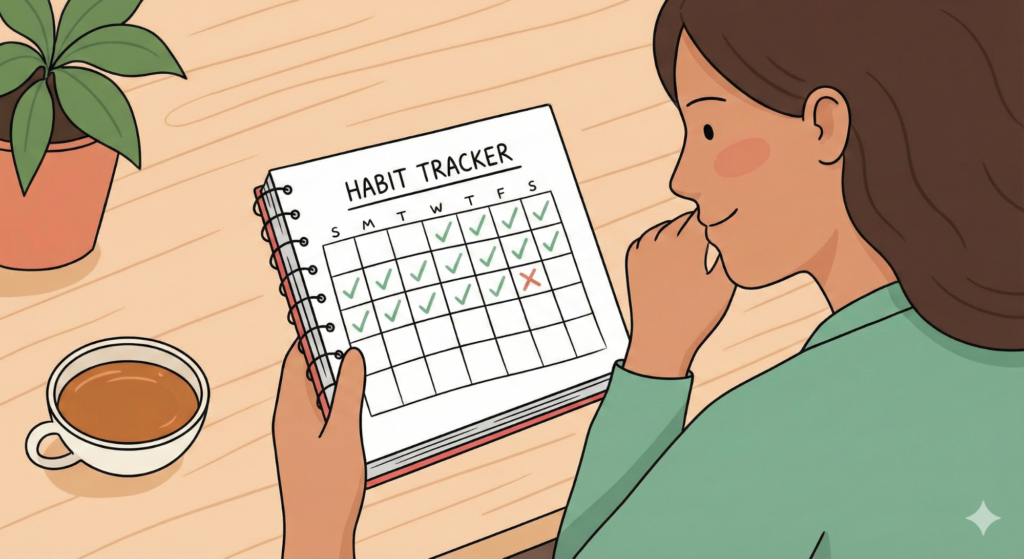
Step 4: Track It Visually
Tracking makes progress visible.
And our brain loves visible success.
Ways to track:
- Habit tracking apps
- Calendar with X marks
- Sticky notes on wall
- A notebook labeled “Consistency Log”
Every mark becomes a victory.
Best Habits to Try With the Two-Day Rule
You can apply this rule to almost anything.
Morning walk
A simple morning walk helps boost metabolism, improve heart health, and clear mental stress. Walking even 10 minutes daily supports weight loss and enhances mood naturally. Apply the Two-Day Rule by never skipping more than two mornings in a row.
Drinking water mindfully
Hydration is essential for glowing skin, better digestion, and higher energy levels. Practice mindful drinking by keeping a bottle nearby and taking sips throughout the day. Even if you forget, return to it within two days to maintain the habit.
Reading spiritual or motivational text
Reading a few lines daily feeds the mind with positive thoughts and wisdom. Spiritual and motivational books reduce anxiety and guide decision-making. Use the Two-Day Rule so your inner growth never goes on pause.
Budget control
Tracking even one small expense daily builds financial discipline. Budget control supports saving habits and reduces stress related to money. With the Two-Day Rule, you stay consistent without feeling pressure.
Studying 20 minutes
Just 20 minutes of study can improve knowledge, grades, or career skills over time. Short learning sessions beat long intense ones you can’t maintain. Missing one day is okay – never let the gap stretch to three.
Practicing a skill (coding, drawing)
Skill growth happens when you show up regularly, not perfectly. Practice 5–10 minutes daily to strengthen creativity and expertise. Whether it’s drawing or coding, apply the Two-Day Rule so your progress doesn’t reset.
Sleeping before 11 PM
Good sleep is the foundation of energy, mood, and productivity. Sleeping before 11 PM supports mental clarity, skin repair, and hormone health. The Two-Day Rule helps bring balance – avoid late-night cycles becoming a habit.
Also Read: Sleep Sweetly: Your Guide to Restful Nights
Cleaning one corner a day
Decluttering small spaces daily creates a clean and peaceful home environment. Instead of heavy weekend cleaning, take 2–3 minutes to tidy one spot. Skip a day if needed – but return before two days pass.
Planning tomorrow’s tasks
Writing a short next-day plan at night
improves time management and reduces morning confusion. It helps you wake up with clarity and purpose. Returning to the habit within 48 hours keeps you consistently organized.
Gratitude journaling
Spend a minute listing 1–2 things you are grateful for. Gratitude rewires the brain toward happiness and reduces stress. The Two-Day Rule ensures positivity becomes a natural part of life.
Benefits of the Two-Day Rule
No More Guilt – You Stay Motivated Instead of Quitting
- One of the biggest reasons people fail to maintain habits is guilt.
- When you miss a day, your mind says “See? You couldn’t do it,” and you quit.
- The Two-Day Rule removes that emotional burden completely.
- It allows you to be human – to have tired days, busy days, or sad days.
- Instead of feeling like you failed, you simply acknowledge and return.
- This approach creates a healthy mindset toward progress.
- Your brain learns that you don’t need perfection to succeed.
- Motivation becomes easier because you don’t fear falling off track.
- This rule lets you forgive yourself and continue your journey with positivity.
Builds Gentle Discipline – Consistency Without Pressure
- Traditional discipline feels strict and draining – like forcing yourself daily.
- The Two-Day Rule builds what we call gentle discipline, which is softer.
- It encourages you to continue at your pace – not society’s pace.
- This method respects real human energy levels and emotions.
- It teaches commitment through repetition, not through punishment.
- You slowly form habits because you choose to, not because you “must.”
- This makes the behavior more natural, long-lasting, and enjoyable.
- You begin trusting yourself because you show up willingly.
- With time, discipline becomes part of your personality, not a forced rule.
Practical for Real Life – Habits That Survive Busy Days
- Life doesn’t run on a perfect routine – and this rule understands that.
- Work deadlines, travel plans, festive seasons, illnesses – all can interrupt habits.
- A harsh routine breaks the moment life gets difficult.
- But the Two-Day Rule bends instead of breaking.
- It gives you space to pause when needed, without losing progress.
- You remain consistent even during chaos because the standard is flexible.
- It suits students, parents, employees, entrepreneurs – everyone.
- This practicality is why the rule is trending globally across productivity communities.
- It helps you build habits that fit real life, not just Instagram-perfect mornings.
Improves Mental Well-Being – Small Wins Boost Self-Confidence
- The state of your mind affects how well you maintain habits.
- When you keep tiny promises to yourself, you begin to feel capable.
- Every small checkmark – every mini-win – strengthens your self-esteem.
- Over time, this lowers anxiety and builds emotional resilience.
- You stop battling self-blame and instead practice self-respect.
- Your thoughts shift from “I never finish anything” to “I always return.”
- The Two-Day Rule supports a much healthier inner dialogue.
- It also reduces decision fatigue because the rule is simple and clear.
- Mental well-being becomes an effortless part of your routine.
Long-Term Transformation – Small Steps That Change Your Life
- Real change doesn’t happen in one giant leap – it happens in quiet repetition.
- Two minutes today may not seem powerful, but it creates momentum.
- In 30 days, those two minutes become a routine.
- In 6 months, that routine becomes part of your lifestyle.
- Small habits compound like interest – growing silently every day.
- This rule protects that compounding effect by closing gaps.
- It prevents long breaks that reset your progress to zero.
- With the Two-Day Rule, time becomes your partner – not your enemy.
- Before you realize it, you look back and see your entire life upgraded.
Also Read: Morning Motivation: Top 10 Morning Habits of Highly Successful People
A Real-Life Example Everyone Can Relate To
Meet Rohan.
He decided to begin yoga.
Day 1 – He stretched for 20 minutes.
Day 2 – He was tired but did 5 minutes.
Day 3 – The office meeting ran late. He skipped.
Day 4 – He felt guilty and didn’t restart.
Day 15 – Yoga is forgotten.
Now imagine Rohan using the Two-Day Rule:
Day 1 – 20 minutes
Day 2 – 5 minutes
Day 3 – Exhausted → 30 seconds breathing (backup habit)
Day 4 – Back to 10 minutes
See the difference?
Consistency beats intensity.
How to Stay Motivated When You Don’t Feel Like It
Use these triggers:
- Put clothes/books/tools in visible places
- Set reminders on your phone
- Pair habits together
- Reward yourself weekly
- Join accountability groups
- Set realistic expectations
Motivation is unreliable.
Systems + environment work better.
Small Habits That Create Big Life Shifts
Never underestimate:
- Drinking enough water
- Making your bed
- Cleaning your desk
- Spending 5 minutes in silence
- Saying thank you
These micro-habits change energy, mood, and clarity.
Avoid This Habit-Building Mistake
Most people quit because they go too hard on Day 1.
Never start with a “100-day challenge.”
Start with Day 1 only.
Your journey is not a battle.
It is a relationship – with yourself.
Success Comes From Small Daily Actions – Not Perfection
Big goals are never achieved overnight. They are built step-by-step through small actions, repeated consistently, and maintained over long periods of time. Every successful person you admire didn’t get there by doing everything perfectly – they got there by simply showing up, even on days when they didn’t feel like it.
This is where the Two-Day Rule becomes a game-changer:
“Don’t aim to be perfect. Aim to return.”
Missing one day is fine – life happens. But never miss twice. When you commit to returning, even when your effort is small, you build unstoppable momentum.
Your habit doesn’t need to look big or impressive to matter. It only needs to exist. Five minutes of progress still counts. A tiny step still moves you forward. What matters most is that you keep coming back.
So start today – take one small action toward your goal.
And tomorrow, show up again.
Because long-term success is simply the result of tiny wins, stacked daily.

How Spiritual Practice Strengthens Discipline
True success is when mind and soul work together. We can build hundreds of worldly habits, but without inner peace, results feel empty.
The spiritual knowledge imparted by Sant Rampal Ji Maharaj teaches a profound truth:
A calm mind is the foundation of discipline. Devotion gives strength to control thoughts and actions. Naam-Simran brings focus, clarity, and emotional balance. Many seekers share that after starting spiritual practice, they naturally became:
- More punctual
- More health-aware
- More consistent
- Less anxious
Why?
Because when the inside gets ordered, the outside becomes easier.
The Two-Day Rule aligns beautifully with spirituality. Just as we shouldn’t skip habits for more than two days, we also shouldn’t skip connection with the Divine. Daily or near-daily remembrance keeps life aligned.
Spiritual practice is the fuel that powers worldly discipline.
Without it, routines feel forced.
With it, routines feel flowing.
FAQs on The Two-Day Rule
Q1. What is the Two-Day Rule for Habits?
It’s a consistency strategy where you never skip your habit more than two days in a row, ensuring long-term success.
Q2. Who can use the Two-Day Rule?
Students, professionals, homemakers, fitness beginners – anyone wanting sustainable habits.
Q3. How long does it take to form a habit?
Studies show it can take 21–66 days, but the key is consistency – not a deadline.
Q4. What if I miss two days accidentally?
Just restart on the third day. The rule is forgiving – progress matters more than perfection.
Q5. Can I use this rule for multiple habits?
Start with one habit until it feels natural, then gradually add more.