

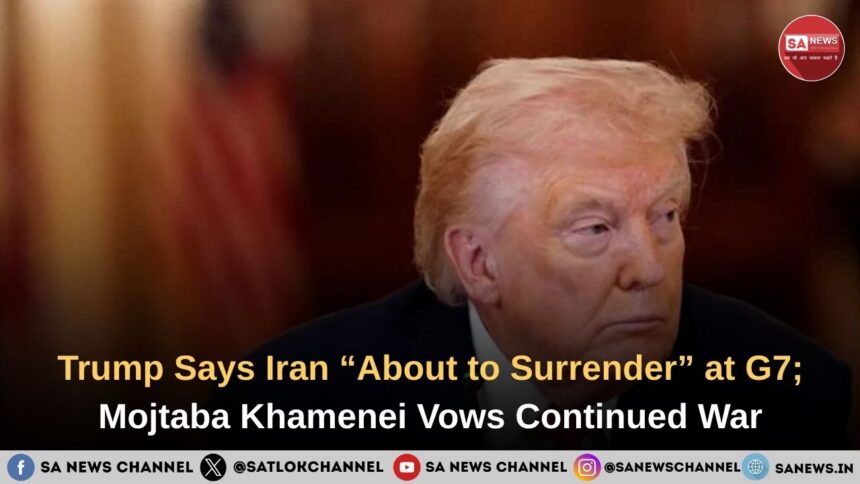
Global tensions escalated this week after former U.S. President Donald Trump reportedly told leaders of the Group of Seven (G7) nations that Iran was “about to surrender” in the ongoing conflict in the Middle East.
- Key Highlights:
- Trump’s Remarks to G7 Leaders
- Iran’s New Supreme Leader Responds
- Strait of Hormuz Emerges as Key Flashpoint
- Growing Military and Economic Impact
- Experts Question Trump’s Claim
- What Happens Next in the Iran War? Key Scenarios That Could Shape the Conflict
- World Watches as Trump Predicts Iran Surrender Amid Strait of Hormuz Tensions
The statement, made during a virtual call with world leaders, quickly drew international attention. However, the claim was strongly contradicted by Iran’s newly appointed Supreme Leader Mojtaba Khamenei, who vowed that the country would continue fighting.
The conflicting messages highlight the uncertainty surrounding the war involving the United States, Israel, and Iran, which has now entered its second week.
Key Highlights:
- Trump Tells G7 Iran Leadership ‘In Disarray,’ Criticizes UK in Tense Call
- Mojtaba Khamenei Rejects ‘Iran Surrender’ Claim, Vows Vengeance Against Adversaries
- Strait of Hormuz Crisis: Iran Threat Raises Global Oil Supply Fears
- Middle East Conflict Escalates: Iran–Israel Strikes Shake Global Oil Markets
- Experts Doubt Trump’s Claim That Iran Is ‘About to Surrender’ Amid Ongoing War
- Iran Conflict at a Turning Point: Possible Military Strikes, Retaliation and Global Impact
- Trump’s Iran Surrender Claim Sparks Global Concern Over Strait of Hormuz Conflict
Trump’s Remarks to G7 Leaders
According to officials familiar with the discussion, Trump told fellow G7 leaders that Iran’s leadership structure had been severely disrupted after recent strikes. He reportedly suggested that the Iranian government was in disarray and claimed that there might be no clear authority left in Tehran capable of formally declaring surrender.
Sources also said Trump criticized British Prime Minister Keir Starmer during the call, accusing the United Kingdom of delaying its offer to allow U.S. forces to use British military bases. The remarks reportedly created a tense moment during the discussion, as several leaders emphasized the need for diplomatic solutions rather than further escalation.
Iran’s New Supreme Leader Responds
Within a day of the reported conversation, Iran’s new Supreme Leader Mojtaba Khamenei delivered his first public message since assuming leadership. In a statement broadcast on Iranian state television, Khamenei rejected any suggestion that Iran was considering surrender. Instead, he declared that the country would continue resisting foreign military pressure.
He also warned that Iran would pursue “vengeance until fully achieved,” signaling a continuation of retaliatory actions against its adversaries. Analysts say the statement was intended both to rally domestic support and to reassure Iran’s regional allies that the country’s leadership remains intact.
Strait of Hormuz Emerges as Key Flashpoint
Another major concern for global leaders is the strategic ‘Strait of Hormuz’, a narrow waterway connecting the Persian Gulf with the Arabian Sea. Nearly one-fifth of the world’s oil supply passes through this shipping corridor every day. Any disruption to traffic in the strait could have serious consequences for global energy markets.
Iran has hinted that it could restrict access to the route as a form of retaliation for U.S. military strikes. Even the possibility of such action has already triggered volatility in oil prices and shipping insurance costs. However, some Iranian officials have suggested that Tehran does not currently intend to completely close the strait, though they maintain that it remains an option if the conflict intensifies.
Growing Military and Economic Impact
The conflict escalated after coordinated U.S. and Israeli operations targeted Iranian military and nuclear facilities earlier this year. Iran responded with missile and drone strikes aimed at Israeli positions and U.S. military bases in the region.
Since then, tensions have steadily increased, raising fears that the war could expand beyond the current combat zones. Energy markets are already reacting to the instability. Oil prices have surged amid concerns about supply disruptions, and several shipping companies are reconsidering routes through the Persian Gulf.
Governments across Europe and Asia are closely monitoring the situation because any prolonged disruption could affect global fuel prices and economic stability.
Experts Question Trump’s Claim
Despite Trump’s assertion that Iran is close to surrender, many geopolitical analysts believe the situation is far more complicated. Iran’s military operations continue, and its political leadership appears to remain active. The appointment of Mojtaba Khamenei as the country’s new Supreme Leader suggests that Tehran is attempting to maintain continuity during wartime rather than preparing to capitulate.
Experts say that while Iran faces significant military pressure, there is currently no clear evidence that the government is nearing collapse.
What Happens Next in the Iran War? Key Scenarios That Could Shape the Conflict
The coming days could prove critical in determining whether the conflict expands or moves toward negotiations.
Possible developments include:
- Additional U.S. or Israeli military strikes on Iranian targets
- Iranian retaliation against regional bases or maritime routes
- Diplomatic intervention by global powers seeking a ceasefire
- Increased pressure on energy markets if the Strait of Hormuz becomes unstable
For now, the war shows no immediate signs of slowing down.
World Watches as Trump Predicts Iran Surrender Amid Strait of Hormuz Tensions
The contrasting messages from Washington and Tehran reflect the uncertainty surrounding the ongoing conflict. While Donald Trump suggested that Iran might soon surrender, Iran’s new Supreme Leader Mojtaba Khamenei has made it clear that the country intends to keep fighting.
As tensions grow and the strategic Strait of Hormuz becomes a focal point, the situation remains one of the most serious geopolitical crises facing the world in 2026.