


The Battle of Plassey, fought on 23 June 1757, is one of the most defining events in Indian history. It was not just a battle between armies but a turning point that reshaped the destiny of an entire nation. This conflict between the British East India Company and the Nawab of Bengal, Siraj-ud-Daulah, marked the beginning of British dominance in India. What makes this event even more significant is that it was decided not only on the battlefield but also through political conspiracies and betrayal. Understanding this battle helps us understand how India moved from independence to colonial rule.
- What Was the Battle of Plassey?
- Causes of the Battle of Plassey
- Misuse of Trade Privileges
- The Black Hole Incident
- Unauthorised Fortification
- Economic & Political Conspiracy
- Course of the Battle
- The Role of Key Personalities in the Battle of Plassey
- Military Tactics and War Strategies
- Economic Consequences for India
- Social and Cultural Impact
- Long-Term Political Consequences
- The Battle of Plassey in Modern Education
- Results of the Battle of Plassey
- Significance of the Battle of Plassey
- Why the Battle of Plassey Changed India’s Fate
- Hidden Lessons for Modern India
- What the Battle of Plassey Teaches About Morality and Truth
- FAQs on the Battle of Plassey
What Was the Battle of Plassey?
The Battle of Plassey was fought between the British East India Company, led by Robert Clive, and the Nawab of Bengal, Siraj-ud-Daulah. It took place near the village of Plassey in Bengal on 23 June 1757. This battle is widely regarded as the starting point of British rule in India.
Although the Nawab had a much larger army, the British emerged victorious due to strategic planning and internal betrayal. This victory allowed the British to gain control over Bengal, one of the richest regions of India.
Also Read: The History of Persia: From Ancient Glory to Modern Identity
Causes of the Battle of Plassey
Misuse of Trade Privileges
The British East India Company misused ‘Dastaks’ (trade permits), which allowed them to trade without paying taxes, causing massive revenue losses for Bengal.
The Black Hole Incident
Tensions peaked when Siraj-ud-Daulah captured Fort William. It was alleged that 146 British prisoners were crowded into a small dungeon, leading to many deaths. This event gave Robert Clive the excuse to launch a military strike.
Unauthorised Fortification
The British began strengthening the walls of Calcutta (Fort William) without the Nawab’s permission, which was seen as a direct challenge to his sovereignty.
Economic & Political Conspiracy
High-ranking officials like Mir Jafar and the wealthy bankers (Jagat Seths) felt threatened by the young Nawab’s temper and policies, leading them to strike a secret deal with the British.
Course of the Battle
The battle itself was surprisingly short. Siraj-ud-Daulah had around 50,000 soldiers, while the British had only about 3,000 troops.
However, many of the Nawab’s commanders, including Mir Jafar, did not actively participate in the fight. This betrayal ensured a British victory.
The battle lasted only a few hours, but its impact lasted for centuries.
The Role of Key Personalities in the Battle of Plassey
The outcome of the Battle of Plassey was not just determined by armies but by influential individuals whose decisions changed history.
Robert Clive’s Strategy
Robert Clive, often called the architect of British success in India, used a combination of military intelligence and political manipulation. Instead of relying solely on battlefield strength, he focused on weakening the enemy internally. His diplomatic moves and secret agreements played a crucial role in ensuring victory.
Siraj-ud-Daulah’s Leadership Challenges
Siraj-ud-Daulah was young and faced multiple internal challenges. His court was filled with people who were not loyal, which made governance difficult. Despite his courage, the lack of unity among his commanders weakened his position during the battle.
Mir Jafar’s Ambition
Mir Jafar’s role remains one of the most controversial in Indian history. His desire for power led him to side with the British. This act of betrayal highlights how personal ambition can influence the fate of nations.
Military Tactics and War Strategies
While the Battle of Plassey was short, it showcased the importance of strategy over strength.
Use of Modern Weapons
The British forces had access to better artillery and firearms compared to the Nawab’s army. Their disciplined use of weapons gave them an advantage during crucial moments.
Weather and Battlefield Conditions
An interesting factor in the battle was the sudden rain. The Nawab’s army failed to protect their gunpowder, rendering their weapons ineffective. In contrast, the British troops managed to keep their ammunition dry, giving them a significant edge.
Psychological Warfare
The British used fear and uncertainty as tools. By securing alliances with key figures, they created confusion within the Nawab’s camp, which ultimately weakened resistance.
Also Read: British Raj: India’s Transformative Journey from Colonial Rule to Independence
Economic Consequences for India
The economic impact of the Battle of Plassey was long-lasting and deeply transformative.
Control Over Revenue Systems
After gaining power, the British East India Company took control of Bengal’s revenue system. This allowed them to collect taxes directly, increasing their wealth significantly.
Decline of Local Industries
Indian artisans and craftsmen suffered due to British policies. Local industries, especially textiles, faced heavy competition from British goods, leading to economic decline.
Beginning of Economic Drain
The wealth generated in India was sent to Britain, which historians describe as the “economic drain.” This weakened India’s economy over time and contributed to poverty in many regions.
Social and Cultural Impact
The Battle of Plassey also brought changes in society and culture.
Shift in Power Structures
Traditional rulers lost authority, and new systems of governance were introduced. This changed how society functioned at multiple levels.
Influence on Education and Language
Over time, British influence led to changes in education systems and the introduction of English as a dominant language. This had both positive and negative effects on Indian society.
Rise of New Classes
A new class of intermediaries emerged who worked closely with the British. This created divisions within society and changed social dynamics.
Also Read: International Day of Happiness 2026: Know the Way To Attain Ultimate Peace and Happiness
Long-Term Political Consequences
The political effects of the Battle of Plassey extended far beyond Bengal.
Expansion of British Territory
After Plassey, the British gradually expanded their control over other parts of India. This marked the beginning of a larger colonial empire.
Weakening of Indian Kingdoms
Indian rulers became more vulnerable due to internal conflicts and lack of unity. This made it easier for the British to establish dominance.
Foundation for Future Conflicts
The events following Plassey eventually led to resistance movements and uprisings, including the Revolt of 1857.
The Battle of Plassey in Modern Education
Today, the Battle of Plassey is an important topic in history education, especially for competitive exams like UPSC, SSC, and state-level exams.
Importance in Competitive Exams
Questions related to causes, consequences, and key figures of the Battle of Plassey frequently appear in exams. Understanding this topic helps students build a strong foundation in modern Indian history.
Academic Research and Analysis
Historians continue to study this event to understand the dynamics of colonial expansion and its long-term effects on India.
Results of the Battle of Plassey
British Control Over Bengal
After the victory, the British East India Company gained control over Bengal’s administration and resources.
Puppet Rulers
Mir Jafar was made the Nawab, but he had no real power. The British controlled all decisions.
Economic Exploitation
The wealth of Bengal was used to strengthen British power, leading to what historians call the “Drain of Wealth.”
Significance of the Battle of Plassey
Political Impact
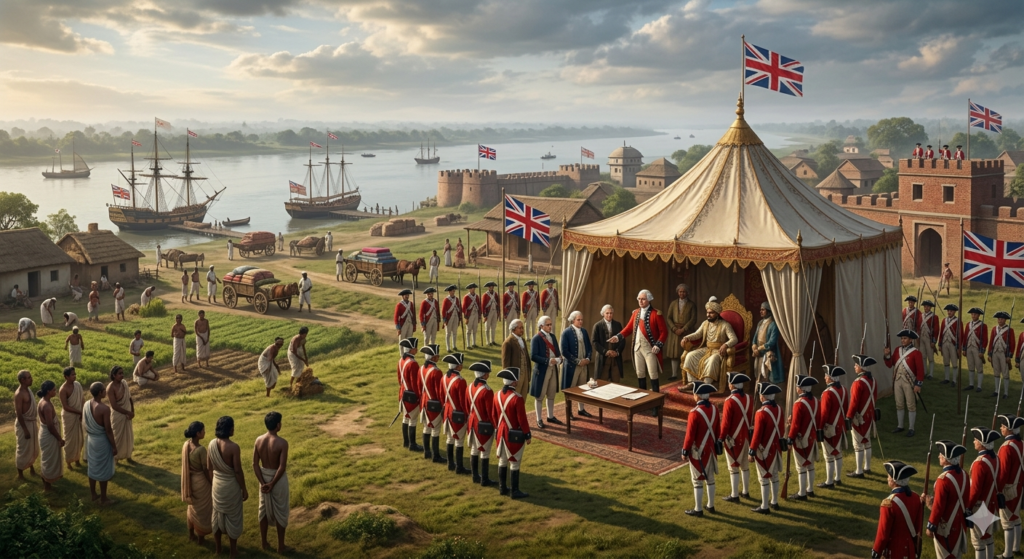
The Battle of Plassey marked a decisive shift in India’s political landscape. Before this event, the British East India Company was primarily a trading entity with limited influence. However, after their victory, they gained the authority to interfere directly in the governance of Indian states. Bengal became the first region where the British exercised real political control, setting a precedent for expansion across the subcontinent.
This battle also introduced the concept of “puppet rulers,” where local kings held titles but lacked real power. Decisions were increasingly made by British officials, weakening traditional governance systems. Over time, this political dominance extended beyond Bengal, allowing the British to establish control over vast territories in India.
Economic Impact
The economic consequences of the Battle of Plassey were profound and long-lasting. Bengal, known for its immense wealth and thriving industries, became a primary source of revenue for the British East India Company. After gaining control, the British started collecting taxes and using the region’s resources to finance their military and administrative expansion across India.
This led to what historians describe as the “Drain of Wealth,” where India’s riches were systematically transferred to Britain. Local economies suffered as traditional industries declined due to unfair trade practices and heavy taxation. The economic policies introduced after Plassey not only weakened India’s financial stability but also laid the foundation for widespread poverty in the years to come.
Social Impact
The Battle of Plassey also brought significant changes to Indian society. Traditional power structures, which were once based on local rulers and community systems, began to weaken. The rise of British authority disrupted long-standing social hierarchies and introduced new systems of administration.
A new class of intermediaries emerged, individuals who worked closely with the British and benefited from their rule. This created divisions within society, as some groups gained advantages while others faced marginalization. Additionally, cultural influences gradually shifted as Western ideas and practices started to spread, affecting education, lifestyle, and social values.
Beginning of Colonial Rule
One of the most important outcomes of the Battle of Plassey was the beginning of colonial rule in India. Although the British had been present for trade earlier, this victory allowed them to transition into rulers. It laid the groundwork for nearly 200 years of British dominance in India.
Following Plassey, the British systematically expanded their control through wars, alliances, and administrative reforms. This period of colonial rule reshaped India’s political boundaries, economy, and society in ways that are still visible today.
The battle, therefore, was not just a single event but the starting point of a long chapter in Indian history that defined the nation’s trajectory for generations.
Why the Battle of Plassey Changed India’s Fate
The Battle of Plassey was not just a military victory; it was a strategic turning point.
- It transformed a trading company into a ruling power
- It exposed the dangers of internal divisions
- It opened the door for foreign domination
This event shows how a single moment in history can shape the destiny of an entire nation.
Hidden Lessons for Modern India
The Battle of Plassey offers valuable lessons that are still relevant today.
Importance of Unity
One of the biggest reasons for the defeat was lack of unity. This teaches us that collective strength is essential for national progress.
Leadership Matters
Strong and wise leadership is crucial during times of crisis. Decisions taken by leaders can shape the future of an entire nation.
Awareness and Vigilance
The event highlights the importance of being aware of external threats and internal weaknesses.
What the Battle of Plassey Teaches About Morality and Truth
Beyond political and economic analysis, the Battle of Plassey also offers a deeper spiritual lesson.
According to the teachings of Sant Rampal Ji Maharaj, human suffering is often the result of greed, ego, and betrayal. The events of Plassey clearly reflect these qualities. Personal ambition and selfish motives led to the downfall of a powerful kingdom.
Sant Rampal Ji Maharaj teaches that true spiritual knowledge (Satgyaan) guides individuals toward unity, truth, and righteousness. If such values were followed, historical tragedies like the Battle of Plassey could have been avoided.
This perspective reminds us that moral and spiritual values are just as important as political strength in shaping the future of society.
FAQs on the Battle of Plassey
1. When was the Battle of Plassey fought?
The Battle of Plassey was fought on 23 June 1757.
2. Who fought in the Battle of Plassey?
It was fought between the British East India Company and Siraj-ud-Daulah, the Nawab of Bengal.
3. Why is the Battle of Plassey important?
It marked the beginning of British rule in India and changed the country’s political and economic structure.
4. Who won the Battle of Plassey?
The British East India Company, led by Robert Clive, won the battle.
5. What was the main cause of the Battle of Plassey?
The main causes included misuse of trade privileges, political tensions, and internal betrayal.