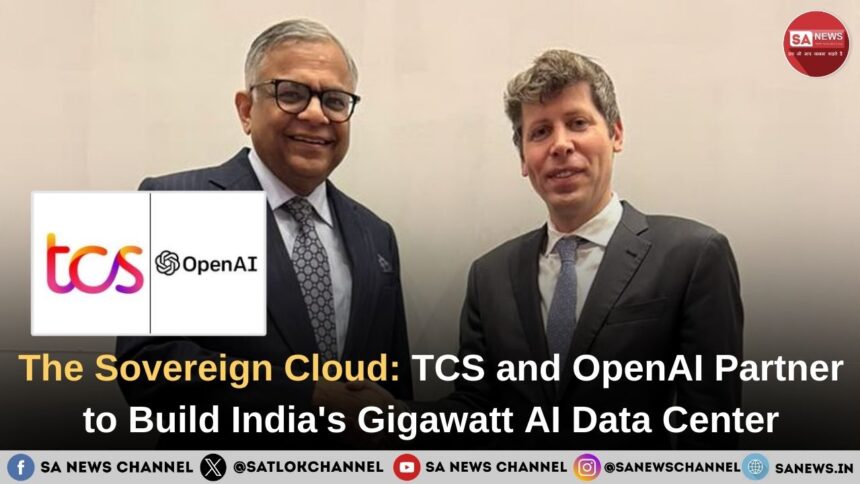
Walk into the India AI Impact Summit 2026 this week, and the primary conversation was not about software patching or traditional cloud migration. The dialogue has aggressively shifted toward pure, raw computational power. In a move that fundamentally alters its global trajectory, Tata Consultancy Services (TCS) has laid the physical groundwork for what will become one of the world’s largest AI-ready data centers on Indian soil.
Spearheaded by Tata Sons Chairman N. Chandrasekaran, this development is far more than a corporate real estate expansion. It is a calculated geopolitical play for digital sovereignty. By aligning with OpenAI and massive institutional investors, TCS is ensuring that the artificial intelligence of tomorrow is housed, trained, and executed domestically, marking a severe pivot from India’s traditional role as an outsourced IT hub.
Key Points at a Glance
- The Gigawatt Ambition: The facility will commence operations with a massive 100 megawatts (MW) of capacity, with a definitive roadmap to scale up to an unprecedented 1 gigawatt (GW).
- The HyperVault Subsidiary: The data center will be built and operated by TCS’s newly minted infrastructure arm, HyperVault, which recently secured a $1 billion investment from TPG.
- OpenAI as the Anchor Tenant: Under the “OpenAI for India” initiative, the ChatGPT maker will be the facility’s first major customer, utilizing the local infrastructure for low-latency processing.
- Hardware Muscle: A deep engineering collaboration with AMD will deploy the “Helios” rack-scale architecture, utilizing top-tier AI accelerators and advanced liquid cooling.
- Enterprise Integration: Thousands of Tata Group employees will be onboarded to ChatGPT Enterprise, embedding AI directly into legacy corporate workflows.
The “HyperVault” Infrastructure Paradigm
For decades, Indian technology giants operated as the digital plumbers of the Western world, managing and maintaining systems physically housed elsewhere. With the launch of HyperVault, TCS is fundamentally changing its business model by owning the core physical assets.
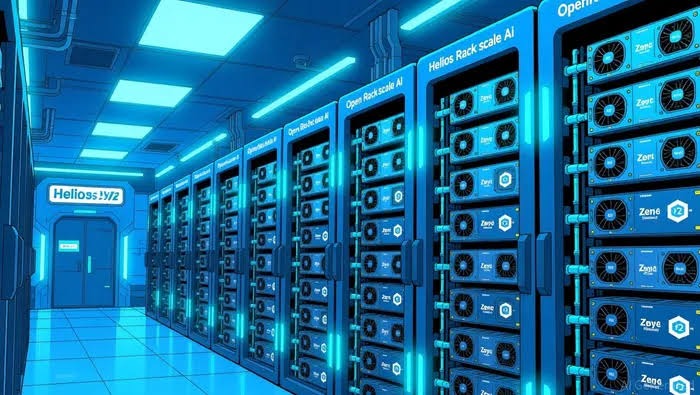
This purpose-built infrastructure is vastly different from a standard data center. Training large language models requires extreme rack densities. Consequently, the HyperVault facilities are being engineered with advanced liquid cooling systems and specialized power grids to manage the intense thermal output generated by heavy graphics processing units (GPUs). It is a highly specialized construction project that bridges heavy civil engineering with advanced microelectronics.
Strategic Alliances: The OpenAI and AMD Ecosystem
The strategic brilliance of this announcement lies in its immediate commercial viability. OpenAI is not merely licensing its technology; it is acting as the foundational customer. This guarantees immediate, high-volume utilization of the initial 100 MW capacity, mitigating the financial risk usually associated with massive infrastructure builds.
Furthermore, by integrating AMD’s cutting-edge Helios architecture, TCS is effectively diversifying its hardware supply chain. In a global market currently plagued by severe silicon bottlenecks, partnering directly with a top-tier chipmaker ensures that the deployment schedule remains uninterrupted and technologically future-proofed.
Data Sovereignty: Securing the Domestic Perimeter
Perhaps the most critical implication of the HyperVault project is data residency. Historically, mission-critical workloads and government projects faced a significant legislative hurdle: the requirement to process highly sensitive data on foreign servers.
This new mega-facility removes that barrier entirely. It ensures that sovereign data remains strictly within national borders, complying seamlessly with strict localization mandates. This creates a trusted environment for the defense sector, public healthcare systems, and financial institutions to confidently integrate deep AI into their operations without compromising national security.
Beyond Service Provisioning
As the dust settles on the AI Impact Summit, the message from the Tata Group is unmistakable. They are no longer content with simply writing the code; they are forging the iron upon which the next industrial revolution will run. By building the world’s largest AI data center, TCS is establishing a domestic launchpad that will dictate the pace of technological adoption for the next decade.
Timely Adoption of the Right Path
Tatvadarshi Sant Rampal Ji Maharaj teaches that human life is extremely precious and short-lived, and that real security does not come from material progress, but from attaining true spiritual knowledge and practicing the correct method of worship.
He states that ignorance is the source of all human woes, fears, and the cycle of birth and death. The ultimate goal of man is to become spiritually enlightened and to use that for gaining peace and security that is even beyond worldly uncertainties.
He emphasizes that time is limited and extremely valuable, and that delaying true worship can prove to be a great loss. Just as people take strong measures to protect what they value most, Sant Rampal Ji Maharaj urges every individual to safeguard their life by choosing the correct spiritual path while the opportunity still remains.
To know more about true spiritual knowledge download Sant Rampal Ji Maharaj App.
FAQs Related to TCS HyperVault Project
1. What is the TCS HyperVault project?
HyperVault is a newly established subsidiary of TCS focused on building and operating large-scale, secure, and reliable AI-ready data centers in India to support massive computational workloads.
2. How is OpenAI involved with the new TCS data center?
OpenAI will be the foundational customer for the HyperVault data center. They are utilizing this local infrastructure to run their advanced models securely in India, ensuring lower latency and strict compliance with data residency laws.
3. What is the power capacity of this new facility?
The data center will initially launch with a highly robust capacity of 100 megawatts (MW) and is engineered with a scalable blueprint to eventually reach 1 gigawatt (GW) over the coming years.
4. Why is an AI-specific data center necessary?
Unlike traditional cloud storage, training and running Artificial Intelligence requires extreme rack densities, specialized GPUs, and advanced liquid cooling systems to handle massive power consumption and heat generation.
5. Which hardware partner is TCS collaborating with?
TCS has formed a strategic alliance with US chipmaker AMD to co-develop a rack-scale AI infrastructure based on the AMD “Helios” platform, ensuring state-of-the-art processing capabilities.