

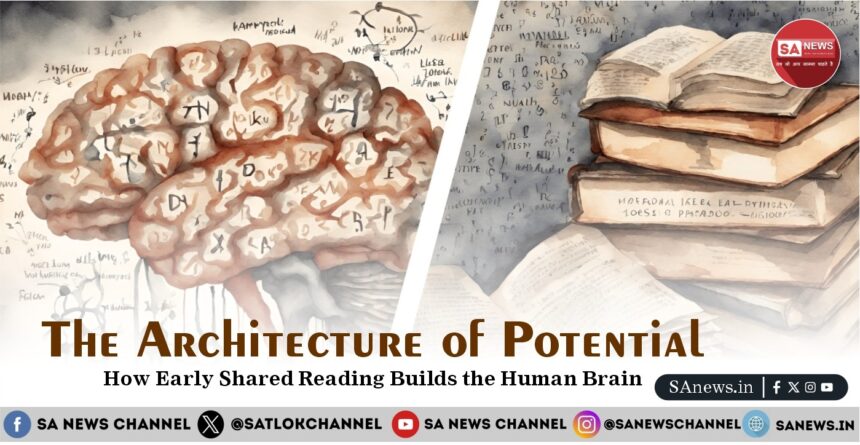
We often assume that reading is a natural milestone in human development, much like learning to walk or speak. However, this is a misconception. While the human brain arrives genetically hardwired to understand spoken language, it possesses no pre-installed program for reading.
- The Unnatural Act of Reading
- Neurobiological Foundations: Wiring the Brain for Speed
- The Social Brain and Hemispheric Balance
- Linguistic Architecture: The Power of Rare Words
- Cognitive Control: The Gymnasium of Attention
- The Physiology of Connection: Stress and Bonding
- Social Cognition: The Empathy Simulator
- The Ecology of Medium: Print vs. Digital
- Pedagogical Mechanics: How to Read Effectively
- Longitudinal Trajectories: The Long Shadow of Literacy
- Investing in the Future: A Lifetime of Returns
- A Book For All Ages
- FAQs
The Unnatural Act of Reading
Literacy is a human invention, a cultural tool created relatively recently in our history. Consequently, no child is “born” a reader.
To acquire literacy, the brain must perform a difficult feat of engineering. It must recycle existing neural networks originally designed for recognizing faces, objects, and spoken sounds and rewire them to decode written symbols. This process requires deliberate construction, circuit by circuit.
The most powerful tool for this construction is not a digital app or a classroom lesson; it is the ancient practice of a caregiver reading to a child. Modern science has moved the concept of “storytime” from a pleasant domestic hobby to a developmental necessity. Research from neuroscience, psychology, and biology confirms that shared reading functions as a primary mechanic for brain development. It changes physical brain structure, regulates stress hormones, and builds the foundation for empathy.
Despite these proven benefits, a significant gap persists. Data indicates that while 54% of children in affluent families are read to daily, only 24% of families living below the poverty line manage this frequency. This disparity creates a ripple effect that lasts a lifetime. To understand why, we must look beyond the simple idea of “learning words” and examine the complex bio-social engine of literacy.
Neurobiological Foundations: Wiring the Brain for Speed
When we say reading “shapes” the brain, we are not speaking metaphorically. We are referring to physical anatomy. Through advanced technology like Diffusion Tensor Imaging (DTI), scientists can now measure the integrity of “white matter” in the living brain.
White matter consists of bundles of nerve fibers (axons) that act as the brain’s communication cables. The thickness and organization of these cables determine how fast information travels between regions. A well-organized white matter tract allows the brain to process information at high speeds, an essential requirement for the lightning-fast cognitive task of reading.
The Reading Network
Research confirms that early exposure to reading strengthens specific white matter tracts in the left hemisphere. These tracts form the “reading network,” and their efficiency is measured by a metric called Fractional Anisotropy (FA). Higher FA numbers indicate better, faster connections. Three specific pathways benefit most from this early exercise:
- The Arcuate Fasciculus: Connects the brain’s language comprehension center (Wernicke’s area) with the speech production center (Broca’s area). This connection is vital for phonological awareness and the ability to hear and manipulate sounds within words.
- The Inferior Longitudinal Fasciculus: Connects visual centers to language centers, helping the brain recognize letters and words as visual objects.
- The Uncinate Fasciculus: Links memory and emotion to meaning. This helps a child understand not just the sound of a word, but its definition and emotional resonance.
When parents read to pre-literate children, they are essentially “pre-wiring” these cables. Kindergarteners with high exposure to reading at home show thicker, more organized white matter in these areas. Conversely, children who struggle with reading often show reduced organization in these tracts. The good news is that the brain is plastic; reading interventions can physically improve these connections over time.
The Social Brain and Hemispheric Balance
The way a child experiences a story dictates which parts of the brain activate. Scientists have compared children listening to a story read by a parent versus a story played on a screen. The difference is stark.
Also Read: How to Get a Promotion: A Strategic Guide to Advancing Your Career
When a child reads with an adult, there is significant activity in the Right Temporal-Parietal Junction (TPJ). This area is the hub of the “social brain,” supporting joint attention and empathy. This proves that for a child, reading is not just a data transfer; it is a social simulation. The child processes the text while simultaneously processing the parent’s reaction to it. Screen-based storytelling fails to trigger this focused social activation.
Linguistic Architecture: The Power of Rare Words
It is common knowledge that reading builds vocabulary. However, the mechanism relies on the type of language used in books versus conversation.
The Rare Word Phenomenon
We tend to overestimate the complexity of our daily speech. When adults speak to children, our language is efficient and simple. We use a small core of high-frequency words like “stop,” “eat,” “go” and rely on pointing or context to fill in the blanks.
Books are “decontextualized,” meaning the text must carry the entire weight of meaning without physical gestures. Consequently, books use a much richer vocabulary. A landmark analysis compared the text of picture books to transcripts of parents talking to their children. The data showed that picture books contain 1.72 times more unique word types per 1,000 words than everyday conversation.
This is the “Rare Word” phenomenon. In conversation, a parent says, “Look at that big bird.” In a book, the text reads, “The massive heron stalked through the lagoon.” These words massive, stalked, lagoon are vital for academic success. They are words a child is unlikely to hear at the dinner table but will inevitably encounter in a science or history textbook. By reading, parents build a dense “semantic network” in the child’s mind, freeing up brain power for concept comprehension later in school.
The Conversational Turn
For years, researchers focused on the “30 Million Word Gap,” a statistic suggesting children from lower-income homes hear millions fewer words than their affluent peers. Modern imaging suggests that while quantity matters, the quality of interaction matters more.
The crucial metric is the conversational turn. Passive listening (like hearing a TV background) does little for brain development. Growth occurs during the back-and-forth tennis match of dialogue. Shared reading is the perfect engine for these turns. The book acts as a prop that invites questions (“What will happen next?”), driving activation in Broca’s area more effectively than the sheer volume of words heard.
Cognitive Control: The Gymnasium of Attention
Beyond language, reading trains executive functions and the high-level management skills that control attention, memory, and impulses. In many ways, these skills predict life success more accurately than IQ scores.
Building the Attention Span
Listening to a story is a workout for a young brain. To follow a narrative, a child must perform three difficult tasks simultaneously:
- Sustain Attention: Ignoring environmental distractions.
- Working Memory: Retaining information about characters from previous pages.
- Inhibitory Control: Fighting the urge to flip pages randomly or wander away.
This creates a developmental cascade. An infant’s ability to sustain attention predicts their executive function in preschool, which in turn predicts reading ability at age six. When a parent engages in “joint attention” looking at the same picture as the child, they scaffold the child’s focus, gently stretching their attention span.
Behavior and Regulation
This training translates to behavior outside of reading time. Data shows that children who are read to frequently exhibit better self-regulation and are less likely to show aggression or hyperactivity. This creates a positive feedback loop: a child with better attention is easier to read to, leading to more reading, which further improves attention.
The Physiology of Connection: Stress and Bonding
Reading is an intimate act, usually occurring with the child tucked closely to the caregiver. This physical proximity, combined with the rhythm of the voice, triggers a powerful chemical reaction.
The Oxytocin-Cortisol Balance
Biomarker research has quantified the soothing power of stories. In a study involving hospitalized children, researchers measured hormone levels before and after a storytelling session.
- Oxytocin: The “bonding hormone” increased significantly in children who were read to approximately twice the increase observed in children engaged in riddle-solving.
- Cortisol: The primary stress hormone decreased significantly.
Because high levels of cortisol can be toxic to a developing brain, this reduction is critical. Shared reading acts as a physiological regulator, helping set a healthy “baseline” for the child’s stress response system.
Neural Synchrony
When a parent reads with warmth, their brain activity synchronizes with their child’s. This “neural synchrony” is a marker of deep connection. Mothers with higher oxytocin levels tend to show greater synchrony, which predicts the child’s future ability to feel empathy. The predictability of a reading routine creates a “safe harbor,” fostering the secure attachment necessary for independence.
Social Cognition: The Empathy Simulator
One of the most complex skills a human must learn is Theory of Mind (ToM) the ability to understand that others have thoughts and beliefs different from one’s own.
Simulating Reality
Fiction is a flight simulator for social life. When a child listens to a story, they must engage in “mentalizing.” They must simulate the internal state of the character (e.g., understanding the mouse is hiding because it is scared). To do this, the child must decouple their own reality from the story’s reality. This activates the Default Mode Network, the same network used to navigate real-world social interactions. Research shows that fiction is superior to non-fiction for this training; the ambiguity of characters forces the brain to work harder to understand motives, strengthening the empathy muscle.
Bibliotherapy
Reading also provides a safe space to explore difficult emotions. Through “bibliotherapy,” a child can encounter concepts like anger or separation vicariously. A parent asking, “How do you think he feels?” helps the child build an emotional vocabulary, reducing the likelihood of tantrums caused by an inability to express frustration.
The Ecology of Medium: Print vs. Digital
In the digital age, does reading an e-book offer the same benefits as a print book? Evidence suggests the answer is no.
The Problem of “Technoference”
Studies consistently favor print for developmental outcomes. When using enhanced e-books (tablets with sounds/animations), the conversation shifts from the story (“Why did the dog run?”) to technical management (“Don’t touch that,” “Swipe here”). This is technoference, the device interfering with human connection.
Read more about Technoference: Parent Distraction with Technology and Associations with Child Behavior Problems here
Cognitive Load
Enhanced e-books often overwhelm a child’s attention. Bells and whistles distract from the narrative, causing the brain to process the experience as a game rather than a story. This leads to lower comprehension and vocabulary retention. Furthermore, physical books promote physical closeness, whereas tablets often create a barrier. Neural synchrony is significantly higher during print reading than screen reading.
Pedagogical Mechanics: How to Read Effectively
The benefits of reading are maximized when the adult uses Dialogic Reading, transforming the child from listener to storyteller. Experts recommend the PEER method:
- Prompt the child to say something about the book.
- Evaluate their response.
- Expand on their response.
- Repeat the expansion.
To vary questions, parents can use the CROWD acronym: Complete a sentence, Recall past events, ask Open-ended questions, ask Wh- questions (who/what/where), and Distance the story by connecting it to real life.
Age-Specific Strategies:
- Infants (0-12 mo): Focus on bonding, tone of voice (“motherese”), and high-contrast board books.
- Toddlers (12-24 mo): Focus on labeling; point to objects and name them.
- Preschoolers (24-36+ mo): Focus on narrative; ask “why” questions and discuss feelings.
Longitudinal Trajectories: The Long Shadow of Literacy
The habits established in the first few years cast a long shadow over a person’s future, impacting education, economics, and longevity.
The Third-Grade Pivot
Educators view the end of third grade as a critical wall. Until then, a child is “learning to read.” Afterward, they are “reading to learn.” Students not reading proficiently by third grade are four times more likely to drop out of high school.
The Matthew Effect
Sociologists describe the “Matthew Effect” (the rich get richer) in reading. Children who start school with a strong vocabulary find learning easier, read more, and get smarter. Conversely, those with poor exposure find reading a struggle, avoid it, and fall further behind. This gap becomes difficult to close after age eight.
Lifelong Health
Surprisingly, reading affects longevity. A longitudinal study found that adults who read books lived, on average, 23 months longer than non-readers, even after adjusting for wealth and education. The deep cognitive engagement of reading builds “cognitive reserve,” neural resilience that helps the brain withstand aging and delays dementia.
Investing in the Future: A Lifetime of Returns
The evidence is overwhelming: reading to a child is not merely a nice activity to pass the time. It is a fundamental mechanism of human development. It shapes the architecture of the brain, builds the vocabulary necessary for thought, and regulates the body’s stress systems through the chemistry of love.
Shared reading acts as a protective shield against the biological risks of premature birth and the sociological risks of poverty. However, the quality of this interaction is what counts. To reap the full benefits, reading must be interactive, reciprocal, and focused on human connection rather than digital distraction.
As the American Academy of Pediatrics suggests, the simple act of opening a book with a child is one of the most scientifically validated investments a parent can make. It is a gift that wires the brain for success, health, and happiness for decades to come.
A Book For All Ages
Reading and learning are vital aspects of life, and while a book offers more than just words and knowledge, some truly stand out as transformative. Some are life-changing, others game-changing, and a select few are truly exceptional.
Among these exceptional works is “Gyaan Ganga,” authored by Saint Rampal Ji Maharaj. This book is intended for all of humanity, offering the potential to permanently alter one’s life and understanding of the universe. It addresses some of life’s deepest questions: our origins, the existence of God, the identity of God, and whether there is a definitive solution to the cycle of birth and death.
Sant Rampal Ji Maharaj provides comprehensive answers to these and many other questions, supporting his statements with extensive evidence drawn from the spiritual texts of various faiths, including the Geeta, Vedas, Puranas, Quran, and Bible. Testimonials from his followers frequently cite this book as a key source of their spiritual awakening and a primary motivation for pursuing the True Spiritual Path. It is a perfect read for individuals of any age or background.
Therefore, whether you seek answers to these fundamental questions, are simply curious about the truth of the universe, or are just a keen reader, religious or otherwise, this book is sure to profoundly change your perspective.
You can access a free PDF of the book here: Gyan Ganga English or order a physical copy delivered to your home for free here: Free Order World’s Best Spiritual Books: Gyan Ganga & Jeene Ki Raah.
FAQs
1. Why is it important to read to children at a young age?
Ans:- Reading at a young age is critical because the human brain is not naturally wired for literacy; early shared reading physically constructs the necessary neural pathways (white matter) that allow a child to learn and read proficiently later in life.
2. What are the benefits of reading books to children?
Ans:- The primary benefits include exposing children to complex “rare words” they won’t hear in conversation, regulating their stress levels through emotional bonding, and training their ability to focus and empathize with others.
3. Is reading an e-book as effective as reading a physical print book?
Ans:- No, studies show that print books are superior because e-books often cause distractions and “technoference,” which reduces the meaningful conversation and brain synchronization between parent and child.
4. What is the best method for reading to a child?
Ans:- The most effective method is “Dialogic Reading,” where the adult actively involves the child by asking open-ended questions (like “What do you think happens next?”) rather than just reading the text passively.
5. How does reading affect a child’s future academic success?
Ans:- Early reading is a strong predictor of third-grade reading proficiency; children who are poor readers by third grade are four times more likely to drop out of high school, whereas strong early readers often find learning easier throughout their lives.
6. Can reading to a child actually improve their health?
Ans:- Yes, shared reading reduces cortisol (stress) levels in children, and lifelong reading habits are linked to delayed cognitive decline and a longer lifespan in adulthood.