

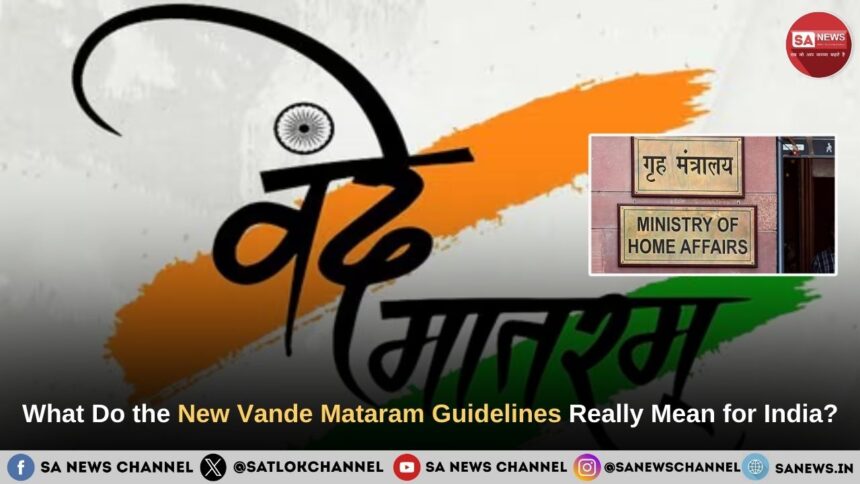
New Vande Mataram Guidelines: The Ministry of Home Affairs has recently issued detailed guidelines on the playback of Vande Mataram, the country’s National Song, enhancing its role and importance in official national ceremonies and functions along with the National Anthem Jana Gana Mana. This move of MHA strengthens the respect for national symbols and standardises the ceremonial practices.
Significance of the National Song “Vande Mataram”
Vande Matram, written by Bankim Chandra Chatterjee in the late 19th century has historically been the strongest symbol of India’s freedom struggle.
During the freedom movement, the song inspired the Indian to fight for the nation and accorded the status of National Song of India.
Referring to the Article 51A of the Indian Constitution and the Prevention of Insults to National Honour Act, 1971 which states that it is the duty of Indian citizens “to abide by the Constitution and respect its ideals and institutions, the National Flag and the National Anthem”. Unlike the National Anthem, Vande Mataram has never had a uniformly accepted protocol until now.
Detailed New MHA Guidelines/ Protocols
The time taken to sing or play the national song is approximately 3 minutes and 10 seconds.
Full Six-Stanza Rendition
As per the new guidelines, the entire six-stanza version of Vande Mataram to be played/ sung at the official functions or ceremonies. Earlier, only the first two stanzas were commonly used, the latter four were omitted in 1937 by the Congress leaders.
The official performance of the Vande Mataram is expected to last approximately 3 minutes and 10 seconds.
Ordered with the National Anthem
The new guidelines mandates that in the event where both Vande Mataram and Jana Gana Mana to be performed, Vande Mataram be played first, followed by the National Anthem.
This protocol will ensure consistency to ceremonial practices.
Standing and Respectful Conduct
The MHA’s issued protocols also specified that like the National Anthem, the audiences must stand at attention when Vande Mataram is sung or played.
Exception: if it is played as a part of a film sequence during a newsreel or documentary.
Official Occasions for Rendering the National Song
As per the list issued by the Ministry of Home Affairs, the official version of Vande Mataram shall be played on the following occasions:
- Ceremonies for civil honours such as the Padma awards.
- At the time of arrival and departure of the President in all occasions and events organised by the Government.
- Before and after the President’s address to the Nation on All India Radio and Doordarshan.
- At the time of arrival and departure of the Governor/ Lieutenant Governor from formal State functions.
- While unfurling the National Flag at cultural events and occasions.
- Other occasions or ceremonies for which the Government of India issues special orders.
Complete Lyrics of Vande Mataram: All Six- Stanzas
Vande Mataram!
Sujalām suphalām malayaja-śītalām,
Śasya-śyāmalām Mātaram!
Vande Mataram!
Śubhra-jyotsnām pulakita-yāminīm,
Phulla-kusumita druma-dala-śobhinim,
Suhāsinīm sumadhura bhāşinim,
Sukhadām varadām Mātaram!
Vande Mataram!
Koți-koţi kaņțha kalakala nināda karāle,
Koți-koți bhujair dhrta kharakaravāle,
Ke bole Mā tumi abale!
Bahubaladhāriņīm namāmi tāriņīm,
Ripudala-vāriņīm Mātaram!
Vande Mataram!
Tumi vidyā, tumi dharma,
Tumi hrdi, tumi marma,
Tvam hi prāņāḥ śarīre!
Bāhute tumi Mā śakti
Hrdaye tumi Mā bhakti,
Tomārai pratima gadi mandire-mandire.
Vande Mataram!
Tvam hi Durgā daśa-praharaņa-dhāriņī,
Kamalā kamala-dala-vihāriņī, Vāņī vidyā-dāyinī,
Namāmi tvām namāmi kamalām,
Amalām atulām,
Sujalām suphalām Mātaram!
Vande Mataram!
Śyāmalām saralām susmitām bhūşitām,
Dharaņim bharaņīm Mātaram!
Vande Mataram!
Vande Mataram Hindi Lyrics
वन्दे मातरम्।
सुजलाम् सुफलाम् मलय़जशीतलाम्,
शस्यश्यामलाम् मातरम्। वन्दे मातरम्।
शुभ्रज्योत्स्ना पुलकितयामिनीम्,
फुल्लकुसुमित द्रुमदलशोभिनीम्,
सुहासिनीम् सुमधुरभाषिणीम्,
सुखदाम् वरदाम् मातरम्। वन्दे मातरम्।
कोटि-कोटि कण्ठ कल-कल निनाद कराले,
कोटि-कोटि भुजैर्धृत खरकरवाले,
के बॉले मां तुमि अबले,
बहुबलधारिणीं नमामि तारिणीम्,
रिपुदलवारिणीं मातरम्। वन्दे मातरम्।
तुमि विद्या तुमि धर्म,
तुमि हृदि तुमि मर्म,
त्वम् हि प्राणाः शरीरे,
बाहुते तुमि मां शक्ति,
हृदये तुमि मां भक्ति,
तोमारेई प्रतिमा गड़ि मन्दिरे-मन्दिरे। वन्दे मातरम् ।
त्वम् हि दुर्गा दशप्रहरणधारिणी,
कमला कमलदलविहारिणी,
वाणी विद्यादायिनी, नमामि त्वाम्,
नमामि कमलाम् अमलाम् अतुलाम्,
सुजलां सुफलां मातरम्। वन्दे मातरम्।
श्यामलाम् सरलाम् सुस्मिताम् भूषिताम्,
धरणीम् भरणीम् मातरम्। वन्दे मातरम्
The Importance of Such Change
For the first time, such comprehensive instructions have been issued for Vande Mataram, signifying the role for the National Song in India’s ceremonial culture.
Supporters argue that the guidelines restores the historic prominence of the National Song and reflects more respect for national symbols.
For Critics, this change is viewed as a potential source of controversy in educational and public systems and has sparked debate about civic expectations.