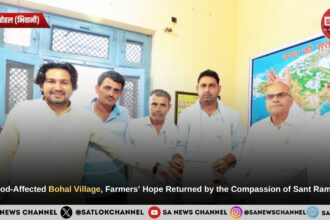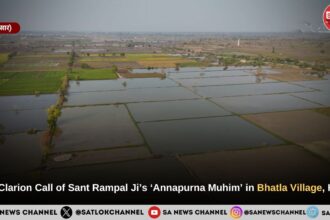


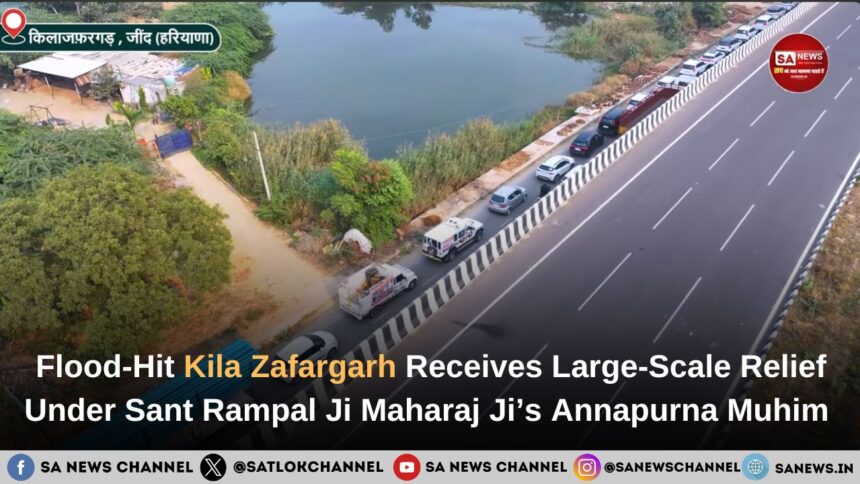
Kila Zafargarh village in Julana tehsil of Haryana’s Jind district has faced severe flooding, leaving 400 to 600 acres of agricultural land submerged and farmers helpless. Villagers reported that repeated approaches to government authorities resulted only in disappointment, as the administration cited a lack of resources. With all official avenues exhausted, the village gram panchayat turned to Tatvdarshi Sant Rampal Ji Maharaj for assistance.
- Villagers Approached With a Formal Prayer
- Key Takeaways: Flood Relief in Kila Zafargarh
- Flood Crisis Leaves Farmers Without Options
- Earlier Relief Work in Hisar and Nearby Villages
- Relief Dispatched Following Sant Rampal Ji Maharaj Ji’s Directive
- Formal Acceptance by Gram Panchayat
- Villagers Compare Response With Government Processes
- Relief Linked to Accountability and Transparency
- Wider Context of Ongoing Flood Relief Efforts
- The Divine Command of Sant Rampal Ji Maharaj Ji
Acting under His direction, large-scale relief reached the village within hours, including extensive pipelines and high-capacity motors, aimed at resolving the long-standing waterlogging crisis and enabling timely crop sowing.
Villagers Approached With a Formal Prayer
After government support failed to materialise, villagers prepared a formal prayer requesting assistance and submitted it through the gram panchayat. The application specifically sought two 10 HP motors and 22,000 feet of 8-inch pipelines to address the persistent flooding. The request was forwarded through the committee and legal representatives. Following the receipt of instructions, the relief material was dispatched without delay to ensure that floodwater could be drained and agricultural activity restored.
Key Takeaways: Flood Relief in Kila Zafargarh
- Kila Zafargarh village in Jind district saw 400–600 acres submerged due to flooding
- Administrative authorities cited lack of resources, leaving villagers without relief
- Gram panchayat submitted a formal prayer seeking assistance
- Relief was provided under Tatvdarshi Sant Rampal Ji Maharaj Ji’s guidance
- 22,000 feet of 8-inch pipelines and two 10 HP motors were delivered
- All accessories, including nuts, bolts, and adhesive materials, were supplied
- The aid was handed over permanently to the village
- More than 400 flood-affected villages have already received similar assistance
- Relief work was carried out without paperwork delays
- Villagers acknowledged the intervention as timely and ground-focused
Flood Crisis Leaves Farmers Without Options
Kila Zafargarh has struggled with waterlogging for several years, with floodwater repeatedly damaging crops and rendering farmland unusable. According to villagers, nearly 400 kilas of land suffered losses annually, while at least 100 acres remained completely unfit for sowing. Schools, dispensaries, and homes were also affected as water entered residential areas. Livestock losses increased due to fodder shortages, further worsening the economic condition of farming families.
Also Read: From Flooded Fields to Renewed Hope: How Sant Rampal Ji Maharaj Changed Adhupur Village’s Fate
Despite repeated appeals to government departments, villagers stated that no effective solution was implemented. Administrative procedures, they said, involved lengthy documentation and repeated visits, often ending without results.
Earlier Relief Work in Hisar and Nearby Villages
Villagers also referred to earlier flood relief work carried out under Sant Rampal Ji Maharaj Ji’s Annapurna Muhim in Hisar, where pipelines were installed, damaged houses were repaired, and medicines were supplied to affected families. They stated that similar assistance had already been provided in two to three villages before reaching Kila Zafargarh, strengthening their confidence in the effectiveness of the intervention.
Relief Dispatched Following Sant Rampal Ji Maharaj Ji’s Directive
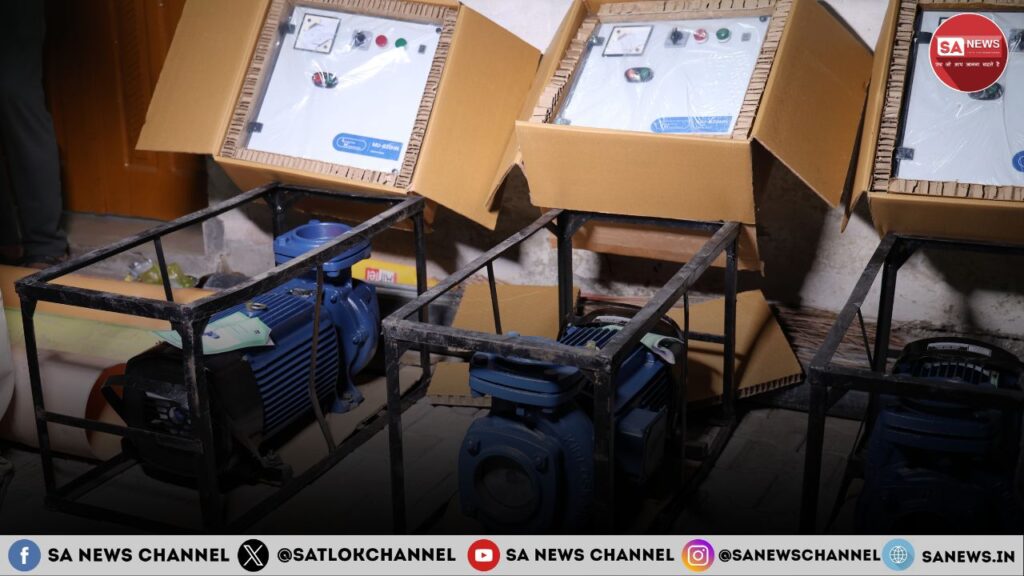
When the gram panchayat placed its request, approval was granted within hours. Trucks carrying relief materials reached Kila Zafargarh soon after. The consignment included:
- 22,000 feet of 8-inch pipelines
- Two motors of 10 horsepower capacity
- Complete installation accessories, including nuts, bolts, and adhesives
Villagers said the scale of the delivery indicated a permanent solution rather than temporary assistance. The pipelines were intended to be installed underground to allow continuous drainage whenever water levels rise.
Formal Acceptance by Gram Panchayat
A written request letter was read aloud in the presence of villagers and handed over to the gram panchayat. The panchayat formally accepted the terms, signed the document, and returned it through the disciples’ sevadars to be placed at the feet of Jagatguru Tatvdarshi Sant Rampal Ji Maharaj Ji.
Panchayat representatives confirmed that all requested materials listed on official letterhead were delivered in full. They stated that even the smallest components required for immediate installation were provided.
Villagers Compare Response With Government Processes
Residents noted that while government procedures often take months for approvals and signatures, the relief reached the village without bureaucratic delays. Several villagers stated that such direct, on-ground execution had not been witnessed before from any religious institution.
According to local farmers, the provided infrastructure would allow at least one full crop cycle to be restored immediately, with the potential to permanently resolve the waterlogging issue.
Relief Linked to Accountability and Transparency
Along with the relief material, villagers were informed of clear conditions. The directive stated that the pipelines and motors must be used effectively to ensure complete drainage of floodwater within the stipulated time. Drone footage of the flooded village had already been recorded, and follow-up videos would document water removal and subsequent crop growth.
These videos are to be displayed during gatherings to demonstrate that donations are utilised responsibly and that relief efforts result in measurable outcomes.
Wider Context of Ongoing Flood Relief Efforts
Villagers were informed that similar assistance has already been extended to more than 400 flood-affected villages. The directive emphasised that the relief work should be carried out without public display and should focus on ground-level results rather than publicity.
The intervention was described by residents as addressing not only agricultural losses but also the broader impact on rural livelihoods, including schooling, healthcare access, and livestock welfare.
The Divine Command of Sant Rampal Ji Maharaj Ji
According to the sacred directive of Tatvdarshi Sant Rampal Ji Maharaj Ji, every village that has received assistance must ensure that the relief materials provided, such as motors and pipelines, are used effectively so that no farmer’s field remains flooded and the next crop can be sown on time. His order clearly states that even if more materials are needed, they should be requested without hesitation, but under no circumstance should water remain stagnant.
Guruji has blessed the villagers, saying that this aid must become a permanent solution for their suffering, a gift from Supreme God Kabir Ji through His grace. He also instructed that if the given resources are not utilized properly and the water is not drained, future assistance will be withheld. Through this divine command, Tatvdarshi Sant Rampal Ji Maharaj Ji has shown that real devotion means timely service, discipline, and accountability towards humanity.