


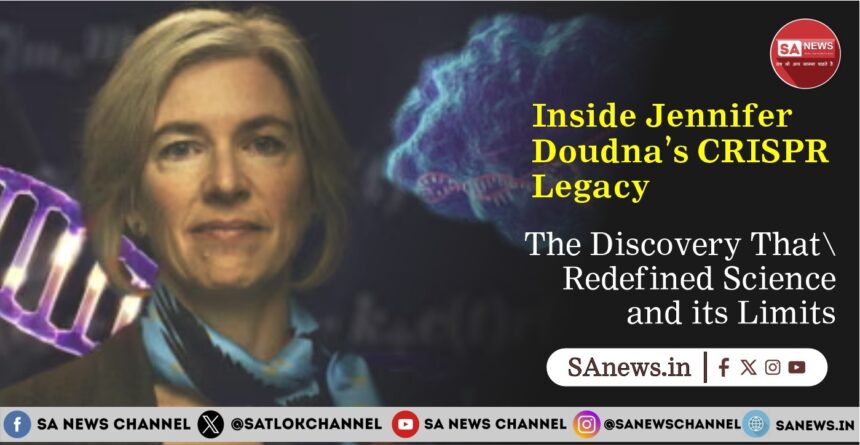
Jennifer Doudna stands today as one of the most influential scientists of the 21st century. Revered for her pioneering work in biochemistry, she co-developed the CRISPR-Cas9 gene-editing system – a breakthrough that many believe has transformed the future of medicine, agriculture, genetics and genome engineering. Her research has placed her at the forefront of global debates on the power and limits of gene editing.
- Who Is Jennifer Doudna?
- Jennifer Doudna’s Childhood in Hawaii
- Jennifer Doudna’s Early Academic Brilliance and Career Choice
- Discovering CRISPR-Cas9: The Jennifer Doudna-Emmanuelle Charpentier Collaboration
- Awards and Recognitions Received by Jennifer Doudna
- What Exactly Is CRISPR-Cas9 and How Did Jennifer Doudna Contribute to It?
- What is CRISPR?
- What is Cas9?
- Doudna’s Core Contribution to CRISPR
- Doudna’s laboratory demonstrations on CRISPR
- Ethical Concerns and Controversies in Gene Editing and Jennifer Doudna’s Overall Ethical Stance on Gene Editing
- The Fear of Human Germline Editing (Heritable DNA Changes)
- The ‘Designer Baby’ Debate
- Inequality in Access to Gene Editing Therapies
- The CRISPR Patent Dispute Surrounding Jennifer Doudna
- The 2018 CRISPR Baby Scandal: A Major Turning Point
- Safety Concerns: Off-Target and Unintended Effects
- Dual-Use Concerns: Could Gene Editing Be Misused?
- Concerns About Commercialisation and Influence
- Public Criticism and the Question of ‘Playing God’
- Gene Editing Cannot Break Karma, But True Worship Can
- FAQs: Biography of Jennifer Doudna
As a central figure in the development of CRISPR technology, Jennifer Doudna’s biography offers profound insight into modern scientific discovery and the ethical questions it raises. This profile explores her life, the CRISPR-Cas9 breakthrough and the major controversies that continue to surround this technological tool.
Who Is Jennifer Doudna?
Jennifer Doudna is an American biochemist best known as one of the pioneering scientists behind CRISPR-Cas9, the revolutionary gene-editing technology that has reshaped modern biology. Her work transformed CRISPR from a bacterial immune mechanism into a powerful tool capable of precisely editing DNA, opening new possibilities in medicine, agriculture and environmental science. In recognition of this achievement, she was awarded the 2020 Nobel Prize in Chemistry, becoming one of the most influential figures in contemporary genetics.
Jennifer Doudna’s Childhood in Hawaii
Jennifer Anne Doudna was born on 19 February 1964 in Washington, D.C., USA. She was raised in an academic household. Her father, Martin Doudna, was a scholar of English literature who taught at the University of Hawai‘i at Hilo. Her mother, Dorothy Jane Doudna, also worked in education, teaching history at a local community college. Their intellectual environment played a quiet but significant role in nurturing her curiosity and love for learning.
The most important influence in her childhood was her father, a literature professor with a passion for ideas. Although he wasn’t a scientist, he encouraged Jennifer’s curiosity in every direction. He left books scattered around the home and pushed her to explore the world intellectually. Jennifer often explained that her father’s approach to learning was open, inquisitive and fearless. This laid the foundation for her scientific thinking.
One formative moment came when she was around 12 years old. Her father placed a book on her bed. It was ‘The Double Helix’ by James Watson, the story of the discovery of DNA’s structure. She initially assumed it was a mistake – why would she want to read a science book, she thought. But once she opened it, she found herself transported into a world she had never imagined – a world where molecules held secrets, where life itself had instructions and where scientists could unlock mysteries hidden in every cell.
This moment didn’t simply prepare her for a career, it ignited the spark in her. She has often said that reading that book made her realise that ‘science was detective work’ and it fascinated her.
Jennifer Doudna’s Early Academic Brilliance and Career Choice
Despite her interest in molecular biology, young Jennifer didn’t enter university with a fixed plan to become a world-changing scientist. She simply followed her curiosity.
She attended Pomona College, where she was majoring in chemistry, finishing it in 1985. Here, she encountered mentors who noticed her unusual discipline, her calm confidence and her love for problem-solving. One of her professors encouraged her to conduct independent research, an opportunity she seized enthusiastically.
This was also the period when she fell in love with RNA (Ribonucleic Acid), the molecule that acts as DNA’s (Dioxyribonucleic Acid) interpreter. Long before CRISPR (Clustered Regularly Interspaced Short Palindromic Repeats) ever entered her life, she was fascinated by how RNA folds itself, how it behaves and how it can catalyse reactions inside cells. This interest became the cornerstone of her scientific journey.
After Pomona, she pursued a PhD at Harvard University, where she trained under Jack Szostak, a prominent molecular biologist. Her doctoral work in 1989 focused on RNA structure and she continued this path during her postdoctoral research at the University of Colorado.
What prompted her to stay in the field of RNA?
Because she saw in RNA something mysterious, elegant and powerful – a molecule that could both carry information and perform actions. This fascination shaped the next two decades of her career and paved the way for the discovery that would change her life.
Discovering CRISPR-Cas9: The Jennifer Doudna-Emmanuelle Charpentier Collaboration
By the early 2000s, Jennifer Doudna was a respected scientist, serving as a professor at the University of California, Berkeley. Her primary focus remained RNA, its shape, its chemistry and its biological functions. She was not searching for a tool to edit DNA. But her search took an unexpected turn.
- Around 2006-2010, microbiologists had been studying a peculiar phenomenon in bacteria that was a strange repeating sequence in their DNA called CRISPR (Clustered Regularly Interspaced Short Palindromic Repeats).
- They didn’t seem to behave like ordinary genes and nobody knew what they meant.
- Eventually, researchers discovered that CRISPR acted like a bacterial immune system, allowing bacteria to “remember” viruses they had encountered.
- This was intriguing enough, but the true turning point came when Doudna met Emmanuelle Charpentier, a French microbiologist.
- The two scientists realised they shared complementary expertise. Charpentier studied the bacterial protein Cas9, while Doudna understood RNA’s structure and function.
- In what science would call a ‘groundbreaking’ collaboration, they discovered that CRISPR-Cas9 could be programmed, meaning scientists could guide the Cas9 protein to cut DNA at any desired location simply by altering a small RNA sequence.
- This is believed to be revolutionary because before CRISPR, gene editing was difficult, slow and imprecise.
- With CRISPR-Cas9, it suddenly became what science believed as simple, cheap, efficient and precise.
- In 2012, they published a paper that changed biology, enabling scientists to edit genes in plants, animals and potentially humans.
The world recognised the importance of this work immediately. It created entire new industries and opened possibilities from curing diseases to developing climate-resilient crops.
Awards and Recognitions Received by Jennifer Doudna
Jennifer Doudna’s scientific contributions have earned her some of the most prestigious honours in modern science, such as:
- Nobel Prize in Chemistry, 2020: Jennifer Doudna, together with Emmanuelle Charpentier, received the Nobel Prize for the development of CRISPR-Cas9 gene-editing technology. This recognition established her as one of the most influential scientists of the 21st century.
- Breakthrough Prize in Life Sciences, 2015: She was awarded the Breakthrough Prize for her role in transforming CRISPR from a bacterial defence mechanism into a scalable, programmable gene-editing tool that can precisely target DNA.
- Kavli Prize in Nanoscience, 2018: This honour acknowledged her contribution to manipulating biological molecules at the nanoscale.
- Japan Prize, 2017: Awarded for significant contributions to science and technology that promote peace and prosperity, the Japan Prize recognised Doudna’s global impact on medical and agricultural innovation.
- L’Oréal-UNESCO For Women in Science Award, 2016: Doudna has been widely recognised for breaking barriers in science and inspiring a new generation of women researchers. This was awarded jointly to Jennifer Doudna and Emmanuelle Charpentier.
- Membership in Elite Scientific Academies: She has been elected to prominent institutions such as The National Academy of Sciences, The American Academy of Arts, and Sciences and The Royal Society.
- The 2026 Priestley Medal awarded by the American Chemical Society (ACS) in August 2025, is one of the recent honours received by Jennifer Doudna.
Also Read: Francis Crick: The Scientist Behind DNA’s Greatest Discovery
What Exactly Is CRISPR-Cas9 and How Did Jennifer Doudna Contribute to It?
Now that we have a fair idea about Jennifer Doudna’s body of work, let us briefly understand what CRISPR-Cas9 exactly is. This will help us uncover some more aspects of Jennifer Doudna’s life.
What is CRISPR?
CRISPR (Clustered Regularly Interspaced Short Palindromic Repeats) is a natural defence system found in bacteria. It allows microbes to identify and destroy viruses by recognising their DNA.
What is Cas9?
Cas9 is an enzyme that acts as the cutting tool. When paired with a guide RNA, it can locate and snip a chosen gene sequence.
Doudna’s Core Contribution to CRISPR
Jennifer Doudna, alongside Emmanuelle Charpentier, made a breakthrough discovery.
They realised that CRISPR and Cas9 could be repurposed as a programmable gene-editing system.
Doudna’s laboratory demonstrations on CRISPR
- CRISPR-Cas9 can target any DNA sequence simply by changing the guide RNA.
- The system works across different organisms, not just bacteria.
- DNA can be edited faster, more accurately and more cheaply than older methods.
Jennifer Doudna’s and Emmanuelle Charpentier’s 2012 paper is considered one of the most influential scientific publications of current times. It is believed to have laid the foundation for gene editing in humans, animals, plants and microorganisms.
Ethical Concerns and Controversies in Gene Editing and Jennifer Doudna’s Overall Ethical Stance on Gene Editing
Though this article is not about Gene Editing or CRISPR-Cas9, it mandates analysing the ethical concerns surrounding Jennifer Doudna’s pioneering subject. It will help us build a perspective on whether Jennifer Doudna’s work is truly pioneering or has it just opened a Pandora’s box.
- Gene editing, especially CRISPR-Cas9, has opened possibilities once considered unimaginable.
- Yet every scientific milestone has also raised serious ethical, moral, social and regulatory questions.
- Though Jennifer Doudna has been at the forefront of these discussions and advocates global responsibility and transparency, ethical concerns remain a grim reality of gene editing.
Below are the key ethical concerns and the major controversies on gene editing that have shaped an ongoing global debate.
The Fear of Human Germline Editing (Heritable DNA Changes)
One of the most sensitive ethical issues is editing the germline, i.e. genes in embryos, sperm or eggs. Changes made here are permanent and pass on to future generations.
Why this is a concern:
- Unknown long-term consequences: Scientists do not yet fully understand the ripple effects of DNA changes across multiple generations.
- Off-target mutations: CRISPR may occasionally cut DNA at unintended locations, creating unpredictable genetic outcomes.
- Consent is impossible: Future generations cannot consent to inheriting edited genes.
- Potential for irreversible changes to human evolution.
Global scientific bodies, including the World Health Organization and the National Academies of Sciences, have recommended extreme caution, with many calling for a moratorium on germline editing until safety and societal consensus improve.
The ‘Designer Baby’ Debate
One of the most widely discussed fears is the possibility of using gene editing for enhancement, not healing.
Concerns include:
- Selecting traits such as height, intelligence, eye colour, athletic ability or personality attributes.
- Reinforcing social inequality, as only wealthy groups may access enhancement technologies.
- Creating a society where children are treated as engineered products.
- Increasing ableism, where natural diversity is undervalued.
Jennifer Doudna has strongly opposed genetic enhancement, stating that CRISPR should be used only to treat serious medical conditions, not create genetically privileged groups. However, whether she has been able to control genetic enhancement is debatable.
Inequality in Access to Gene Editing Therapies
CRISPR-based treatments are expensive and early therapies have cost millions of dollars per patient.
For example: The first CRISPR-based sickle-cell therapy approved in 2023 in some countries is priced extremely high and remains inaccessible in low-income regions where the disease is most common.
This raises ethical questions:
- Who gets life-saving gene therapies?
- Will poorer populations be left behind despite CRISPR’s potential to eliminate diseases that affect them most?
- Should gene editing be treated as a global public good rather than a luxury medical product?
Though Jennifer Doudna has repeatedly emphasised that equitable access must be a priority, it is far from the reality.
The CRISPR Patent Dispute Surrounding Jennifer Doudna
Gene editing is not only a scientific tool but also a high-value commercial technology.
The major patent dispute between the University of California, Berkeley (Doudna’s team) and the Broad Institute of MIT and Harvard became a global controversy. Although Jennifer Doudna is celebrated as one of the key pioneers of CRISPR-Cas9, her journey has also placed her in the middle of a high-stakes commercial dispute that raises a fundamental question: who gets to control a technology powerful enough to edit genes?
- The conflict centres on the ownership of patents governing the use of CRISPR in human and animal cells, applications that carry extraordinary scientific promise and enormous commercial value.
- A major ruling in 2022 granted the Broad Institute priority over these patents in the United States,
- As a result, companies wishing to use the tool for therapeutic purposes are often required to negotiate licences from Broad rather than from Doudna’s academic institutions.
- The case exposed a tension rarely discussed outside scientific circles. Even transformative discoveries that aim to benefit humanity can become entangled in fierce legal battles.
- For many, the situation underscored how competing institutions, financial stakes and intellectual property laws can overshadow collaborative scientific progress.
- It also revealed that even scientists driven by curiosity and public good, such as Doudna, can be drawn into complex money-driven disputes over who ultimately ‘owns’ life-altering biotechnology.
While the legal case focused on technical details of CRISPR discovery timelines, the public debate focused on who should control genetic tools that affect humanity’s future.
The 2018 CRISPR Baby Scandal: A Major Turning Point
One of the most consequential controversies in modern science occurred in 2018, when Chinese scientist He Jiankui announced that he had created the world’s first gene-edited babies, known as Lulu and Nana. He edited the CCR5 gene in embryos in an attempt to make them resistant to HIV.
This was considered outrageous because:
- The experiment was done in secret, without proper ethical oversight.
- The parents were not fully informed of risks.
- The technique was not ready, with high risk of off-target changes.
- The edit was medically unnecessary—HIV can be prevented by safer methods.
- The modified CCR5 gene has known links to higher susceptibility to other diseases.
- The global community condemned the experiment.
- He Jiankui was later sentenced to prison for violating medical regulations.
- Jennifer Doudna’s Response: Doudna called the incident a ‘shocking and deeply disturbing misuse of CRISPR’.
- She used it as a rallying point to call for International guidelines, Stronger ethical frameworks and Transparent research practices
- However, because Jennifer Doudna helped develop the technology, public debates questioned whether CRISPR leaders anticipated such misuse. This is a very important point, considering scientists are deep thinkers with considerably forward-looking searches.
- This placed Doudna in the uncomfortable position of defending the ethical boundaries of her own invention.
This scandal dramatically intensified global regulatory discussions.
Safety Concerns: Off-Target and Unintended Effects
Even with modern improvements, Jennifer Doudna’s pathway with CRISPR is not perfect. Safety concerns include:
- Off-target edits: Unintended changes in DNA
- On-target complications: Correct cuts but unpredictable cellular repair
- Mosaicism: Not all cells are edited uniformly
- Long-term health unknowns
These risks are particularly significant when editing embryos, as even a single harmful mutation could cause a lifetime of consequences.
Dual-Use Concerns: Could Gene Editing Be Misused?
CRISPR is powerful and raises fears about misuse.
Risks include:
- Biological weapons development
- Rogue experiments by unregulated labs
- Unethical genetic modification in competitive environments
- Bioterrorism scenarios where pathogens are engineered for harmful purposes
Concerns About Commercialisation and Influence
Some critics have raised questions about the commercial power of CRISPR companies. Jennifer Doudna co-founded several biotech startups focused on gene-editing applications. Critics worry that:
- Commercial interests may influence academic research
- Gene-editing therapies could become unaffordable
- Patents held by institutions could limit global access
Doudna typically responds by advocating for ethical regulation and global equity, but the interplay between academic science and billion-dollar biotechnology remains a point of debate. Also, can only publicly advocating stop the misuse of this technology?
Public Criticism and the Question of ‘Playing God’
One of the recurring critiques surrounding CRISPR is that gene editing risks crossing a boundary, that it allows humans to ‘interfere with nature’ or step into roles traditionally attributed to God. Although these concerns are not aimed at Jennifer Doudna personally, her pioneering position in CRISPR research often places her at the heart of these conversations.
The story of CRISPR, with its triumphs, uncertainties and imperfections, quietly reflects a deeper truth: no human innovation can rival the precision and harmony crafted by the Divine. Even the most groundbreaking technologies, including those shaped by Jennifer Doudna’s work, remain susceptible to errors and unforeseen consequences. This is a stark reminder that human understanding, however advanced, can only ever be partial.
God’s creation itself is flawless. What we perceive as disorder, disease or imbalance is not a defect in nature, but the manifestation of the soul’s accumulated karma. The true origin of suffering lies not in microbes or mutations, but in the karmic echoes carried across lifetimes. Bacteria and viruses, in this view, are not enemies but instruments through which past actions return to equilibrium. A soul that harmed another being in a previous birth will encounter that harm again through these microscopic carriers, fulfilling a law that operates far beyond the reach of laboratories and scientific tools.
Science can observe, measure and describe these processes, but it does NOT create them. What science ‘discovers’ is merely what has always existed. The real question is: Who created all this? Who created us all?
Technology may soothe the body or prolong life, but it cannot break the law of karma. No laboratory, technique or gene-editing tool can dissolve the soul’s accumulated debts. Only a Tatvdarshi Sant (a Complete Saint), endowed with ultimate spiritual knowledge, possesses the authority to sever karmic bonds. In His refuge, the soul is freed from the endless cycle of cause and effect, receiving a liberation that no scientific achievement can ever offer.
Gene Editing Cannot Break Karma, But True Worship Can
While the world continues to debate, analyse and experiment with new technologies in the hope of defeating disease, a far simpler and far more profound solution has already begun transforming lives – the divine, authentic path revealed by Jagatguru Tatvdarshi Sant Rampal Ji Maharaj.
Sant Rampal Ji Maharaj, the only Complete Enlightened Saint of this era, imparts the true method of worship of Supreme God Kabir, the Eternal Creator of all universes, all souls and every law of nature. He is the sole spiritual teacher who first openly explained that Yajurved Adhyay 8, Mantra 13 declares the unmatched power of Supreme God Kabir, the power to erase even the gravest sins of His devotee.
Because this supreme way of worship cuts through every karmic bondage, disciples of Sant Rampal Ji Maharaj have witnessed miracles beyond imagination, including liberation from diseases long considered incurable, recovery from conditions deemed impossible, and even lives restored from the brink of death. These are not isolated testimonies but emerging patterns of grace experienced by countless.
To truly understand how this divine knowledge uplifts, heals and liberates, one must listen directly to the spiritual discourses of Sant Rampal Ji Maharaj, a path-breaking revelation that frees the soul from sorrow, suffering and the endless cycle of karma. To know more, visit:
- Website: www.jagatgururampalji.org
- YouTube: Sant Rampal Ji Maharaj
- Facebook: Spiritual Leader Saint Rampal Ji
- ‘X’ handle: @SaintRampalJiM
FAQs: Biography of Jennifer Doudna
Q1) Who is Jennifer Doudna?
Answer: Jennifer Doudna is an American biochemist known for co-discovering CRISPR-Cas9 genome editing.
Q2) What companies has Jennifer Doudna founded?
Answer: She has co-founded multiple CRISPR-focused biotechs, including Caribou Biosciences, Mammoth Biosciences, Scribe Therapeutics and Intellia Therapeutics to name a few.