



Everyone reaches a point where quitting feels easier than continuing. Whether it’s career pressure, financial struggles, academic stress, relationship problems, or personal failures – the feeling of wanting to give up is universal.
- Why Do We Feel Like Giving Up?
- The Psychology Behind Motivation
- 10 Powerful Strategies to Stay Motivated When You Feel Like Giving Up
- 1. Reconnect With Your “Why”
- 2. Break Big Goals into Micro Goals (The Kaizen Approach)
- 3. Change Your Environment
- 4. Practice the 5-Minute Rule
- 5. Learn From Failure Stories
- 6. Take Care of Your Physical Health
- 7. Limit Negative News Consumption
- 8. Surround Yourself With Encouraging People
- 9. Celebrate Progress, Not Perfection
- 10. Develop Spiritual Strength
- Building Emotional Resilience in Difficult Times
- The Hidden Cost of Giving Up Too Soon
- The Power of Self-Talk in Motivation
- How Daily Habits Shape Long-Term Motivation
- The Role of Inspiration in Staying Motivated
- How Social Media Affects Motivation
- The Importance of Patience in Achieving Goals
- Success Is Often Slow and Gradual
- Finding Motivation Through Service and Helping Others
- Why Helping Others Boosts Motivation
- Creating a Personal Vision for Your Life
- Motivation Is a Journey, Not a Moment
- A Higher Perspective: Finding Strength Through True worship
- FAQs on How to Stay Motivated
In today’s fast-paced world, where social media shows highlight reels and success stories dominate headlines, it’s easy to feel left behind. However, staying motivated during tough times is not about being constantly positive. It’s about building resilience, emotional strength, and a deeper purpose. This blog explores practical strategies, psychological insights, real-world examples, and spiritual wisdom to help you stay motivated even when life feels overwhelming.
Why Do We Feel Like Giving Up?
Before learning how to stay motivated, it’s important to understand why we lose motivation.
1. Burnout and Mental Fatigue
The World Health Organization officially recognizes burnout as an occupational phenomenon. Constant stress without adequate rest drains emotional and physical energy, making quitting seem like relief.
2. Fear of Failure
Fear activates survival instincts. When we associate failure with shame or rejection, the brain chooses avoidance.
3. Comparison Culture
Social platforms amplify unrealistic standards. Constant comparison damages self-esteem and reduces motivation.
4. Lack of Purpose
Goals without deeper meaning quickly lose momentum.
The Psychology Behind Motivation
Motivation is not just emotion; it’s a system.
According to research from American Psychological Association, sustainable motivation is driven by:
- Clear goals
- Personal meaning
- Incremental progress
- Social support
- Positive reinforcement
Motivation operates in two forms:
- Intrinsic Motivation
Driven by passion, growth, and personal satisfaction.
- Extrinsic Motivation
Driven by rewards, money, recognition, or fear.
The key to long-term resilience is strengthening intrinsic motivation.
10 Powerful Strategies to Stay Motivated When You Feel Like Giving Up
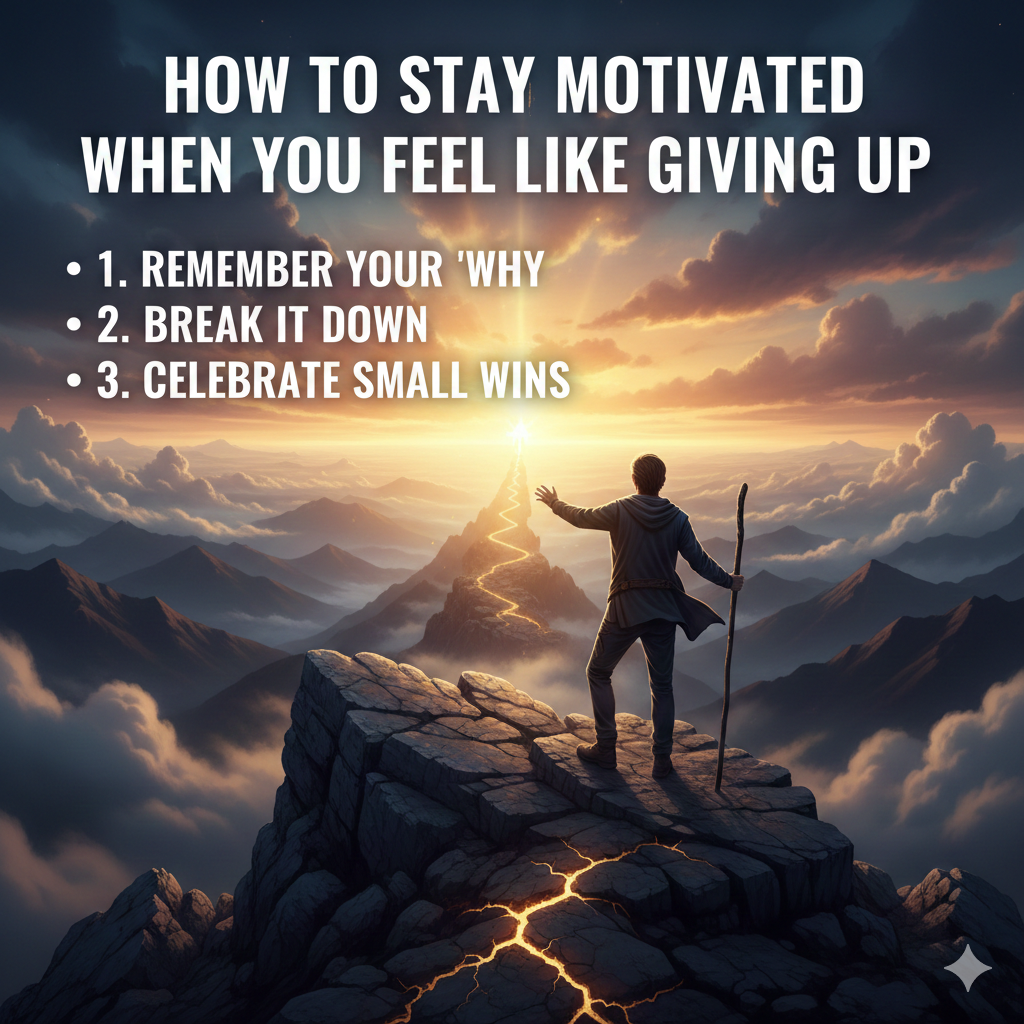
1. Reconnect With Your “Why”
Ask yourself:
- Why did I start?
- What will happen if I quit?
- Who benefits if I succeed?
Purpose fuels persistence.
2. Break Big Goals into Micro Goals (The Kaizen Approach)
Overwhelm kills motivation. Instead of focusing on the mountain, focus on the next step. Small wins create dopamine boosts, reinforcing progress. The Kaizen method, a Japanese philosophy of continuous improvement, suggests focusing on 1% shifts.
3. Change Your Environment
Sometimes you’re not unmotivated – you’re uninspired.
- Rearrange your workspace
- Take a short trip
- Limit negative influences
Environment shapes mindset.
4. Practice the 5-Minute Rule
Tell yourself: “I’ll just do this for five minutes.”
Starting is often the hardest part.
5. Learn From Failure Stories
Consider J.K. Rowling, who faced multiple rejections before publishing Harry Potter. Or Elon Musk, who nearly lost Tesla and SpaceX in 2008.
Failure is feedback – not finality.
6. Take Care of Your Physical Health
Exercise improves mood and reduces anxiety. Nutrition impacts energy. Sleep restores willpower.
A tired body creates a tired mind.
7. Limit Negative News Consumption
While staying informed is important, overexposure to distressing news increases anxiety and hopelessness.
Recent reports from global media like BBC News highlight increasing stress levels worldwide due to economic uncertainty and global conflicts.
Balance awareness with mental protection.
8. Surround Yourself With Encouraging People
Motivation spreads socially. Join supportive communities. Distance yourself from chronic negativity.
9. Celebrate Progress, Not Perfection
Perfectionism delays action. Progress builds
confidence.
10. Develop Spiritual Strength
Mental strength alone sometimes isn’t enough. Many people find deeper resilience through spirituality.
Building Emotional Resilience in Difficult Times
Resilience isn’t built in comfort; it’s forged in adversity.
Reframe the Narrative
Instead of “Why is this happening to me?” ask:
“What is this teaching me?”
Practice Gratitude
Gratitude shifts focus from scarcity to abundance.
Accept Discomfort
Growth requires temporary discomfort.
The Hidden Cost of Giving Up Too Soon
Many people quit not because they lack ability, but because they stop right before progress begins. Success often happens after long periods of invisible effort. When we give up early, we lose the chance to experience the results of persistence.
The “Valley of Disappointment”
Experts in behavioral science often describe a phase where effort feels useless because results are not visible yet. This period is sometimes called the valley of disappointment.
People who push through this stage usually experience sudden growth afterward.
Growth Happens in the Invisible Stage
Just like a seed grows underground before becoming a tree, personal development often happens quietly before becoming visible. Staying motivated means trusting the process even when results are delayed.
The Power of Self-Talk in Motivation
The way you talk to yourself directly affects your motivation levels.
Negative self-talk can create mental barriers, while positive self-talk builds resilience and confidence.
Replace These Thoughts
Instead of saying:
- “I can’t do this.”
- “I always fail.”
- “What’s the point?”
Try saying:
- “I’m learning and improving.”
- “This challenge is temporary.”
- “I will figure this out step by step.”
Over time, this shift in thinking rewires the brain toward optimism and perseverance.
Also Read- Strategies to Build Lasting Self Confidence
How Daily Habits Shape Long-Term Motivation
Motivation is often mistaken for a sudden burst of energy. In reality, it grows from daily habits and consistent routines.
Small habits repeated daily create powerful long-term outcomes.
Build a Simple Motivation Routine
- A basic routine could include:
- Morning reflection or journaling
- Physical activity
- Reviewing daily goals
- Limiting distractions
- Practicing gratitude
These habits create structure, which reduces mental chaos and increases productivity.
The Role of Inspiration in Staying Motivated
Inspiration fuels motivation. When people see others overcome challenges, they begin to believe that success is possible for them as well.
Stories of perseverance remind us that setbacks are part of the journey.
Learn From Real-Life Journeys
Many successful individuals faced repeated failures before achieving success. Their journeys teach an important lesson: persistence often matters more than talent.
Reading biographies, listening to motivational talks, and learning from mentors can reignite lost motivation.
How Social Media Affects Motivation
Social media can be both motivating and discouraging depending on how it is used.
While it can provide inspiration and learning opportunities, excessive comparison can create feelings of inadequacy.
Healthy Social Media Habits
To protect your motivation:
- Follow educational and positive content
- Limit time spent scrolling
- Avoid comparing your journey with others
- Use platforms for learning rather than validation
A balanced digital lifestyle supports mental well-being.
Also Read- Endless Reels Scrolling: Hidden Impact on Mental Health
The Importance of Patience in Achieving Goals
Patience is one of the most underrated aspects of success. Modern culture promotes instant results, but meaningful achievements require time, effort, and persistence.
Success Is Often Slow and Gradual
Great accomplishments rarely happen overnight. They develop through:
- continuous learning
- repeated effort
- resilience during setbacks
Understanding this truth helps maintain motivation during difficult phases.
Finding Motivation Through Service and Helping Others
Helping others can surprisingly increase personal motivation.
When people contribute to society, they experience a sense of purpose and fulfillment.
Why Helping Others Boosts Motivation
Acts of service:
- increase happiness
- strengthen emotional resilience
- create a sense of belonging
- remind us that our actions matter
- Purpose-driven living often leads to stronger motivation than personal success alone.
Creating a Personal Vision for Your Life
Motivation becomes stronger when people have a clear vision of their future.
Without direction, effort feels meaningless. But when goals align with a larger life vision, motivation naturally increases.
Questions to Clarify Your Vision
Ask yourself:
- What kind of life do I want to build?
- What values matter most to me?
- How do I want to contribute to the world?
- What legacy do I want to leave behind?
Answering these questions can provide powerful long-term motivation.
Motivation Is a Journey, Not a Moment
Motivation is not something you find once and keep forever. It is something you nurture daily through mindset, habits, purpose, and spiritual awareness.
Every challenge you face strengthens your ability to move forward.
The key is simple: keep moving, even if the steps are small.
Because sometimes, the moment you feel like giving up is exactly when your breakthrough is about to happen.
A Higher Perspective: Finding Strength Through True worship
When modern psychology reaches its limit, spiritual science begins. In a world where the World Health Organization reports a staggering rise in global anxiety, many find that “positive thinking” is a temporary bandage. For a permanent cure, one must look toward the deeper laws of the universe.
According to the spiritual discourses of Saint Rampal Ji Maharaj, the root cause of our lack of motivation is “Atma-Bal” (Soul-Strength)
Saint Rampal Ji explains that our current struggles-whether financial, physical, or mental-are often the result of past karmic debts.
The Insight: Just as a person cannot run a race with heavy chains, we cannot find motivation when weighed down by negative karmas.
The Solution: True worship (Bhakti) acts as a “cleansing agent” for these deeds, lightening the mental load and allowing natural motivation. The reason we feel like “giving up” is that the soul is tired of the illusions of this world. By connecting with the True Way of Worship (Sat-Bhakti), one gains the “Atma-Bal” (Soul-Strength) that makes worldly hurdles look insignificant
Finally, staying motivated is made easier through the “Way of Living” advocated by Saint Rampal Ji, which emphasizes strict moral conduct as a prerequisite for mental peace. Adhering to a lifestyle free from intoxicants, meat, and dishonesty removes the internal chaos and guilt that often drain our willpower. This moral clarity, combined with the protection of a Living Master, creates a spiritual “shield” against the stresses of modern life. Instead of fighting battles alone, a seeker experiences divine grace that clears paths and provides mental clarity during times of confusion. By aligning our daily actions with these spiritual laws, we don’t just find the motivation to survive-we find the inspiration to thrive and fulfill the ultimate purpose of our existence.
FAQs on How to Stay Motivated
1. How do I stay motivated when I feel like quitting everything?
Break tasks into small steps, reconnect with your purpose, seek support, rest properly, and focus on daily progress rather than long-term pressure.
2. Why do I lose motivation so easily?
Common causes include burnout, fear of failure, lack of clarity, comparison, poor sleep, and stress overload.
3. Can spirituality help improve motivation?
Yes. People find that spiritual understanding provides deeper purpose, emotional balance, and resilience during hard times. One can watch spiritual discourses of Sant Rampal Ji Maharaj.
4. What are quick ways to boost motivation instantly?
Use the 5-minute rule, change your environment, listen to inspiring content, move your body, or talk to someone supportive.