For decades, the dream of designing an aircraft or launching a satellite in India was heavily guarded by one of the world’s most notoriously difficult academic gates: the Joint Entrance Examination (JEE). Millions of students spent their high school years burning the midnight oil, knowing that a single bad day in the exam hall could permanently ground their aerospace ambitions.
- Key Points at a Glance
- The Logic Behind Bypassing the JEE
- Inside the Curriculum: From Screen to Spacecraft
- Career Trajectories: Where Does This Degree Lead?
- The Future of Engineering Education
- Conclusion: Beyond Learning and Material Success Lies the True Purpose of Human Life
- FAQs about IIT Madras Online Aeronautics & Space Tech
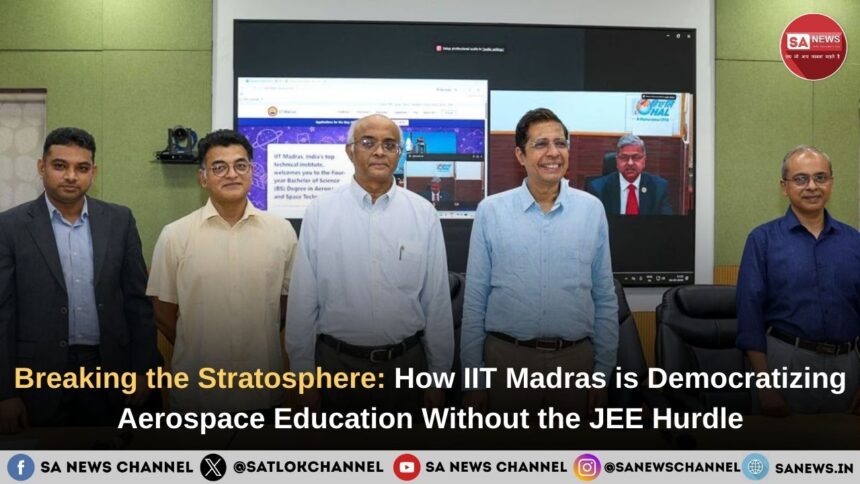
However, a fundamental shift in technical education is unfolding. On February 9, 2026, the Indian Institute of Technology (IIT) Madras dismantled that rigid barrier by launching a fully online Bachelor of Science (BS) in Aeronautics and Space Technology.
The most revolutionary part of this announcement? You do not need a JEE score to get in. By shifting the focus from an elimination-based entrance test to a passion-driven learning model, India’s top technical institute is rewriting the rules of access to elite engineering disciplines.
Key Points at a Glance
- Zero JEE Requirement: Admission bypasses the traditional entrance exam, focusing instead on foundational Class 12 eligibility.
- Ultimate Flexibility: The program is entirely online with self-paced milestones, catering to both fresh high-school graduates and working professionals.
- Rigorous Evaluation: While learning is remote, academic integrity is maintained through Sunday exams featuring a mix of centre-based and proctored testing.
- Hands-on Capstone: Students won’t just study theory; the BS level demands the actual design of an aircraft or spacecraft.
- The “Campus Gateway”: Top-performing online students can earn a chance to transition into on-campus programs or pursue advanced degrees physically at IIT Madras.
The Logic Behind Bypassing the JEE
Why would a premier institute drop its most famous filter? The answer lies in the evolving needs of the global aerospace industry. The traditional examination system is excellent at identifying students who can solve complex physics problems under extreme time pressure. However, innovation in space technology also requires deep, sustained passion, creative problem-solving, and the ability to iterate on failures, traits that a three-hour multiple-choice test cannot always measure.
By removing the JEE mandate, IIT Madras is acknowledging that talent isn’t strictly confined to the top percentile of exam-takers. A student might be an average test-taker but possess a brilliant mind for computational fluid dynamics. This open-door policy ensures that pure interest and dedication become the primary drivers of success in the program.
Inside the Curriculum: From Screen to Spacecraft
Skeptics often question the viability of an “online” engineering degree, especially in a field as hardware-intensive as aeronautics. IIT Madras has countered this by structuring a curriculum that bridges the digital-physical divide.
The pedagogical approach relies on a blend of recorded lectures by seasoned faculty and live, interactive tutorial sessions to clear complex doubts. However, the real substance lies in the project work.
At the diploma level, students dive into industry-standard software. They will work on projects utilizing Finite Element Methods (FEM) and Computational Fluid Dynamics (CFD) , the exact same tools used by engineers at Boeing, Airbus, and ISRO to test stress and aerodynamics.
As learners progress to the final BS level, the theoretical safety nets are removed. They are tasked with a capstone project that requires designing an actual aircraft or spacecraft. This isn’t just a paper exercise; it’s a simulation of real-world aerospace engineering, complete with internship options that provide crucial industry exposure.
Career Trajectories: Where Does This Degree Lead?
The Indian space sector is experiencing an unprecedented boom, heavily fueled by privatization and the rise of deep-tech startups like Skyroot Aerospace and Agnikul Cosmos. The industry is hungry for specialized talent, and traditional physical campuses simply cannot produce enough graduates to meet the demand.
Graduates of this new BS program will find themselves stepping into a highly receptive job market. IIT Madras has explicitly designed the coursework to align with industry expectations. The launch event itself featured representatives from Hindustan Aeronautics Limited (HAL) and the broader civil aviation sector, signaling strong industry validation.
Career paths span across Public Sector Undertakings (PSUs), private aerospace manufacturing, defense startups, and specialized engineering analysis firms. Furthermore, the rigorous mathematical and analytical foundation provided by the curriculum acts as a perfect launchpad for students aiming to clear the Graduate Aptitude Test in Engineering (GATE) or pursue Master’s degrees at the IITs and the Indian Institute of Science (IISc).
The Future of Engineering Education
The launch of the online BS in Aeronautics and Space Technology is more than just a new course announcement; it is a blueprint for the future of higher education in India. It proves that academic rigor and widespread accessibility are not mutually exclusive.
As the program rolls out, it will be closely watched by educational boards globally. If successful, it could prompt other elite institutions to decouple their specialized programs from high-stress entrance exams, finally allowing the focus to shift from “cracking the test” to actually mastering the science.
For the young student looking up at the night sky, the message from Chennai is clear: the launchpad is ready, and the gates are finally open.
Conclusion: Beyond Learning and Material Success Lies the True Purpose of Human Life
Globally renowned Chyren Saint Rampal Ji Maharaj’s spiritual knowledge draws attention to a far deeper truth, that education and achievements alone are not the ultimate goal of human life. According to spiritual wisdom, this rare human birth is attained after passing through the cycle of 84 lakh life forms (yonis), making it extremely precious and purposeful. Wasting it solely in material pursuits, without understanding its true aim, is considered a great loss.
Sant Rampal Ji Maharaj teaches that along with worldly education and professional growth, a human being must strive for the ultimate objective of life: salvation (moksha). He explains that true knowledge is that which liberates the soul from the cycle of birth and death, not just knowledge that brings temporary comfort, status, or success. In this context, disciplined learning, focus, and awareness should be used not only for exams or careers, but also to understand spiritual truth.
Sant Rampal Ji Maharaj is the only spiritual leader imparting complete and authentic spiritual knowledge based on scriptures, showing the correct path to salvation. Therefore, while smart learning helps manage material life efficiently, true spiritual knowledge gives meaning to life itself. A balanced life is one where material progress goes hand in hand with the pursuit of eternal liberation.
FAQs about IIT Madras Online Aeronautics & Space Tech
1. Do I need a JEE score to apply for the IIT Madras online Aeronautics BS?
No. The program does not require a JEE score. Any student who has completed their Class 12 (or equivalent) examination is eligible to apply for the course.
2. Is the IIT Madras Aeronautics BS degree fully online?
Yes, the learning modules, recorded lectures, and live tutorials are conducted entirely online. However, the examinations are held on Sundays and involve a combination of centre-based tests and online proctored assessments.
3. What kind of practical work is included in this online aerospace degree?
Students will engage in heavy project work using industry-standard tools like Computational Fluid Dynamics (CFD) and Finite Element Methods (FEM). The final BS level includes a capstone project focused on designing an actual aircraft or spacecraft.
4. Can online BS students eventually study on the physical IIT Madras campus?
Yes. According to the institute, top-performing students in the online program may be considered for on-campus programs or advanced degrees at IIT Madras based on their academic excellence.
5. What are the career prospects after completing this program?
Graduates can pursue careers in Public Sector Undertakings (PSUs), private aerospace companies, civil aviation, and deep-tech startups. The curriculum also thoroughly prepares students for the GATE exam and higher studies at institutions like IISc.