

Every day, the Sun sends an enormous amount of energy toward Earth. In fact, the sunlight that reaches our planet in just one hour contains more energy than the entire world consumes in a year. For centuries, humans relied on sunlight mainly for warmth, agriculture, and natural light. Today, technological progress has enabled us to transform this natural resource into electricity through solar panels.
- The Basic Structure of a Solar Panel
- 3. The Photovoltaic Effect: The Heart of Solar Power
- 4. The Role of Silicon and Electric Fields
- 5. From Direct Current to Usable Electricity
- 6. Efficiency and Factors That Affect Solar Power Generation
- 7. The Environmental Benefits of Solar Energy
- 8. The Future of Solar Power
- Looking Ahead: The Promise of Solar Power
- Spiritual Perspective:Harness the Light of Wisdom Through the Sant Rampal Ji Maharaj App
- FAQs based on “How Does a Solar Panel Generate Electricity?”
Solar energy has become one of the fastest-growing renewable energy sources. Governments, businesses, and households are increasingly adopting solar power because it is clean, sustainable, and abundant. Unlike fossil fuels such as coal or oil, solar energy does not produce harmful emissions during electricity generation.
But how exactly does a solar panel convert sunlight into usable electricity? The process may appear simple from the outside, panels placed on rooftops quietly producing power, but inside these panels lies an impressive combination of physics, materials science, and engineering.
Understanding how solar panels work not only helps people appreciate renewable energy technology but also highlights humanity’s growing ability to use nature’s resources responsibly.
The Basic Structure of a Solar Panel
A solar panel is made up of multiple smaller units called solar cells, also known as photovoltaic (PV) cells. These cells are the true power generators inside the panel.
Most solar panels contain dozens of photovoltaic cells arranged in a grid pattern. These cells are typically made from silicon, a material widely used in the electronics industry because of its ability to conduct electricity under certain conditions.
A typical solar panel includes several layers:
- Glass layer – protects the cells from weather and damage
- Encapsulation layer – holds the cells in place and prevents moisture from entering
- Solar cells – where electricity is generated
- Backsheet – provides insulation and structural support
- Metal frame – gives the panel strength and allows mounting on roofs or structures
Each solar cell is extremely thin but carefully engineered. When sunlight strikes these cells, they initiate the process that ultimately produces electric current.
While a single solar cell generates only a small amount of electricity, combining many cells together allows solar panels to produce useful levels of power.
3. The Photovoltaic Effect: The Heart of Solar Power
The fundamental scientific principle behind solar panels is called the photovoltaic effect. This phenomenon describes how certain materials produce electricity when exposed to light.
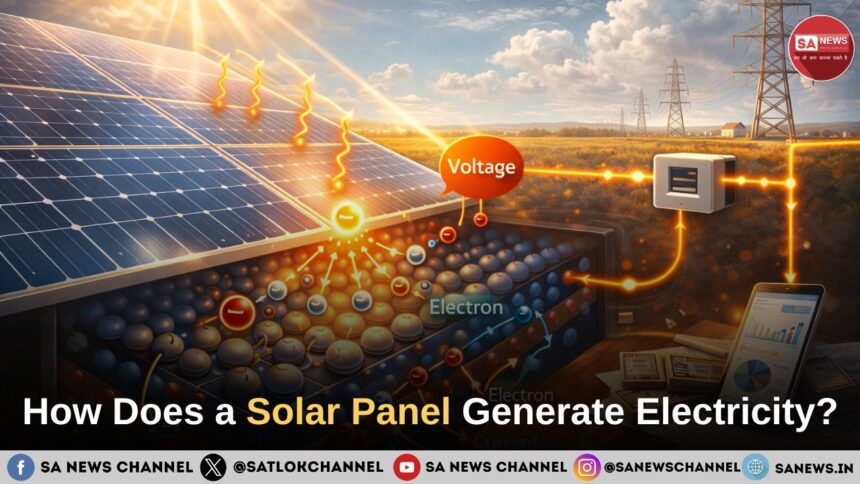
When sunlight hits a solar cell, it carries packets of energy called photons. These photons interact with the atoms inside the silicon material.
Silicon atoms contain electrons that normally remain bound within the material’s structure. When photons from sunlight strike the silicon surface, their energy can knock these electrons free from their positions. Once freed, the electrons begin to move.
However, random electron movement alone would not produce usable electricity. To generate electrical power, the solar cell must guide these electrons in a specific direction. This is achieved through a carefully designed internal structure within the silicon layers.
The photovoltaic effect is therefore the key mechanism that allows sunlight to become electric energy.
4. The Role of Silicon and Electric Fields
Silicon plays a central role in solar panel technology because it can be engineered to create an electric field inside the solar cell.
This is achieved through a process called doping, where small amounts of other elements are added to the silicon.
Two types of silicon layers are created:
- N-type silicon – contains extra electrons
- P-type silicon – contains spaces called “holes” where electrons can move
When these two layers are placed together, they form a p-n junction, a boundary that creates an internal electric field.
When sunlight frees electrons inside the solar cell, this electric field pushes the electrons in a specific direction. The electrons begin to flow toward metal contacts placed on the surface of the cell.
This controlled movement of electrons forms an electric current, which is the same type of electricity used to power lights, appliances, and electronic devices.
Thus, the combination of sunlight, silicon, and the internal electric field allows solar panels to transform light energy into electrical energy.
5. From Direct Current to Usable Electricity
The electricity generated by solar panels is known as direct current (DC). In DC electricity, electrons flow in one continuous direction.
However, most homes and electrical grids use alternating current (AC), where the flow of electricity periodically changes direction.
To make solar electricity compatible with household systems, an important device called an inverter is used. The inverter converts DC electricity produced by the solar panels into AC electricity that can power everyday appliances.
The process works as follows:
- Solar panels capture sunlight and generate DC electricity.
- The electricity flows through wiring into the inverter.
- The inverter converts DC into AC power.
- The AC electricity is then used in homes or supplied to the grid.
Many modern solar systems also include monitoring systems that allow users to track how much electricity their panels produce each day.
Through this combination of solar panels and inverters, sunlight is transformed into reliable electrical power that can support homes, businesses, and communities.
6. Efficiency and Factors That Affect Solar Power Generation
Solar panels do not convert all sunlight into electricity. Their ability to convert sunlight into usable power is called efficiency.
Most modern solar panels have efficiencies ranging from 15% to 23%, meaning only a portion of the sunlight striking the panel becomes electricity. The rest is reflected or converted into heat.
Several factors influence how much electricity a solar panel can generate:
Sunlight Intensity
Panels produce more electricity under strong sunlight. Cloudy weather reduces output but does not stop generation completely.
Angle and Orientation
Solar panels work best when positioned to face the Sun directly. In many regions, panels are tilted to capture the maximum amount of sunlight throughout the year.
Temperature
Surprisingly, extremely high temperatures can reduce solar panel efficiency slightly.
Cleanliness
Dust, dirt, and bird droppings can block sunlight from reaching the cells, lowering electricity production.
Shading
Even partial shade from trees, buildings, or poles can reduce panel output significantly.
By optimizing installation conditions, solar systems can produce electricity more efficiently and reliably.
7. The Environmental Benefits of Solar Energy
One of the main reasons solar energy is gaining global attention is its environmental advantage.
Traditional electricity generation often depends on fossil fuels such as coal, oil, and natural gas. Burning these fuels releases carbon dioxide and other pollutants into the atmosphere, contributing to climate change and air pollution.
Solar panels, on the other hand, generate electricity without combustion. Once installed, they produce energy without emitting greenhouse gases.
Key environmental benefits include:
- Reduced carbon emissions
- Lower air pollution
- Decreased dependence on fossil fuels
- Sustainable long-term energy production
Solar panels also require relatively little maintenance and can operate for 25 to 30 years or more.
As technology continues to improve, solar energy is becoming more affordable and accessible, making it an important part of the global transition toward cleaner energy systems.
8. The Future of Solar Power
Solar technology continues to evolve rapidly. Researchers and engineers are exploring new materials and designs that can increase efficiency and reduce production costs.
Some promising developments include:
Perovskite Solar Cells
These new materials may allow cheaper and more efficient solar panels in the future.
Flexible Solar Panels
Thin and lightweight panels could be integrated into clothing, vehicles, and building materials.
Solar Storage Systems
Battery technology is improving, allowing homes to store solar energy for use during the night or cloudy periods.
Solar Integration in Cities
Solar panels are increasingly being incorporated into building designs, windows, and infrastructure.
As innovation continues, solar energy may become one of the dominant sources of electricity worldwide.
Looking Ahead: The Promise of Solar Power
Solar panels demonstrate how human ingenuity can transform a natural resource into practical energy for everyday life. By capturing sunlight and converting it into electricity through the photovoltaic effect, solar technology provides a clean and sustainable power source.
Beyond the engineering behind solar panels lies a deeper reflection. The Sun has supported life on Earth since the beginning, and learning to harness its energy responsibly represents an important step toward a more balanced relationship with nature.
As societies continue to search for sustainable solutions to growing energy demands, solar power offers a promising path forward, one that relies not on finite resources but on the endless light of the Sun.
Spiritual Perspective:Harness the Light of Wisdom Through the Sant Rampal Ji Maharaj App
According to the true spiritual knowledge explained by Chyren Sant Rampal Ji Maharaj, the visible universe is temporary and operates under the laws of birth, aging, and destruction. The Sun, planets, and natural forces that sustain life on Earth are part of this material system. While humans admire the power of nature and develop technologies to harness energy from sources like sunlight, the deeper purpose of human life goes far beyond material advancement.
Sant Rampal Ji Maharaj explains through the evidence of sacred scriptures that beyond this temporary universe exists the eternal divine realm called Satlok. Satlok is the immortal abode of the Supreme God where there is no sorrow, disease, fear, or death. Unlike the physical world, everything in Satlok is everlasting and filled with divine harmony.
Satlok is described as a self-illuminating realm, meaning it shines with its own natural divine light and does not depend on the Sun, moon, or any external source of illumination. The entire environment remains radiant, peaceful, and eternally beautiful. The land there is said to be more magnificent than anything seen in the material universe, and divine trees provide every pure necessity of the souls living there.
Sant Rampal Ji Maharaj teaches that human birth is extremely precious among the countless life forms in creation. It is granted so that a soul can obtain true spiritual knowledge from a Tatvadarshi Saint, recognize the identity of the Supreme God, and practice the correct method of devotion. By following the path of true worship, a soul can become free from the cycle of birth and death and return to Satlok, its original and eternal home.
Thus, while humanity continues to explore the wonders of nature and develop new technologies, the ultimate success of life lies in spiritual awakening and attaining the everlasting peace and divine beauty of Satlok.
To understand this divine knowledge more deeply, readers are encouraged to study the sacred book Gyan Ganga, which explains the true spiritual wisdom based on authentic scriptures. This book reveals the identity of the Supreme God, the purpose of human life, and the correct method of worship that leads the soul toward liberation.
You can easily read this valuable spiritual text by downloading the Sant Rampal Ji Maharaj App, where the Gyan Ganga book is available as a free PDF along with many other spiritual resources. Exploring this knowledge can help seekers understand the deeper truth of life and the path to attaining the eternal abode, Satlok.
FAQs based on “How Does a Solar Panel Generate Electricity?”
1. How does a solar panel generate electricity from sunlight?
A solar panel generates electricity through the photovoltaic effect. When sunlight strikes the solar cells inside the panel, particles of light called photons transfer energy to electrons in the silicon material. These energized electrons begin to move, creating an electric current. This current is captured by the panel’s wiring and then converted into usable electricity.
2. What materials are used to make solar panels?
Most solar panels are made from silicon-based photovoltaic cells. Silicon is a semiconductor that allows electrons to move when exposed to sunlight. A solar panel also contains protective glass, metal frames, electrical wiring, and insulating layers that help protect the cells and improve durability.
3. Can solar panels generate electricity on cloudy days?
Yes, solar panels can still generate electricity on cloudy days, although their efficiency is lower compared to bright sunny conditions. Even when clouds reduce sunlight intensity, enough light reaches the panels to produce some electricity. However, energy output is usually higher on clear and sunny days.
4. Why is an inverter necessary in a solar power system?
Solar panels produce direct current (DC) electricity, but most homes and appliances operate using alternating current (AC). An inverter converts the DC electricity produced by solar panels into AC electricity so it can be used safely in homes or supplied to the electrical grid.
5. How long do solar panels typically last?
Most modern solar panels are designed to last 25 to 30 years or even longer. Over time, their efficiency may gradually decrease, but they can continue producing electricity for many years. Proper installation and occasional maintenance help ensure long-term performance.