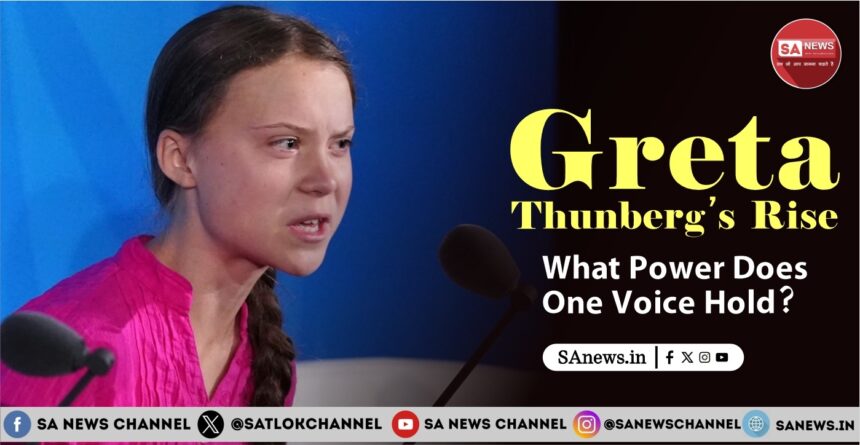
‘How dare you?’ Is probably the line that defines Greta Thunberg the most. One of the most recognised climate activists of the 21st century, Greta is a young woman whose voice has echoed through parliaments, global summits, classrooms and living rooms around the world. This comprehensive article explores Greta Thunberg’s life story and rise to global influence, activism and impact, and the ongoing debate around whether speaking up can truly change a world that appears to be sliding deeper into an environmental crisis.
- The Making of Greta Thunberg as an Advocate of Climate in Her Childhood
- Greta’s Childhood in Stockholm
- Discovering Climate Change in School
- Greta Thunberg’s Struggles with Mental Health and Neurodiversity
- Becoming Vegan and Reducing Her Carbon Footprint
- Greta’s Rise to Fame and The Global Movement She Started
- The First School Strike
- The Birth of Greta Thunberg’s Fridays for Future
- Greta Thunberg’s Viral Speeches and Global Recognition
- Greta Thunberg’s No-Flight Travel and Low-Carbon Journeys
- Greta Thunberg’s Activism and Core Messages
- Greta Thunberg’s Signature Speeches: Moments That Shocked the World
- ‘Our House is on Fire’: World Economic Forum, Davos (2019)
- ‘How Dare You?’: UN Climate Action Summit, New York (2019)
- A Demand for Real Action: COP25 Speech, Madrid (2019)
- The Science-First Message: European Parliament, Brussels (2020)
- ‘Performative Activism’ by Greta Thunberg?
- Controversies and Criticism: The Other Side of Greta Thunberg
- The Real Question: Does Greta Actually Make an Impact?
- The Case for Greta Thunberg’s Impact
- The Counter-View for Greta’s Impact: Why Speech Alone May Not Be Enough
- What If Climate Change Isn’t Our Biggest Problem?
- Human Life’s Real Mission
- FAQs
The Making of Greta Thunberg as an Advocate of Climate in Her Childhood
Greta Thunberg’s tryst to fame came in very early during her childhood when she was just 15 years old. What catapulted Greta into the public eye? Let’s uncover the foundations of her passion for speaking about climate change.
Greta’s Childhood in Stockholm
Greta Tintin Eleonora Ernman Thunberg, known to the world as Greta Thunberg, was born on 3rd January 2003 in Stockholm, Sweden. Her family is deeply rooted in the arts. Her mother, Malena Ernman, is an internationally acclaimed opera singer, whereas her father, Svante Thunberg, is an actor and producer. Greta grew up in a culturally rich household where creativity, expression and public engagement were normal parts of life.
Despite this artistic background, Greta’s interests took a different direction entirely. From an early age, she demonstrated a sharp awareness of the natural world and a tendency to question why adults appeared comfortable ignoring environmental degradation.
Discovering Climate Change in School
Greta Thunberg first learned about climate change at school at the age of eight. Unlike many children, she did not simply forget the lesson. She felt a profound emotional response of confusion, fear and a sense of injustice. Greta later described this moment as a ‘turning point’, realising that the greatest threat to humanity, rapid changes in climate, was being treated as a minor issue.
At this juncture, it is important for readers to pause and reflect whether climate change really is the ‘greatest threat to humanity’. We will circle back to this topic later in this article.
Greta Thunberg’s reaction was not just sadness but urgency. She asked the adults around her several questions such as: Why are we not acting? Why are we pretending everything is normal? Why are governments not following scientists?
The absence of answers troubled her deeply, as per her interviews.
Greta Thunberg’s Struggles with Mental Health and Neurodiversity
Greta Thunberg has been open about her diagnoses of Asperger’s syndrome (now part of Autism Spectrum Disorder), OCD and selective mutism. She often emphasises that being neurodivergent is not a weakness, but a ‘superpower’ that allows her to see issues clearly and speak without compromise, as has been stated by her in multiple interviews.
Becoming Vegan and Reducing Her Carbon Footprint
Motivated by sincerity rather than symbolism, Greta transformed her lifestyle as a child. She gave up meat and dairy. She refused to fly in planes and she encouraged her family to reduce their emissions
Her mother famously gave up international opera tours. It was a bold decision that attracted global attention.
This lifestyle shift reinforced Greta’s credibility that she practised exactly what she preached, long before she became a public figure.
Greta’s Rise to Fame and The Global Movement She Started
Here, we will track how Greta Thunberg turned into a public figure.
The First School Strike
In August 2018, at just 15 years old, Greta Thunberg sat alone outside the Swedish Parliament with a hand-painted sign reading ‘Skolstrejk för klimatet’ (School Strike for Climate).
She skipped school to demand stronger climate policies from the Swedish government. At first, people walked past her with curiosity or confusion. By the second week, journalists began to notice. By the third week, students across Sweden joined her.
What began as a solitary protest soon ignited a global movement. This brought Greta Thunberg into the media spotlight.
It is important to note here that at this point, the world has already begun to feel the climate crisis. Worldwide several protests erupted. 2018 is also the year when the United Nations (UN) and the World Health Organization (WHO) reframed the climate crisis as a human crisis.
The Birth of Greta Thunberg’s Fridays for Future
Driven by a desire to force real political action on climate change, Greta Thunberg decided to take a bold step. In the lead-up to Sweden’s national election in September 2018, she stopped attending school and positioned herself outside the Swedish parliament for nearly three weeks. Holding a simple hand-painted sign reading ‘Skolstrejk för Klimatet’ (School Strike for Climate), she protested alone on the very first day. Initially, she protested alone. Slowly, the media became intrigued by a fifteen-year-old’s persistence.
Also Read: Biography of Samuel Morse: The Visionary Behind the Telegraph Revolution
Each day, more supporters gathered beside her and her message began to spread across Sweden and beyond.
Once the elections were over, Greta returned to her classroom, yet she continued her protest by refusing to attend school on Fridays. These weekly demonstrations soon became known as ‘Fridays for Future’. Her actions struck a chord with young people worldwide. Within months, students from countries including the United States, the United Kingdom, and European countries such as Finland, Denmark, France, the Netherlands and Belgium were organising their own climate strikes, echoing Greta Thunberg’s call for urgent environmental responsibility. What began as a solitary sit-in outside parliament evolved into a global youth-led movement demanding climate justice.
Greta Thunberg’s Viral Speeches and Global Recognition
Greta’s speeches at the UN, the European Parliament, and various climate summits went viral. Her emotional address in 2019 of ‘How dare you?’ became one of the most watched climate speeches in history.
She won numerous awards and was nominated multiple times for the Nobel Peace Prize.
Greta Thunberg’s No-Flight Travel and Low-Carbon Journeys
Greta Thunberg is widely recognised for her strong stance against aviation because of its significant carbon emissions. She has avoided flying since 2015, encouraging others to rethink high-carbon travel and adopt more sustainable choices.
- To remain true to her climate activism, Greta uses environmentally friendly transport whenever possible.
- She travels mainly by train across Europe, choosing rail because it has a much smaller environmental impact.
- For longer, intercontinental trips, Greta relies on emission-free sea travel.
- In 2019, she crossed the Atlantic Ocean twice on zero-carbon sailing vessels to attend major climate conferences in New York and Madrid, demonstrating that sustainable travel alternatives are achievable with commitment and planning.
- Greta Thunberg was detained by Israeli authorities after a Gaza-bound flotilla was intercepted in June 2025, and on 10 June 2025 she was deported from Israel aboard a flight to France. She had to take the flight not out of choice though.
The Debate Around Her Travel Choices
Thunberg’s refusal to fly has been widely praised as a rare example of moral consistency. Supporters see her choices as proof that she is willing to make personal sacrifices for the planet. They argue that she is not merely demanding change from others by demonstrating how change can begin.
However, her stance also sparks criticism. Some say her transport alternatives such as racing yachts are only available to a privileged few, making them unrealistic for the general public. Others point out that support crews sometimes travel by air, questioning the true carbon savings of such voyages. Critics also argue that global climate progress depends on policy and system-wide reforms, not individual lifestyle decisions, no matter how admirable.
Greta Thunberg’s Activism and Core Messages
Greta’s activism is grounded in several core principles. Enumerating some key principles here:
‘Listen to the Scientists’
Greta Thunberg consistently states that climate change is not a political issue but a scientific reality. Her demands are based on the IPCC reports, carbon budget calculations and global warming projections.
Greta insists on following science.
Climate Justice
Greta argues that climate change disproportionately affects the Global South, indigenous communities, vulnerable groups and future generations.
She exposes the injustice of wealthy nations contributing most to the crisis while suffering least.
Accountability Over Applause
Greta famously rejects awards and praise, stating that symbolic gestures are meaningless without real action. In the event she accepted certain awards, she publicly donated the prize money. Greta emphasises policy change, emission cuts and structural reforms
Her message is that climate action is not about inspiration; it is about responsibility.
Greta Thunberg’s Signature Speeches: Moments That Shocked the World
Greta Thunberg’s rise from a lone protester in Stockholm to a globally recognised climate activist was propelled not only by her school strikes but by the extraordinary power of her speeches. With a tone that blends urgency, moral clarity and scientific accuracy, her words repeatedly went viral, capturing the attention of political leaders, media and millions of young people.
Lets now see how the words of the young Greta shocked the world as they were from a child rather than a seasoned climate activist.
‘Our House is on Fire’: World Economic Forum, Davos (2019)
When Greta addressed leaders at the World Economic Forum, she delivered a stark warning that became one of her most quoted lines.
- “I want you to act as if our house is on fire. Because it is.”
- Standing before some of the world’s most influential figures, Greta accused decision-makers of prioritising profit over the planet’s future.
- Her directness unsettled many but marked a turning point. She was no longer just a teenager with a sign; she was a voice political elites could not ignore.
‘How Dare You?’: UN Climate Action Summit, New York (2019)
Perhaps the speech that cemented her climate iconic status, Greta confronted global leaders with an emotional question.
- “How dare you steal my dreams and my childhood with your empty words?”
- Greta criticised empty climate promises and insisted that the younger generation refused to bear the consequences of political inaction.
- The speech spread worldwide within hours, making headlines, sparking debates and even becoming an Internet meme.
A Demand for Real Action: COP25 Speech, Madrid (2019)
At the UN’s COP25 conference, Greta rejected vague targets and feel-good environmental slogans.
- “We don’t need more distant dates. We need real action today.”
- She attacked global leaders for celebrating minimal progress while carbon emissions kept rising.
- Greta’s speech urged governments to stop using carbon offsetting and distant net-zero promises as an excuse for delay.
The Science-First Message: European Parliament, Brussels (2020)
Addressing EU lawmakers, Greta shifted focus back to data.
- Her message was to listen to the scientists.
- She emphasised that the climate emergency is not political, it’s rooted in evidence.
- Greta reiterated that if the goals of the Paris Agreement were taken seriously, the world would already be in drastic emissions-cutting mode. The speech won respect from policymakers and reinforced her reputation as a messenger for scientific truth.
‘Performative Activism’ by Greta Thunberg?
Greta’s bold speeches also fuelled criticism. Some commentators accused her of oversimplifying complex issues or being a ‘performer’ backed by political groups and environmental organisations.
Supporters, however, argue that speeches are a tool, not the solution itself. They also argue that raising awareness and pressuring lawmakers are crucial steps in any global movement.
We will further analyse the criticism surrounding Greta Thunberg.
Controversies and Criticism: The Other Side of Greta Thunberg
Despite her influence, Greta remains a polarising figure. Some of the major criticisms include:
- Accusations of Being a Paid Artiste: A common conspiracy theory claims Greta is controlled by political lobbies, green-energy companies, NGOs and elite foundations
- So far, no evidence has been found to support these claims. Her family maintains that they funded her early activism independently.
- They also said she does not receive payment for her speeches she refuses corporate sponsorship
However, the perception of being ‘managed’ persists due to media attention and coordinated climate marches.
- Being Too Confrontational: Critics argue Greta’s speeches are accusatory, emotional and oversimplified
- Being Used Symbolically: Some argue she has become a symbolic token at climate summits, a public relations tool for politicians and more like a media figure rather than a driver of policy
- They claim global leaders praise her publicly but make little real change.
- Lack of Policy Expertise: Critics say Greta is not a policymaker, scientist or economist, which limits her ability to propose implementable solutions.
The Real Question: Does Greta Actually Make an Impact?
With climate disasters increasing, emissions rising and global politics moving slowly, many wonder if Greta’s influence matters at all.
Here is a two-part analysis with the argument for her impact and the counter-view.
The Case for Greta Thunberg’s Impact
Supporters believe Greta Thunberg changed Global Awareness in the following ways.
- Before Greta, climate change was often treated as a distant threat, a scientific issue or a political discussion
- Greta brought it into everyday conversation, youth culture, social movements and global media coverage.
- This shift matters because awareness precedes political change.
- The Fridays for Future movement pressured governments, influenced elections and increased climate education in schools, while encouraging youth engagement.
- Greta’s presence at the UN climate summits, European Parliament and COP meetings created pressure that institutions could not ignore.
The Counter-View for Greta’s Impact: Why Speech Alone May Not Be Enough
Critics often point to the fact that Greta’s speeches have not really materialised into something concrete for the climate.
- Fossil Fuel Systems Remain Dominant: Despite Greta’s influence, oil exploration continues, coal plants are still expanding, and therefore, global emissions are rising overall.
- The world’s energy systems change slowly and require massive investment.
- Governments often avoid bold climate policies and prioritise short-term economic gains. They bow to industrial pressures
- No activist, no matter how influential, can override national interests.
- While protests create visibility, they do not guarantee concrete results like legislative change, binding treaties and enforceable regulations
- Greta’s critics argue that awareness without action is insufficient.
What If Climate Change Isn’t Our Biggest Problem?
It is now time to confront a deeper and more uncomfortable question: What is the true ‘greatest threat to humanity’? Greta Thunberg and countless other climate advocates warn that climate change is our most dangerous enemy. But is it really the ultimate threat?
The phrase ‘greatest threat to humanity’ goes far beyond melting ice caps and rising temperatures. It points to an unsettling truth about human existence – a truth most people never stop to consider.
Jagatguru Tatvdarshi Sant Rampal Ji Maharaj discloses that humanity’s greatest danger is not environmental collapse, but the ignorance of the real purpose of human life. Science can measure carbon emissions, predict temperature rises and sound alarms about planet-wide crises. But it cannot show us how rapidly our own lifetimes are slipping away without fulfilling the very reason we were born.
Only a true Tatvdarshi Sant has the spiritual authority to reveal the genuine threat that has shadowed humanity since the beginning, and continues to defeat us every single day.
Climate leaders like Greta Thunberg are driven by noble intentions. They want a safer, healthier planet for future generations. But here lies a profound irony – the world they are fighting to protect is not destined to last. Saint Garibdas Ji Maharaj from Haryana has stated:
Drishti pade so dhokha re. Khand pind brahmand chalenge thir nahi rahsi loka re. thir nahi rahsi loka re.
Earth, and the entire universe that contains it, is governed by a system of gradual decay. Sant Rampal Ji Maharaj is the only spiritual guru Who has openly revealed this hidden reality. No revolution, no climate policy and no scientific advancement can reverse the cosmic law of deterioration.
Just look at the human body. Aging begins the moment we take our first breath. Sant Rampal Ji Maharaj explains every passing breath brings us closer to our final moment. If our own bodies cannot be saved from decline, how can we expect permanent safety for the entire planet?
This recognition and acceptance leads us to the most significant question we could ever ask. What is the true purpose of human life and how do we fulfil it before time runs out?
Human Life’s Real Mission
Every human being, no matter their nationality, gender, or beliefs, shares the same life cycle stages. We are born, we mature, we struggle, we age and we eventually die.
But why? If our existence were limited to survival, careers or environmental battles, then everything would end in disappointment. Jagatguru Tatvdarshi Sant Rampal Ji Maharaj reveals that the true purpose of a human life is to attain complete liberation or Moksh. We are stuck in a never-ending karmic cycle that can be brought to an end solely through the worship of Supreme God Kabir bestowed by Jagatguru Tatvdarshi Sant Rampal Ji Maharaj, for He is today’s singular Tatvdarshi Sant (Complete Saint).
Climate change threatens our surroundings. Ignorance threatens our very existence. Failure to fulfill the primary duty of a human life will condemn us further into 8.4 million birth cycles as different animal forms.
While the world pours its energy into saving the climate, the most secure and transformative path is to strive for true salvation, because when a person connects with the Supreme God Kabir through authentic worship, not only is their soul protected forever, but the world around them also becomes more peaceful, pure, and harmonious.
To discover this life-changing spiritual knowledge, listen to the divine sermons of Sant Rampal Ji Maharaj on:
- Website: www.jagatgururampalji.org
- YouTube: Sant Rampal Ji Maharaj
- Facebook page: Spiritual Leader Saint Rampal Ji
- X Handle: @SaintRampalJiM
FAQs
Q1) Why is Greta Thunberg well-known?
Answer: Greta Thunberg became globally recognised for inspiring a youth-led climate movement demanding stronger action on global warming.
Q2) Why does Greta Thunberg refuse to travel by plane?
Answer: She avoids air travel to keep her carbon footprint as low as possible and encourage greener transport options.
Q3) What is ‘Fridays for Future’?
Answer: Fridays for Future is a worldwide student protest movement sparked by Greta’s climate strike outside the Swedish Parliament.
Q4) Has Greta Thunberg ever been deported?
Answer: Yes, in June 2025, she was deported from Israel after joining a flotilla aiming to deliver aid to Gaza.