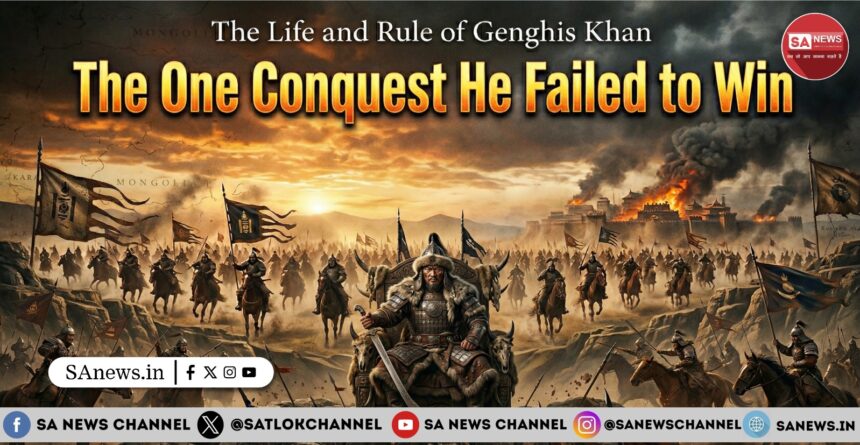
The name Genghis Khan immediately invokes images of terror and wanton massacres committed by a fierce conqueror who built a vast empire. But his story is not limited to battlefield victories and destruction. The majority of the world views Genghis Khan as a cruel ruler, whereas some segments look up to him as an awe-inspiring conqueror. In this life study of Genghis Khan, you will not only discover how he rose from hardship and transformed warfare, but also uncover a deeper reflection into the lesser-discussed aspects about his life, acquiring never-heard-before perspectives to the story of Genghis Khan.
- Highlights
- Who Was Genghis Khan?
- What Is The Life and Rule of Genghis Khan?
- What Makes Genghis Khan a Significant Figure in Global History?
- What Was Genghis Khan’s Early Life Like?
- How Did Genghis Khan Unite the Mongol Tribes?
- What Military Strategies Made Genghis Khan So Successful?
- How Did Genghis Khan Govern the Mongol Empire?
- What Were the Major Conquests of Genghis Khan?
- In What Ways Did the Mongol Empire Shape Trade and the Development of the Silk Road?
- The Terror of Genghis Khan: Ruthlessness as a Tool of Conquest
- Did Some Scholars Justify Genghis Khan’s Destruction as Necessary?
- What Should We Unlearn from Genghis Khan’s ‘Legacy’ in Modern History?
- What Genghis Khan Could Not Conquer: The Ultimate Reality of Human Life
- FAQs: The Life and Rule of Genghis Khan
Highlights
- Genghis Khan founded the Mongol Empire, the largest contiguous land empire in history.
- His rise from poverty to power is viewed by many as a demonstration of resilience and strategic thinking.
- Mongol military success relied on speed, discipline and psychological warfare.
- The most well-known aspect of Genghis Khan’s life, however, remains the horror he set forth during his conquests. What drove him to undertake barbaric conquests?
- Despite this, governance under Genghis Khan introduced meritocracy, law and religious tolerance.
- The Mongol Empire boosted trade and cultural exchange along the Silk Road.
- His ‘legacy’ remains complex, combining destruction with global unification.
- This article attempts to decode Genghis Khan’s actions in a light never-heard-before.
Who Was Genghis Khan?
The most common textbook answer to this question would be that Genghis Khan is considered one of the most powerful and controversial leaders in world history. He was a Mongolian warrior and ruler who founded the Mongol Empire and unified the nomadic tribes of Mongolia into one powerful state in the early 13th century.
- Genghis Khan was born as Temujin around 1162 near present-day Mongolia and rose from humble and difficult beginnings to become one of history’s most influential conquerors.
- For example, after uniting the Mongol tribes in 1206, he launched campaigns that stretched from China to parts of Europe, creating a vast empire across Eurasia.
- Genghis Khan is also viewed as a warrior-ruler of exceptional strategic ability who transformed scattered tribal groups into a disciplined military empire – a rare concept during his time period.
- Another example – his forces conquered large parts of Central Asia and northern China within just a few decades, demonstrating impressive military organisation and leadership.
- However, the terror unleashed by Genghis Khan during his conquests is what leaves most readers or connoisseurs of history speechless.
We will further explore the actual aspects that drove Genghis Khan’s aspirations and actions in life.
What Is The Life and Rule of Genghis Khan?
The Life and Rule of Genghis Khan refers to the historical journey of Temujin, who became Genghis Khan and established the Mongol Empire in the 13th century. The original name of Genghis Khan has been depicted across cultures as Temujin, Temüjin, Chinggis and even Temuchin.
It is also important to note here that there are conflicting records about the exact period of Genghis Khan’s birth. However, as most historians settle with 1162 as his approximate birth year, we will also accept the same timeline as our focus is more substantial than just the birth year.
Few notable aspects about the life and rule of Genghis Khan:
- As is already known across literature, Genghis Khan (known as Temujin around 1162, at birth) rose from a tribal warrior to the founder of a vast empire spanning Asia (China especially) and parts of Europe.
- Most importantly, Genghis Khan was the founder of the Mongol Empire, which became the largest contiguous land empire in history.
- At its peak, the Mongol empire covered nearly 12 million square miles.
In addition, his rule combined military conquest, governance innovation and economic expansion, making his life one of the most studied in world history.
What Makes Genghis Khan a Significant Figure in Global History?
Genghis Khan is important because most historians believe he reshaped global trade, politics and cultural exchange through the creation of the Mongol Empire.
Here are some reasons why:
- The Mongol Empire connected vast regions of Eurasia, enabling safe travel and communication. For example, the Silk Road flourished under Mongol protection during the Pax Mongolica, allowing merchants like Marco Polo to travel safely.
- The Mongols also facilitated trade and cultural exchange by securing and expanding the Silk Road routes. This led to increased economic activity across continents.
- Additionally, the empire unified diverse cultures and systems. We will dig deeper into this aspect further ahead.
- Despite his ruthlessness, Genghis Khan is often credited for transforming regional conflicts into global connectivity.
What Was Genghis Khan’s Early Life Like?
Genghis Khan’s early life was marked by hardship, tribal conflict and survival struggles that seem to have shaped his leadership. Let us analyse his childhood and the subsequent birth of his support groups.
Childhood and Hardships
Core aspects of Genghis Khan’s childhood that need to be discussed are as follows:
- Temujin was born at Dadal Somon, Khentei province in eastern Mongolia. He was born into a noble family but faced tragedy early in life.
- Temujin was Yesugei’s son from his first wife, Hö’elün. Subsequently, he had taken another wife with a turn of unforeseen events.
- After his father, a tribal leader, was poisoned, Temujin’s family was abandoned and forced into poverty. At that time he was just about nine years old.
- During this period, a ghastly act committed by Genghis Khan and his real brother was the murder of his stepbrother, Bekhter during a dispute over food and authority. Genghis Khan wanted to eliminate any sort of competition in leading their family.
- The relationship between the children of Yesugei’s first and second wife had always been unpleasant.
- What is the reason that children fathered by the same individual can have such immense varying temperament and no scope for mercy for their own kin? Though the world readily accepts that family members are like the five fingers of the same hand, varying in nature. However, the real reason for such contrasting personalities and actions is beyond shocking – something we will uncover as we proceed.
- Genghis Khan experienced betrayal and even captivity. He was captured by a rival of his father and taken in as a slave.
- He managed to escape this enslavement. Historians often credited this part of his life for the resilience, survival instincts and ‘courage’ he developed.
However, it is pertinent to note that murder or mass massacre are not acts of bravery or courage. They are born out of no fear of God Almighty and the long-bearing consequences of such heinous acts in the Constitution of God.
Therefore, it was not Genghis Khan’s childhood adversity that forged his ruthless mindset, but the outcome of the lack of guidance of a True Saint (Complete Saint) in his life. Individuals like Genghis Khan, who are unfortunate not to receive the refuge of a True Saint no longer fear the repercussions of their actions.
Formation of Alliances
The second aspect of Temujin’s childhood were the alliances he built to survive and grow in power. Some examples:
- He formed bonds with warriors like Jamukha, his childhood friend, before eventually becoming rivals.
- In addition to Jamukha, Genghis Khan also struck an alliance with Ong Khan, also known as Toghrul.
- Furthermore, he rewarded loyalty over lineage in his alliances. What this meant is he awarded his stakeholders based on their merit and not their noble birth. This later became a key leadership principle.
- Moreover, his personal relationships played a key role in his rise. For example, his marriage to Börte helped him form crucial alliances, although she was later kidnapped – an event that pushed Temujin to gather allies and launch his first major rescue mission.
Overall, the rise of Genghis Khan involved uniting fragmented Mongol tribes through strategic alliances and military strength.
How Did Genghis Khan Unite the Mongol Tribes?
Genghis Khan united the Mongol tribes through military victories, strategic alliances and a merit-based leadership system. An overview of the key aspects:
Key Strategies for Unification
As discussed already, Genghis Khan broke traditional tribal loyalties.
- He reorganised tribes into military units based on loyalty rather than family ties.
- He also promoted individuals based on merit, allowing a fair ground for evaluation. This also allowed talented warriors from lower backgrounds to rise quickly.
- This further helped Genghis Khan gradually gain followers because he promoted individuals based on ability, not birth.
- He used both diplomacy and force to consolidate power. Rival tribes were either defeated in battle or absorbed into his growing coalition.
Genghis Khan transformed tribal divisions into a unified military and political system. Meritocracy became the backbone of Mongol unity.
Declaration as Genghis Khan
In 1206, Temujin was formally declared ‘Genghis Khan’, meaning ‘universal ruler’.
This marked the official formation of the Mongol Empire, uniting previously divided tribes under one leader.
What Military Strategies Made Genghis Khan So Successful?
Mongol military strategy relied on speed, discipline, adaptability and psychological warfare to defeat larger armies. A brief analysis of their tactics gives us an insight into Genghis Khan’s war mindset.
Mobility and Speed
Mongol armies used highly mobile cavalry units. Soldiers often had multiple horses, allowing rapid movement across vast distances. This mobility enabled surprise attacks and quick retreats.
Speed was the Mongols’ greatest battlefield advantage.
Psychological Warfare
Genghis Khan used psychological warfare to weaken opposition. He trained the Mongols to use fear as a weapon. For example, they spread rumours of destruction to weaken enemy morale before battles. Cities often surrendered without resistance due to fear of devastation.
Brutality
Early campaigns in China and Central Asia were deliberately brutal to instil fear and discourage resistance.
Advanced Tactics
Genghis Khan used innovative techniques such as:
- Feigned retreats: Genghis Khan’s armies often pretended to flee in panic to lure enemies into pursuit, then suddenly turned back to attack when the opposing forces became disorganised and vulnerable.
- Coordinated attacks: Mongol troops operated in highly disciplined units that communicated through signals and messengers, allowing them to launch synchronised assaults from multiple directions and overwhelm larger armies.
- Siege warfare with borrowed technologies: The Mongols adopted advanced siege techniques from conquered regions, such as Chinese catapults and gunpowder weapons, enabling them to breach fortified cities that were previously difficult to conquer.
Other Strategies
Genghis Khan adapted strategies based on circumstances.
- A noteworthy example: During his campaign against the Khwarezmian Empire, he launched a devastating invasion after his envoys were killed, demonstrating both strategic retaliation and expansionist ambition.
- However, he was also selective in destruction. Skilled artisans, scholars and religious figures were often spared and integrated into Mongol society.
Mongol warfare combined destruction with strategic resource acquisition.
How Did Genghis Khan Govern the Mongol Empire?
Genghis Khan governed the Mongol Empire through a structured legal system, meritocracy and policies promoting trade and tolerance. Some well-acknowledged aspects of his governance are as follows:
- Genghis Khan governed through strict discipline, practical administration and policies that encouraged stability and growth.
- He introduced a system of law and order that maintained unity across vast territories. For instance, his governance emphasised discipline, loyalty and accountability among both soldiers and civilians.
- He also recognised the value of skilled individuals – an important aspect of Genghis Khan’s war and governance strategy, both. Craftsmen, scholars and religious leaders from conquered regions were protected and brought into Mongol domains to strengthen the empire.
- He understood that long-term control required more than fear. Instead of continuous destruction, he promoted trade, cultural exchange and economic development across regions.
Genghis Khan shifted from conquest to consolidation to sustain his empire, wherein one could observe some important pillars, such as:
The Yassa Law Code
The Yassa was a legal code established by Genghis Khan to maintain order and discipline across his empire. It covered laws on military conduct, theft and social behaviour. The Yassa ensured unity across diverse populations.
Meritocracy and Administration
Leadership roles were assigned based on ability. A unique aspect of this pillar was that even former enemies could become generals if they proved loyalty. This system increased efficiency and reduced internal conflict.
Religious Tolerance and Trade
Genghis Khan allowed freedom of religion. For example, Buddhists, Muslims and Christians coexisted peacefully under his rule.
What Were the Major Conquests of Genghis Khan?
Genghis Khan’s major conquests included territories across China, Central Asia and parts of Eastern Europe. As the scope of this article is Genghis Khan’s life and rule, in particular, we will not examine the Mongol Empire and its conquests in detail. We will cover those aspects that specifically reveal the person Genghis Khan.
However, should you want to explore the Mongol Empire in depth, please read our in-depth coverage ‘The Rise and Fall of the Mongol Empire: A Comprehensive Historical Account’.
Moving on, two important geographies of Genghis Khan’s conquests are:
Conquest of China and Central Asia
First, he defeated the Jin dynasty and captured Beijing in 1215. He also conquered the Khwarezmian Empire, destroying major cities like Bukhara and Samarkand.
Expansion into Europe
Then the Mongol armies advanced into Eastern Europe, such as regions near Russia and Crimea. These campaigns demonstrated the global scale of Mongol expansion.
The Mongol Empire grew at an unmatched pace, surpassing all other empires in the speed of its expansion. An extremely important question here is why do individuals of power seek to seize more land or kingdoms? Why is there so much desire to establish power and dominance? Isn’t this desire the cause of all wars, including the current USA-Israel-Iran war?
In What Ways Did the Mongol Empire Shape Trade and the Development of the Silk Road?
Before analysing some deep insights into the nature of Genghis Khan’s conquests and the terror he unleashed, it is important to pause and briefly acknowledge the much-talked-about Silk Route.
- The Mongol Empire influenced trade by securing routes and promoting economic exchange across Eurasia.
- Mongol rule created stability across trade routes. Traders were able to move across regions with greater security due to the protection enforced by Mongol rule.
- The Silk Road is believed to have reached its peak during Mongol rule, facilitating global commerce and cultural exchange.
- Additionally, goods like silk, spices and metals also moved across continents and boosted economies.
The Silk Road under Mongols is seen as a bridge between East and West.
Also Read: The Silk Road: A Historic Network of Trade, Culture, and Global Influence
The Terror of Genghis Khan: Ruthlessness as a Tool of Conquest
The terror of Genghis Khan refers to the deliberate use of extreme violence and psychological fear to subdue enemies and accelerate conquest across vast regions.
Some critical insights:
- Genghis Khan’s campaigns created what many described as a deep, almost instinctive fear among settled civilisations. For example, societies across Eurasia viewed the Mongol advance as an unstoppable force, often surrendering without resistance simply to avoid destruction.
- His invasions were marked by large-scale devastation when resistance was encountered. A fatal instance was that after the execution of Mongol envoys by the Khwarazmian ruler around 1219, Genghis Khan launched a retaliatory campaign that resulted in widespread destruction and significant loss of life across regions like Iran and Central Asia.
- Entire urban centres were also severely impacted: Historically significant cities in regions such as Khorasan and Transoxiana suffered long-term decline as the economic and cultural activity was disrupted for decades following the invasions.
- As discussed earlier, Genghis Khan used destruction not randomly, but strategically to send a clear message of absolute authority.
- This approach had long-term consequences beyond immediate conquest. For example, some regions experienced prolonged instability and weakened governance structures after Mongol rule was imposed. This delayed its recovery and integration into the wider empire.
- At the same time, this brutality was rooted in a broader worldview. An example: the nomadic traditions of the steppe often rejected fixed borders and demanded submission from settled societies, reinforcing a system where power was asserted through dominance rather than negotiation.
Astonishingly, some contemporary observers interpreted these events differently. Certain historians of the time viewed the destruction as a necessary evil or even divine process, where upheaval eventually led to new forms of political and cultural expansion.
Can any sort of justification be acceptable for the loss of previous human lives? No cause, belief or ambition gives anyone the right to take a life they cannot restore – a life that is sacred, irreplaceable, and God-given.
Did Some Scholars Justify Genghis Khan’s Destruction as Necessary?
Some scholars justified the destruction caused by Genghis Khan as a necessary transformation that led to political stability, religious expansion and cultural renewal.
This crucial section will provide food for thought for immense introspection into what has been accepted in the world as ‘historians views’.
- Several Persian administrators and historians who later served the Mongol regime reinterpreted the violence as part of a larger historical purpose. Rather than viewing the invasions purely as devastation, they framed them as a turning point that reshaped fractured societies into more unified political systems.
- This is the reason why Genghis Khan’s invasions, though extremely devastating, have been portrayed as that ‘unified’ kingdoms under one flag. One cannot help but ask – what was sacrificed in the process?
- It is also crucial to note here – who were those voices that shaped this narrative of whitewashing war crimes? They were the same scholars whose lives were spared by Genghis Khan so as to induct them into his kingdom. The blatant justification of massacres speaks volumes of the shift in loyalty of those skilled personalities, whether historians, scholars, artisans, etc. Can such accounts be morally trusted?
- Another justification of war crimes has always been religion. One such voice supporting this view was Ata Malik Juwayni, a Persian historian and adviser under Mongol rule. After witnessing the fall of major strongholds, he argued that the Mongol conquests reflected a deeper ‘divine intention’, justifying the destruction as a means to eliminate what he considered religious corruption and instability.
- It is not so difficult for a discerning reader to ascertain whether God can ever be associated with destruction or not. Attributing such abhorrent crimes of killing people to ‘divine intention’ is an oxymoron the world fails to recognise even today.
- The outcome of Juwayni’s interpretation reframed Mongol destruction as a ‘divinely guided restructuring’ of the world order.
The current world scenario also draws parallel to this school of thought where world leaders today are looking to rewrite the world order and establish their dominance at the cost of innumerable lives.
What Should We Unlearn from Genghis Khan’s ‘Legacy’ in Modern History?
The ‘legacy’ of Genghis Khan is portrayed as a combination of military brilliance, cultural exchange and controversial destruction.
His conquests are credited for creating the largest contiguous land empire in history, linking East and West; and fostering cultural and economic exchanges between regions like China, the Middle East and Europe increased significantly under Mongol rule. Genghis Khan’s empire is also credited for influencing artistic, religious and intellectual traditions.
However, all of these ‘achievements’ stand defeated when pitched across the wanton massacres Genghis Khan’s invasions produced. What blinds humans so much as to become indifferent to ending another’s life? The answer lies in a simple analysis of Genghis Khan’s life.
Scarcity of resources threatened Genghis Khan’s existence. This shaped his choices that have often been framed as necessary for survival. It brings to mind the familiar phrase ‘survival of the fittest’, repeated so often that it begins to sound like justification rather than observation. However, rather than focussing on this make-believe illusion, the real point we must examine is not survival, but scarcity itself.
Why does our world remain so deeply, evidently unequal and unjust? What is the purpose of a system where existence is reduced to a relentless and often brutal struggle over limited resources? Is scarcity an unavoidable reality or is there something deeper, something unseen, that we have failed to question?
What Genghis Khan Could Not Conquer: The Ultimate Reality of Human Life
Jagatguru Tatvdarshi Sant Rampal Ji Maharajexposes a profound and unsettling trap that humanity has been stuck in – a cycle of deception since time immemorial on earth. Kaal Brahm, often identified with Satan, rules over the domain of 21-universes, wielding scarcity as a calculated instrument to fuel conflict, unrest and an unending struggle for survival.
But what does the ruler of this mortal realm gain from keeping humanity trapped in such relentless turmoil? Bound by the consequences of a grave sin, Satan Kaal Brahm is cursed to consume one lakh human lives each day. To sustain this fate, he entangles souls in cycles of conflict and suffering, ensuring their spiritual downfall. In doing so, the rare and invaluable opportunity of human birth, granted once in 84 lakh lifetimes, is squandered, delaying the soul’s chance at liberation.
Furthermore, this system operates through the law of karma. By connivingly engineering circumstances that push individuals towards grave actions in the name of survival, souls become burdened with karmic debts. These debts do not end with one lifetime, instead, they bind the soul across successive births, perpetuating a karmic cycle that is difficult to escape.
Therefore, the struggle for survival is not merely physical, it is deeply spiritual and the cost of remaining unaware is far greater than it appears.
Had Genghis Khan been blessed with the guidance of a Tatvdarshi Sant (a True, Enlightened Saint), his path might have unfolded very differently. The actions that went on to leave such devastating, far-reaching scars that are so severe they still send chills down the spine, may never have come to pass.
Only a Tatvdarshi Sant can awaken the soul to the authentic way of living and reveal the deeper purpose behind this rare human birth. Many powerful figures, even someone as formidable as Genghis Khan, could not fulfil the true aim of life simply because they never came under the guidance of such a realised saint.
But that missed opportunity need not be yours.
You still hold this precious, once-in-a-lifetime chance to make your human life truly meaningful. By seeking refuge in the sole Tatvdarshi Sant of our time – Jagatguru Tatvdarshi Sant Rampal Ji Maharaj, you open the door to the rarest spiritual wisdom. Under His guidance, one gains access to true spiritual knowledge and the path that leads us beyond the cycle of birth and death, towards complete and lasting liberation.
Deepen your understanding and take the first step towards true spiritual awakening. Explore further by visiting:
Website: www.jagatgururampalji.org
YouTube: Sant Rampal Ji Maharaj
Facebook: Spiritual Leader Saint Rampal Ji
‘X’ handle: @SaintRampalJiM
FAQs: The Life and Rule of Genghis Khan
Q1) Who was Genghis Khan?
Answer:Genghis Khan was a 13th-century ruler who united nomadic tribes and founded the vast Mongol Empire.
Q2) How did Genghis Khan establish his empire?
Answer: He built his empire by forming alliances, rewarding merit, and using highly strategic and mobile warfare.
Q3) Why is Genghis Khan historically significant?
Answer: He reshaped world history by expanding trade networks and creating one of the largest empires ever known.