

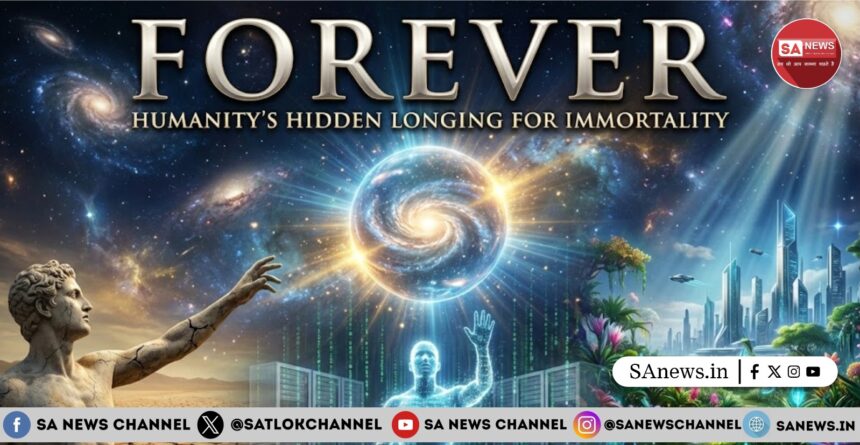
Is humanity’s obsession with ‘forever’ merely a linguistic accident? People use the word ‘forever’ with astonishing ease. Forever love. Forever memories. Friends forever. Promises that will last forever. And yet the evidence against the word is everywhere. Cemeteries expand. Buildings decay. Empires collapse. Even mountains, given enough time, surrender to wind and water. Every visible thing carries an expiry date. So why does humanity cling so fiercely to the promise of ‘forever’ that cannot possibly fulfill? This article introspects our deep yearning for permanence and traces our true ‘immortal’ roots.
Are We Really Obsessed With ‘Forever’?
At first glance, it may seem like exaggeration, a poetic habit or sentimental optimism. But scrutinising more closely reveals the repetition that is harder to dismiss. The word appears in vows, in prayers, in monuments, in lullabies, in national myths. Its forms and representation may vary, but resounds firmly especially in contexts where human feelings are the core.
Most would assume that often ‘forever’ must be associated with love for our loved ones, but the obsession runs far wider.
We want our names to survive us. We want our work to outlive us. We want to be remembered, quoted and continued. We have often heard statements such as, ‘After I am gone, the world will remember me through my work, the legacy I leave behind’. Such sentiments are scarily double-edged – we accept that we must leave, yet we quietly refuse to be gone.
Museums, libraries, family trees, archives, memorials – these are all technologies against disappearance. Even the most modest life often contains the hope that something of it will remain somewhere, in someone. Therefore, is it safe to discern that forever is a linguistic form of immortality that we humans chase.
Is it a mere coincidence that since the beginning of time, humans depict a similar yearning for a form of immortality? Could our understanding be missing its deepest layer? For time is a witness how several saints and others have undertaken severe penance to achieve immortality with little or no success.
Is it even right to term it as ‘obsession’ when this evident yearning for ‘forever’ is so deep-seated? The answer will shock you beyond words. Let us begin our investigation into how ‘forever’, immortality and permanence seem deeply engineered within human DNA.
The Etymology of Forever
Let us begin at the nearest root available to us – language. Etymology may not reveal eternity itself, but words and actions are the instruments through which human longing presents itself as feelings.
‘Forever’ comes from the Old English ‘for ēfre’ that literally means ‘for always’.
Break it apart and the structure is almost disappointingly simple:
- for – in the sense of duration (for example, for a week, for a lifetime, etc.)
- ever – always, at any time.
Together: for + ever = for always
It is plain. Practical. Far smaller than the emotional universe it now carries.
However, centuries of human hope have loaded the word with enormous weight. It has been entrusted with God, loyalty, memory, salvation, identity. A practical phrase became infinite because the human heart kept clinging to it.
How Old Is The Word ‘Forever’?
Forms of for ēfre appear in English writing from around the twelfth century. Early usage suggested continuity or something ongoing, rather than the grand metaphysical infinity the term later acquired. Infinity was not in the dictionary. It was in us.
Do other languages reach differently?
Yes and no both. The vocabulary changes, but the architecture of the idea is astonishingly similar. Across languages, forever is typically constructed from some combination of age, continuity or the refusal of ending.
- In almost every major language, ‘forever’ is built using one of three building blocks – space, continuity or age.
- In English and German, ‘forever’ is actually a spatial and temporal measurement. The ‘ever’ in English comes from the Old English ēfre, which is linked to the Proto-Germanic aiwi, meaning ‘an age’ or ‘a lifetime’. The logic was originally to say ‘for all ages’.
- German gives us ‘für immer’. Immer comes from forms meaning always more wherein time continually added, never concluded.
- Latin-based languages use a linear approach. They focus on the fact that the flow of time remains undivided.
- Latin: The Latin word ‘perpetuus’ is the root of ‘perpetual’. It comes from per- (through) and petere (to go or to aim for). It literally means ‘to go through to the end’, except there is no end.
- Italian offers ‘per sempre’ and in French they say ‘pour toujours’. Sempre comes from the Latin semper (always/continuously). Whereas, toujours literally means ‘all days’. These cultures define forever as a ‘steady state’. Here forever is time that refuses to rupture.
- Many Eastern expressions approach the idea differently. Rather than extending time, they remove death.
- In Sanskrit it is ‘amar’ or ‘amara’. Derived from a- (not) and mara (death). Here, forever isn’t a long time, it is the state of being deathless. But Sanskrit also has more words that can be used in this context. For example, ‘ananta’ is derived from an (without) and anta (end). It describes the infinite.
- Arabic and Hebrew take a more mysterious, almost ‘spatial’ approach to the concept. In Arabic ‘abad’ or ‘abadan’ is used for ‘forever’ as in ‘in the future’. It’s related to the idea of a long, long time. Whereas, in Hebrew it is ‘olam’. This is one of the most unique etymologies. Olam means ‘forever’ or ‘eternity’, but its root is ‘hidden’ or ‘concealed’, that is ’alam.
- It implies eternity is that which is ‘hidden’ from human sight because it is too big or too far to see.
It is worth pausing here to ask a dangerous question: is eternity hidden from us because it lies beyond our sight?
Can it truly be accidental that, across continents and centuries, human instinct keeps bending towards the idea of forever? Civilisations disagree on almost everything – morality, gods, politics, destiny, and yet they converge on this single ache for permanence. This cannot be random.
So why, if the pull is so universal, do we still fail to see the Foreverland? Where is this landscape in which nothing is lost, nothing collapses, nothing slips away?
Before we attempt to approach that mystery, we must first understand how profoundly the pursuit of forever has already shaped the habits, rituals and emotional architecture of cultures around the world.
Also Read: Learning New Languages and the Role of Digital Tools
Does ‘Forever’ Translate Into Cultural Traditions?
It is fascinating that even while we perceive forever as physically unachievable, humanity has spent millennia behaving as if it might be within reach. We have even constructed environments for it.
Entire infrastructures such as social, architectural and spiritual, are erected to shelter the possibility that something of us can continue. Here is a brief overview of how ‘forever’ translates through symbolism across cultures.
Symbols: Giving Infinity A Shape?
The human mind struggles with abstraction, so we build visual anchors or forms that allow us to see what we cannot experience. Two symbolic examples:
- The Greek Ouroboros, the serpent devouring its own tail, stands for an ending that is merely re-entry.
- The Egyptian Ankh, or ‘the key of life’, placed in the hands of gods and carved into tombs, declares life unconquered by death. It stands for eternal life.
- Circle or Wreaths as a symbol of eternity: The circle is humanity’s long-standing symbol of eternity. It is essentially a line with no beginning and no end. Ancient Egyptians saw in it the shape of the infinite, later echoed in the belief that a vein ran from the ring finger to the heart. This is how wedding rings or bands came into being.
Also Read: The Creation Conundrum of Ancient Egypt: The Missing Pieces
Rituals That Rehearsed Permanence
Since we can’t live forever, we created rituals that made our presence feel permanent, out of ignorance.
- In Madagascar, families practise Famadihana or the ‘turning of the bones’ by lifting ancestors from tombs, rewrapping them, dancing with them, renewing belonging. It is a ritual intended to prove that the bond between the living and the dead is everlasting. Though rooted in an effort to conquer the separation caused by death, in reality, this ritual is futile. It is more of a make-believe method. The question we must ask is, is there truly a way to conquer death?
- The ‘eternal’ flame, whether in ancient temples or modern memorials, is often seen as a ritualistic symbol of memory. Again, here too, the ritual argues more with disappearance than that embodying the actual meaning of forever.
- The Ner Tamid (Judaism): The ‘Eternal Light’ hanging in front of the Torah ark in synagogues, never to be extinguished, is seen as representing the eternal presence of the divine. Whether it fulfills its objectives is debatable.
Modern Search For ‘Forever’
Even in our secular, scientific age, the yearning hasn’t left. We have just redesigned them. Some examples:
- Digital Estates: Curating social media profiles to outlive us.
- Cryonics: Freezing bodies in hopes of a future ‘thaw’ or revival back to life.
- Data Backups: The hope that if we can just save enough information, we never truly disappear.
It seems that the more we realise how fragile life is, the harder we work to build things that look like they’ll last. We are the only species that builds ‘forever’ out of sand, knowing that the tide will erase our sandcastle.
Try this Free Tool: Random Object Generator to Draw: Get Unlimited Sketch Ideas
Before finally revealing the answer to Foreverland, it is important to explore how Corporates have exploited human desire for permanence by handing over toys in our hands that are false promises and distractions from the actual path to immortality.
How Corporates Used the ‘Forever’ Sentiment to Market Products
At this juncture, it is also important to examine how our deepest feelings are being exploited by corporate giants.
Because ‘forever’ is our deepest emotional itch, marketers have become master ‘scratchers’. They know that if they can link a temporary product to the concept of eternity, they can bypass your logic and go straight to your soul and your wallet too.
Here are some of the most powerful and manipulative examples of ‘Forever’ as a marketing tool:
- Diamonds and the performance of commitment: Before the mid-twentieth century, a diamond ring was an option, not an obligation. Then advertising performed a subtle alchemy. By pairing the physical hardness of the stone with the promise of ‘unending’ devotion, the purchase became symbolic testimony. Durability in carbon was made to imply durability in love. Frugality could suddenly be interpreted as doubt and thus the ‘A Diamond is Forever’ campaign was born.
- The retailing of permanent youth: A name like ‘Forever 21’ does not pretend fabrics will last indefinitely. Instead it invites the wearer to inhabit a preserved moment of vitality. Time, in reality, continues its work, but the brand offers a stage set on which ageing appears temporarily suspended.
- Disney’s ‘The Vault’ and ‘Happily Ever After’: Disney has been the undisputed king of selling ‘The End of Time’ concept. Each of its movies ends with ‘Happily Ever After’ – a phrase that essentially asks you to stop thinking about what happens next ( for example, mortality, taxes, chores). The result is that they sell a perpetual childhood. By putting movies in ‘The Vault’ and then re-releasing them, they create a cycle where the brand feels like an eternal constant in a changing world. This is also another reminder that movies only corrupt and exploit unsuspecting viewers.
- The Russian ‘Cosmist’: In the late 19th century, a movement called Russian Cosmism (led by Nikolai Fedorov) took a wildly different approach. They believed that ‘forever’ shouldn’t be a religious hope, but a scientific duty. Fedorov argued that we have a moral obligation to use technology to physically resurrect every human who ever lived and achieve literal, physical immortality. This movement was a major inspiration for the Soviet space program. They wanted to go to space not for glory, but because if they succeeded in resurrecting everyone, they would need more room to live.
The most cynical part? Companies use the words ‘forever’, ‘for life’, ‘timeless’ in their ads while intentionally building products designed to break or become obsolete in 24 months. They sell you the concept of the eternal to distract you from the reality of the disposable.
Which brings us back to the wound at the centre of this essay.
If we know, with complete intellectual clarity, that our bodies end, our possessions decay and our names eventually thin into archives, why does the appetite for immortality remain so fierce?
Does immortality truly exist? Does a Foreverland truly exist?
Satlok: The True Foreverland
Is immortality real? A resounding yes, it is. The answer offered here is not metaphorical. It is Real.
Immortality exists, but it remains distant, concealed from ordinary perception, for a profound reason.
Jagatguru Tatvdarshi Sant Rampal Ji Maharaj explains that the human obsession with permanence and immortality is not poetic exaggeration, nor psychological weakness. It is deep-seated Memory. A buried inheritance. A pull towards our true, immortal origin.
Sant Rampal Ji Maharaj reveals that the soul is not native to a dying world. All souls, whether humans or others, originated in an immortal realm known as ‘Satlok’ through the word power of the Ultimate Creator of all universes – Supreme God Kabir.
Satlok is not touched by decay, grief, fear, hunger or inequality. Nothing withers there. Nothing competes. It is the land of absolute abundance, where food replenishes itself through the power of God Kabir, and so do all other resources. There is equality for all. It is the land of True Happiness – the true Foreverland.
Why, then, do we not remember? Sant Rampal Ji Maharaj clarifies a crucial distinction. The mind forgets. The soul does not.
At every birth, mental memory is wiped clean. The intellect therefore doubts, calculates, dismisses. But the soul, being a fragment of the Immortal God Kabir, retains an imprint of that former state of boundless happiness. That silent remembrance acts like a magnet.
It is why promises of eternity mesmerise us.
Why disappearance terrifies us. Why the heart keeps searching for a condition it cannot logically prove. We are homesick for a place the mind cannot recall.
How did we, then, arrive here? If our origin is eternal, why are we trapped in transience and decay?
Sant Rampal Ji Maharaj reveals that through a grave error, souls were expelled from Satlok and confined within this jail of twenty-one universes – a domain governed by Kaal Brahm (Satan), where birth, death, disease and unrest are unavoidable.
What we call normal life is, in this understanding, a condition of exile.
To a modern ear, such claims may resemble myth or fairy tale. However, the distinction lies in the undeniable evidence highlighted by Sant Rampal Ji Maharaj across scriptures of several religions. The testimony of multiple sacred scriptures, when read without distortion, points toward the same forgotten origin and the same path of return.
This is not a sentimental promise crafted to soothe fear. It is the true explanation for why fear exists in the first place. The ache for forever is universal because it is ancestral. Our innate longing is our soul-memory trying to surface.
Understand where we came from, the mistake that led to exile and the assured path back to the eternal abode in this spiritual discourse by Jagatguru Tatvdarshi Sant Rampal Ji Maharaj:
For more information, visit:
Website: www.jagatgururampalji.org
YouTube: Sant Rampal Ji Maharaj
Facebook: Spiritual Leader Saint Rampal Ji
‘X’ handle: @SaintRampalJiM
FAQs on Forever
Q1) Does immortality or an eternal world really exist?
Answer: Jagatguru Tatvdarshi Sant Rampal Ji Maharaj reveals that the deathless realm of Satlok is real and attainable through true and authentic worship of Supreme God Kabir bestowed by Him.
Q2) Who created all souls?
Answer: Supreme God Kabir is the Father and Creator of all souls, whether human or not. He created us through His word-power or shabd-shakti.