

If you think you need to look to the stars to find alien life, you’re looking in the wrong direction.
- 1. The Immortal Jellyfish (Turritopsis dohrnii)
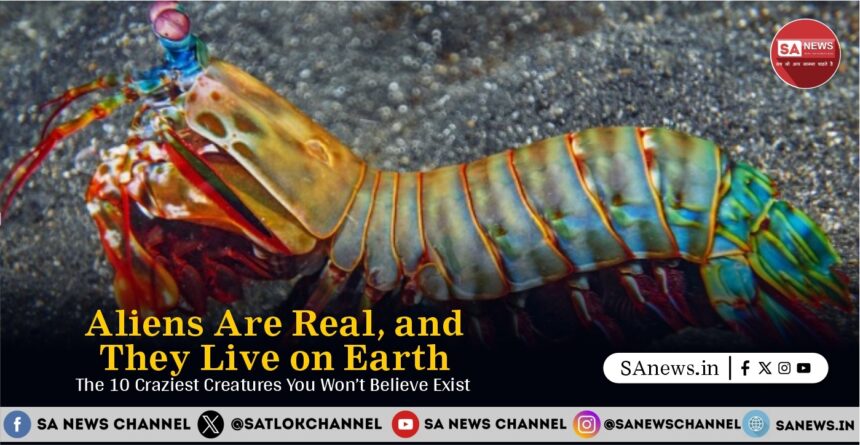
- 2. The Peacock Mantis Shrimp (Odontodactylus scyllarus)
- 3. The Barreleye Fish (Macropinna microstoma)
- 4. The Tardigrade (Water Bear)
- 5. The Shoebill Stork (Balaeniceps rex)
- 6. The Axolotl (Ambystoma mexicanum)
- 7. The Blue Glaucus (Glaucus atlanticus)
- 8. The Platypus (Ornithorhynchus anatinus)
- 9. The Blobfish (Psychrolutes marcidus)
- 10. The Zombie-Ant Fungus (Ophiocordyceps unilateralis)
Right now, beneath your feet and deep within our oceans, exist organisms so biologically defying that they break the very rules of life we thought were constant. Did you know that there is a creature that can boil water with its fist? Or another that is biologically immortal, reversing its aging process on command?
We often view biology as a linear path of evolution, but nature is far more chaotic. From the pressure-crushing depths of the Mariana Trench to the microscopic battlegrounds in a drop of water, evolution has crafted survival mechanisms that seem more like magic than science.
The following list is not just a collection of weird animals; it is a testament to biodiversity’s refusal to be boring. These are the deep-sea anomalies, the extremophiles, and the evolutionary oddities that challenge our understanding of what is possible on Earth.
Buckle up. It gets weird.
1. The Immortal Jellyfish (Turritopsis dohrnii)
The only creature that cheats death.
While humans spend billions trying to halt the aging process, a tiny hydrozoan in the Mediterranean Sea has already solved it. The Turritopsis dohrnii is the only known animal capable of reverting completely to a sexually immature, colonial stage after having reached sexual maturity.
Physical Description: Tiny, bell-shaped, and transparent, measuring only about 4.5 millimeters. It reveals a bright red digestive system in its center, looking deceptively simple for a creature that has conquered mortality.
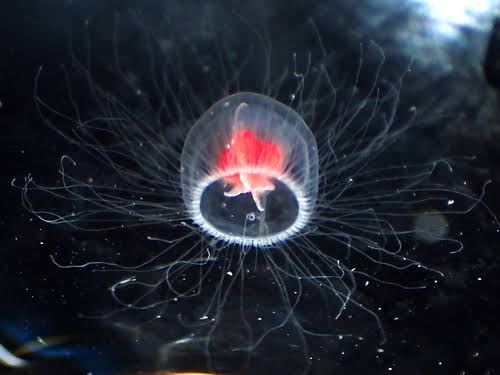
Crazy Factor: When injured, starving, or stressed, it doesn’t die. It literally hits the “reset” button, absorbing its tentacles and shrinking into a blob of tissue that settles on the sea floor to become a polyp again, spawning a new colony of genetically identical clones.
The Science: This process is called transdifferentiation. It is a rare cellular mechanism where a fully differentiated cell (like a skin cell) transforms into a completely different type of cell (like a nerve cell). In humans, this is impossible; once a heart cell, always a heart cell. But T. dohrnii can reprogram its own genome to revert its cells back to stem cells, effectively making it biologically immortal.
Fast Facts:
- Habitat: Temperate to tropical waters worldwide.
- Size: 4.5 mm (0.18 in).
- Lifespan: Potentially infinite.
2. The Peacock Mantis Shrimp (Odontodactylus scyllarus)
The lightweight boxing champion of the world.
Don’t let the rainbow colors deceive you; this crustacean is a violent, underwater nightmare for anything that crosses its path. It is one of the most studied creatures in physics due to the sheer kinetic energy it can generate.
Physical Description: A vibrant, neon-colored crustacean resembling a lobster-shrimp hybrid.
Crazy Factor: Its club-like appendages strike with the speed of a .22 caliber bullet. The punch is so fast (50 mph in milliseconds) that it boils the water around it, creating “cavitation bubbles.” When these bubbles collapse, they release a shockwave and a flash of light/heat reaching temperatures near the surface of the sun (thousands of Kelvin).
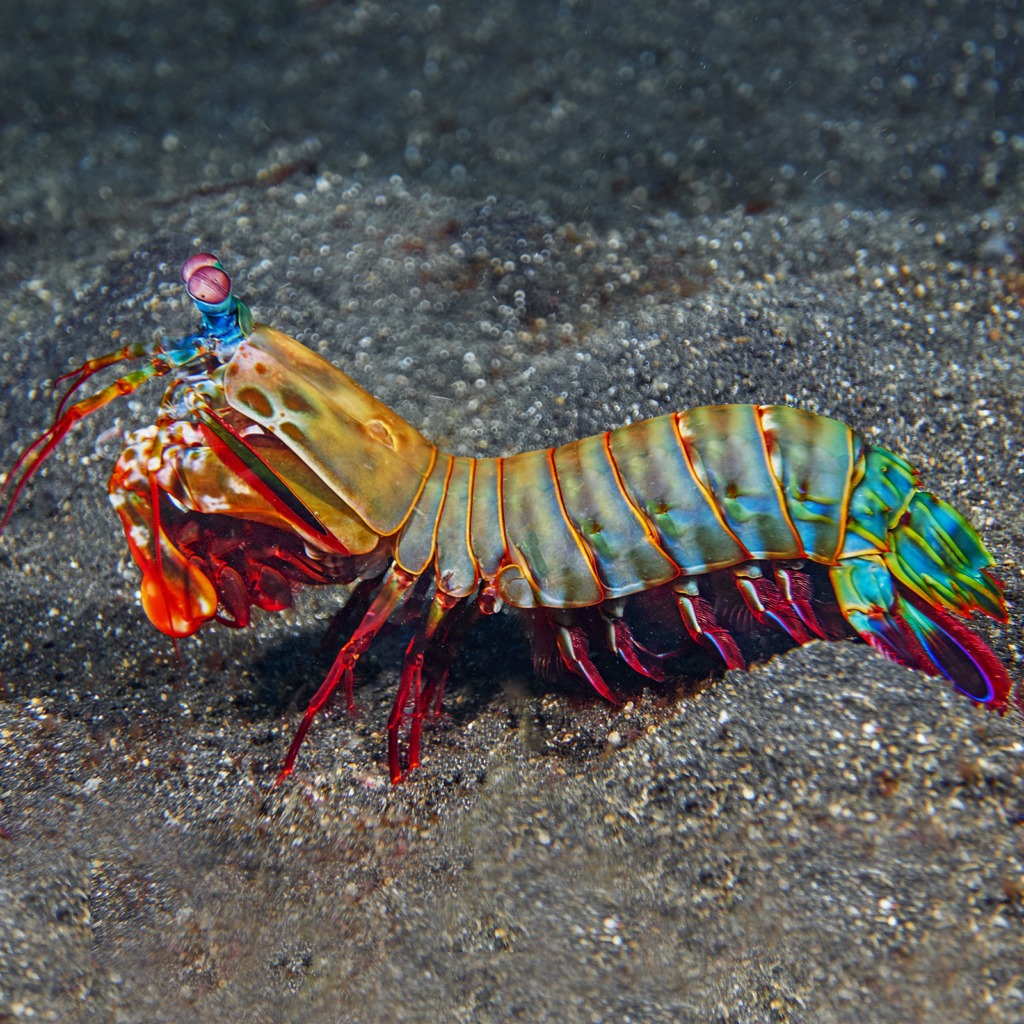
The Science: The Mantis Shrimp uses a saddle-shaped spring mechanism in its arms. It locks its arm in place, building up potential energy in the exoskeleton’s elastic structures, and then releases a latch, launching the club forward. Furthermore, its eyes are an evolutionary marvel. While humans have 3 color-receptive cones, the Mantis Shrimp has 16, allowing it to see polarized light and colors we cannot even imagine.
Fast Facts:
- Strike Speed: 23 meters per second (50 mph).
- Force: 1,500 Newtons (enough to smash aquarium glass).
- Vision: Trinocular depth perception in each eye.
3. The Barreleye Fish (Macropinna microstoma)
The fish with a cockpit for a head.
Living in the twilight zone of the ocean, the Barreleye fish looks like a photoshop experiment gone wrong. For decades, scientists knew of it only from mangled specimens, but deep-sea submersibles have revealed its true, bizarre form.
Physical Description: A deep-sea fish with a completely transparent, fluid-filled dome on its head. Inside this cockpit are two glowing green orbs, those are its eyes. The “eyes” on the front of its face are actually olfactory organs (nostrils).
Also Read : All Science Related Articles by SA News
Crazy Factor: Its tubular eyes are protected inside its clear skull, pointing straight up to spot the silhouettes of prey against the faint light from the surface.
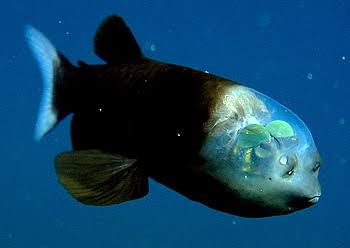
The Science: This is an extreme adaptation to low-light environments. The green pigments in its eyes filter out sunlight to spot the bioluminescent glow of jellies directly above it. The transparent shield protects these sensitive eyes from the stinging tentacles of siphonophores, which it steals food from. It can rotate its eyes forward when it is time to eat, shifting its perspective from “surveillance” to “attack.”
Fast Facts:
- Depth: 600 to 800 meters (2,000 to 2,600 feet).
- Diet: Zooplankton and small crustaceans (often stolen).
- Discovery: Live observation wasn’t captured until 2004.
4. The Tardigrade (Water Bear)
The indestructible micro-animal.
If Earth is ever hit by a sterilization event, asteroid, supernova, or gamma-ray burst, the Tardigrade will likely be the last thing standing.
Physical Description: Microscopic, eight-legged invertebrates that look like chubby bears in hazmat suits.
Crazy Factor: They can survive the vacuum of space, pressure six times greater than the deepest ocean trench, and radiation doses that would incinerate a human. They have even been revived after being frozen for 30 years.
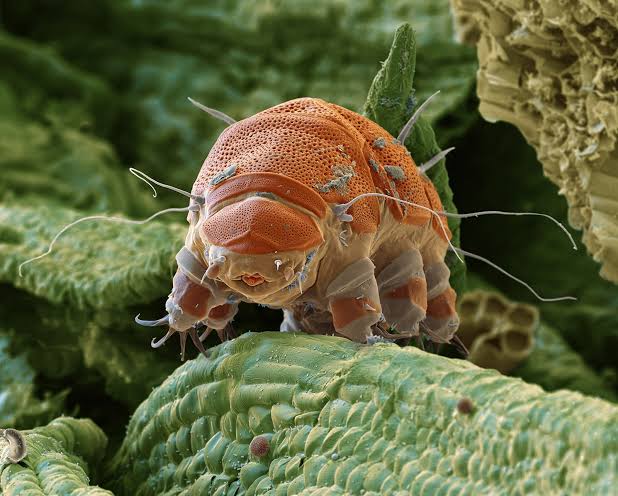
The Science: Their secret is cryptobiosis. When faced with extreme conditions, they expel nearly all water from their bodies and curl into a “tun” state. In this state, their metabolism slows to 0.01% of normal. They produce unique “tardigrade-disordered proteins” (TDPs) that turn their internal cells into a glass-like matrix, protecting their DNA from shattering under stress until conditions improve.
Fast Facts:
- Size: 0.5 mm.
- Resilience: Can survive -272°C to 150°C.
- Location: Everywhere (from moss in your garden to Antarctica).
5. The Shoebill Stork (Balaeniceps rex)
The dinosaur that never went extinct.
Standing face-to-face with a Shoebill is a terrifying reminder that birds are the direct descendants of theropod dinosaurs.
Physical Description: A massive, towering bird standing up to 5 feet tall, with a shoe-shaped beak that looks like a Dutch wooden clog but functions like a guillotine.
Crazy Factor: It hunts by standing absolutely motionless for hours, blending into the swamp. When it strikes, it collapses its body weight forward, decapitating lungfish, snakes, or even baby crocodiles with its razor-sharp beak. It also makes a “machine-gun” sound by clattering its bill, a noise that sounds terrifyingly like automatic gunfire.
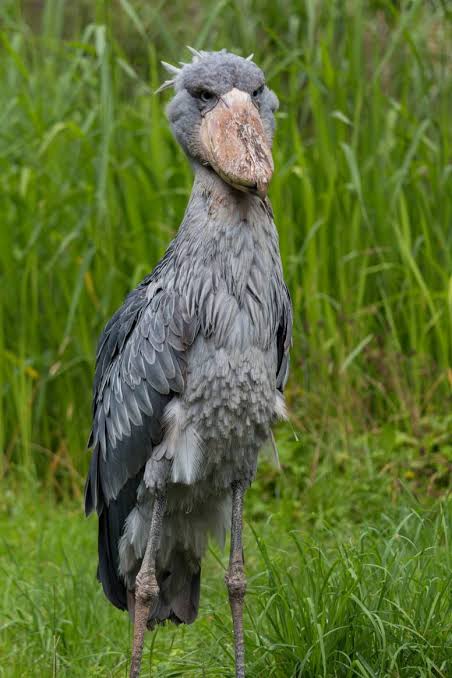
The Science: The Shoebill is an example of evolutionary stasis in specialized predators. Its massive beak is adapted specifically for catching slippery, large prey in oxygen-poor swamps. The hook at the tip of the beak is sharp enough to pierce the thick skin of crocodiles, a trait evolved to dominate the marshes of East Africa.
Fast Facts:
- Height: 4 to 5 feet.
- Wingspan: 8 feet.
- Status: Vulnerable (due to habitat loss).
6. The Axolotl (Ambystoma mexicanum)
The Peter Pan of the amphibian world.
Native only to the remnants of Lake Xochimilco in Mexico, the Axolotl is a biological paradox that refuses to grow up.
Physical Description: A “walking fish” with feathery pink external gills and a permanent smile.
Crazy Factor: Unlike other salamanders, the Axolotl never undergoes metamorphosis. It keeps its gills and aquatic lifestyle permanently (a condition called neoteny). Even crazier? It can regenerate almost any part of its body, limbs, heart, spinal cord, and even parts of its brain, without scarring.
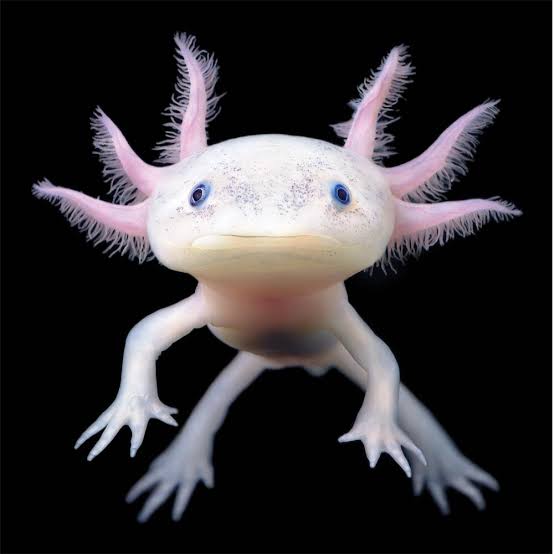
The Science: The Axolotl’s regenerative ability comes from its macrophages (immune cells). In humans, macrophages cause scarring (fibrosis) to quickly close a wound. In Axolotls, these cells signal the tissue to regrow rather than scar, effectively reverting cells at the wound site to a stem-cell-like state. This makes them the “Holy Grail” for regenerative medicine research.
Fast Facts:
- Lifespan: 10–15 years.
- Habitat: Exclusive to the canal system of Xochimilco, Mexico.
- Status: Critically Endangered in the wild.
7. The Blue Glaucus (Glaucus atlanticus)
The dragon that steals venom.
This creature looks like a Pokémon but floats upside down on the surface of the ocean, wreaking havoc on creatures ten times its size.
Physical Description: A vibrant blue, alien-like sea slug rarely exceeding 3 centimeters.
Crazy Factor: It feeds on the Portuguese Man o’ War, one of the most venomous creatures in the ocean. Not only is the Blue Glaucus immune to the sting, but it also harvests the venom. It stores the Man o’ War’s stinging cells (nematocysts) in its own finger-like appendages, concentrating the venom to be even more deadly than the creature it stole it from.
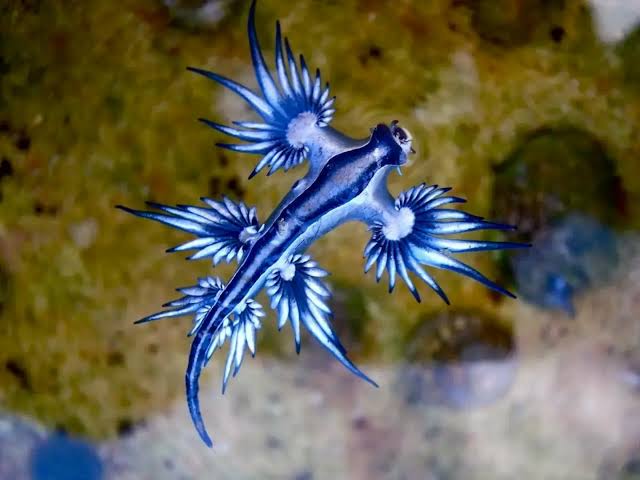
The Science: This is a survival mechanism known as kleptocnidae (literally “theft of stinging cells”). The slug creates a mucus barrier that prevents the nematocysts from firing during consumption. It then transports the unfired cells to the tips of its cerata (the wing-like fingers) to use for its own defense.
Fast Facts:
- Nickname: “The Blue Dragon.”
- Locomotion: Floats upside down using surface tension.
- Warning: Do not touch; the sting is agonizing.
8. The Platypus (Ornithorhynchus anatinus)
Nature’s “spare parts” project.
When European scientists first saw a pelt of a platypus in 1799, they assumed it was a hoax, a duck’s bill sewn onto a beaver’s body.
Physical Description: Duck bill, beaver tail, otter feet, and venomous spurs.
Crazy Factor: It is a mammal that lays eggs. It sweats milk (it has no nipples; milk oozes from skin pores). Males have spurs on their hind legs capable of delivering a venom so painful it can incapacitate a human. It also hunts with its eyes closed, using “electrolocation” to detect the electrical signals of muscle contractions in its prey.
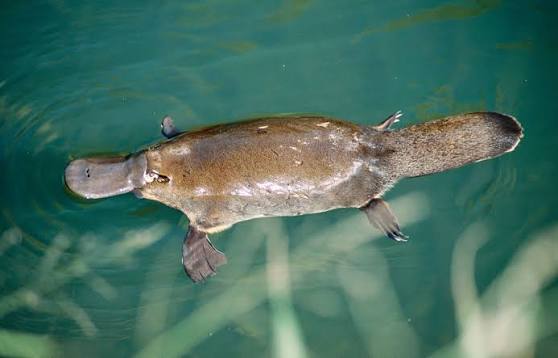
The Science: The Platypus is a monotreme, the most primitive order of mammals. Its genome is a patchwork of avian, reptilian, and mammalian DNA. Its bill is not hard like a bird’s but soft and rubbery, packed with thousands of electroreceptors, a sixth sense essentially unmatched in land mammals.
Fast Facts:
- Location: Eastern Australia and Tasmania.
- Venom: Causes “immediate, excruciating pain” that morphine cannot relieve.
- Evolution: Split from other mammals 166 million years ago.
9. The Blobfish (Psychrolutes marcidus)
The victim of physics.
Often voted the “World’s Ugliest Animal,” the Blobfish is actually misunderstood. It looks perfectly normal in its natural habitat; we are the ones who ruin it.
Physical Description: A gelatinous, pink pile of sludge with a drooping nose.
Also Read : The Craziest and Most Shocking Planets in the Universe That Feel Unreal
Crazy Factor: The Blobfish has no swim bladder (the gas-filled organ most fish use for buoyancy). At the crushing depths where it lives, a gas bladder would explode. Instead, its flesh is a jelly-like mass with a density slightly less than water. This allows it to float effortlessly above the sea floor without expending energy.

The Science: The “blob” look only happens when the fish is brought to the surface. Decompression damage causes its gelatinous structure to collapse under the low pressure of the atmosphere. At 4,000 feet deep, the water pressure holds its body in a tighter, more fish-like shape. We are essentially mocking a fish for exploding.
Fast Facts:
- Depth: 2,000 to 4,000 feet.
- Muscle Mass: Near zero (it eats whatever drifts into its mouth).
- Location: Waters off Australia and New Zealand.
10. The Zombie-Ant Fungus (Ophiocordyceps unilateralis)
The real-life body snatcher.
While technically a fungus, its interaction with the animal kingdom is so bizarre it demands a spot on this list. It turns ants into biological puppets.
Physical Description: A parasitic fungus that grows a stalk out of an ant’s head.
Crazy Factor: The fungus infects a foraging ant, hijacking its central nervous system. It chemically forces the ant to leave its colony, climb a plant to a specific height (exactly 25cm above the ground), and bite down on a leaf with a “death grip.” The ant dies, and the fungus digests the ant’s innards, eventually erupting a spore capsule from the ant’s head to rain spores down on the colony below.
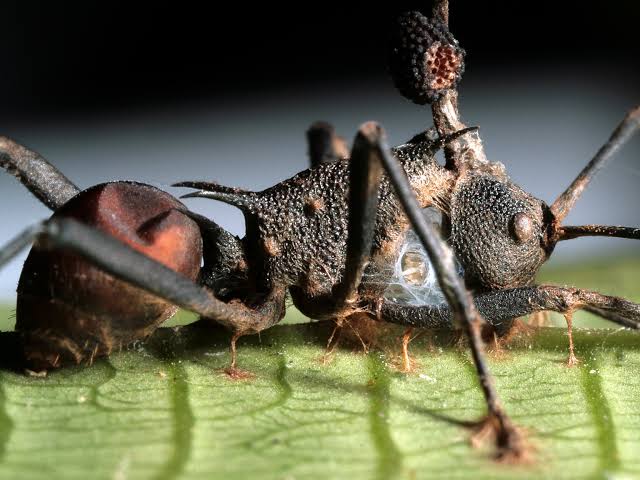
The Science: This is an extended phenotype in action, where a parasite’s genes control the host’s behavior to maximize the parasite’s survival. The fungus chemically manipulates the ant’s muscles to lock the jaw (tetany) at the precise moment conducive to fungal growth (high humidity, correct temperature).
Fast Facts:
- Host: Carpenter ants.
- Habitat: Tropical rainforests.
- Impact: Can wipe out entire ant colonies.
The Verdict: We Know Nothing
We have explored less than 5% of our oceans. We discover roughly 18,000 new species every single year. The creatures listed above are not the exception; they are a glimpse into the vast, weird reality of life on Earth.
So, the next time you look at a spider and think it looks creepy, remember: somewhere in the deep ocean, a transparent-headed fish is stealing food from a 100-foot-long colony of clones. Nature is infinitely stranger than fiction.
The Masterpiece of Creation: Finding Purpose in the Profound
The breathtaking diversity of these “alien” neighbors reveals a fundamental truth: we inhabit a world designed with infinite complexity and precision. When we observe the biological genius of the immortal jellyfish or the indestructible tardigrade, we are forced to move beyond mere curiosity and confront deeper questions of our own existence. Why are we here? Is there a higher purpose behind this intricate tapestry of life?
True enlightenment begins when we seek the source of this divine connection. To bridge the gap between scientific wonder and spiritual peace, we invite you to explore the profound wisdom found in the books “Gyan Ganga” and “Way of Living” by Saint Rampal Ji Maharaj. These texts offer a transformative perspective on authentic worship and the path to a meaningful, liberated life.
Next Step: Would you like me to provide a brief summary of the core philosophical themes explored in these books to see how they align with your journey?