


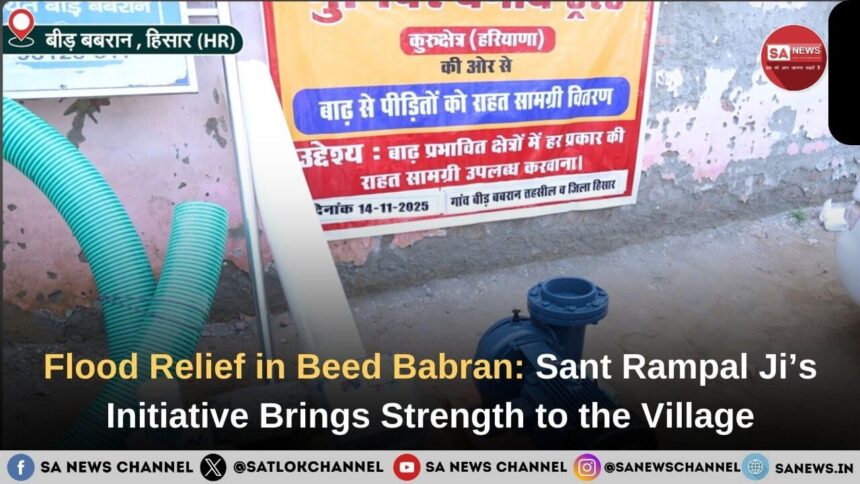
Beed Babran, a small village in Hisar district of Haryana where life revolves around fields, livestock, and children’s education, suddenly found itself trapped in a calamity that shook its very foundations. Continuous rainfall and severe waterlogging worsened the situation to such an extent that water seeped into the walls of houses, foundations began to sink, and several homes stood on the brink of collapse. The village school was also submerged.
- Disappointment with Administration and the Last Ray of Hope
- A Relief Convoy in Just Five Days
- Voices Echoing in the Village: “Our Homes Will Be Saved Now”
- Protecting School, Homes, and Fields Together
- Annapurna Campaign and the Scale of Service
- An Approach That Understands Farmers’ Pain
- Trust and Responsibility of the Village Panchayat
- Sant Rampal Ji Maharaj: A True Support in Crisis
- Social Impact: From Fear to Trust
- Beed Babran’s Story: A Symbol of Hope
Children were forced to study amid mud and filthy water, and for several days, education came to a complete halt.
Villagers repeatedly wrote to the administration and pleaded for help. Surveys were conducted, but solutions did not arrive in time. There was a deep fear that if the water was not drained soon, homes would be lost, crops would be destroyed, and children’s futures would be ruined.
Disappointment with Administration and the Last Ray of Hope
When government channels became exhausting and slow, the village sarpanch and panchayat came across a video showing relief work being carried out in flood-affected areas. That video gave the village a direction. The panchayat decided that as a last hope, they would place their plea at the feet of Sant Rampal Ji Maharaj.
This was not merely a formal letter; it was the collective cry of pain from every household—“Please remove the water, please save us.”
A Relief Convoy in Just Five Days
Once the plea reached Him, what followed felt nothing short of a miracle for the villagers. Within just five days, a relief convoy arrived in Beed Babran.
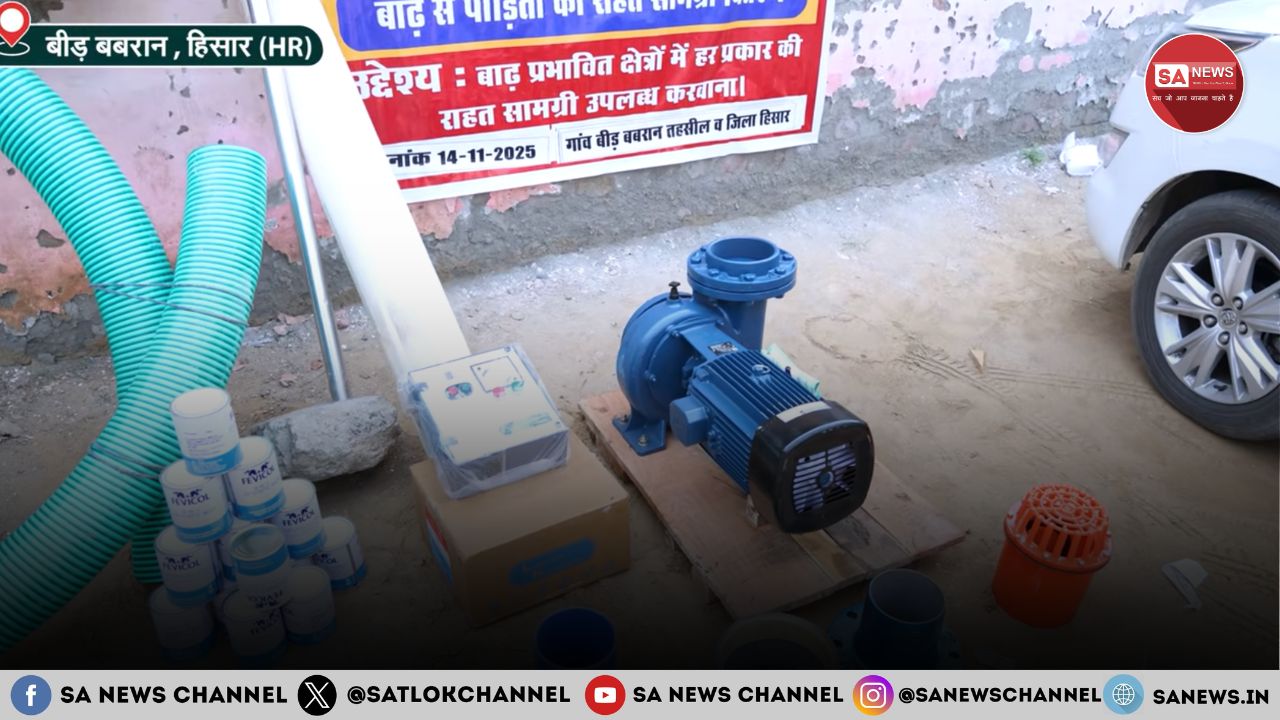
The assistance was not symbolic but practical and effective. To save the village from drowning, the following were provided:
– A 10 HP motor
– 2,500 feet of 8-inch pipeline
– Starters, nipples, and all other necessary equipment required to drain the water
Sevadars arrived at the village outskirts, performed a ceremonial invocation, and then respectfully handed over the material to the panchayat. Elders, youth, and women of the village all showed visible relief and joy, replacing the fear that had dominated their faces for weeks.
Voices Echoing in the Village: “Our Homes Will Be Saved Now”
As soon as the relief material arrived, a new energy spread through the village. People began sharing their experiences.
Yashwant Singh said, “The foundations of our houses were sinking, cracks had appeared in the walls, and the school walls had split. This help is immense for us.” An elderly woman, her eyes filled with tears, said, “Children were studying in mud. Now the water will be drained from the school.” Many villagers stated openly, “We had high hopes from the government, but nothing happened in time. Maharaj Ji saved us.”
Protecting School, Homes, and Fields Together
The problem in Beed Babran was not limited to homes alone. The village pond was overflowing, causing cracks in nearby houses. Waterlogging in the fields threatened the sowing of the next crop.
Villagers explained that children had been forced to study in muddy conditions, but now the water would be drained from the school. A sarpanch representative acknowledged that they had contacted after seeing a video and were astonished by how quickly their plea was heard. Villagers described it as God’s work.
A plan was made to extend the pipeline to a canal so that water could be drained permanently. This relief was not temporary but a step toward a long-term solution, ensuring that the village remains safe even during future rains.
Also Read: Floods, Helplessness, and a Ray of Hope: The Ground Reality of Bhagana Village in Hisar
Annapurna Campaign and the Scale of Service
This service is not limited to one village. Under the Annapurna campaign, flood relief has reached more than 300 villages so far, and the effort continues.
Sevadars explain that the instruction is clear: no showmanship, only work. Each village receives motors, pipelines, and supporting equipment according to its needs. Where help is required, future assistance remains open—with one condition only: water must be drained and crops must be saved.
An Approach That Understands Farmers’ Pain
The core sentiment behind the relief in Beed Babran is an understanding of farmers’ suffering. If fields are not sown on time, not only farmers but the entire social fabric suffers—laborers, shopkeepers, livestock owners, everyone.
This philosophy underpins the service: only when the farmer’s crop survives does society’s kitchen continue to function.
Trust and Responsibility of the Village Panchayat
An important aspect of this entire relief effort was that Sant Rampal Ji Maharaj’s team did not only hand over relief materials to the village panchayat, but also provided a strict and responsible written appeal. This letter was read aloud in the village and signed by the entire panchayat.
It clearly stated that if, despite the motor and pipeline provided, the village failed to drain the water within the stipulated time and sowing could not take place, then the trust would not provide any assistance to that village in future disasters. This warning was not meant to stop service, but to ensure proper utilization of donations and collective responsibility.
It was also explained that a drone survey of the village was conducted before providing relief. After water drainage, a second video would be recorded, and when crops flourish in the fields, a third video would be made. These three stages would be shown on projectors at Satlok Ashrams and congregations to assure devotees that their donations are being used transparently for ground-level service.
Sant Rampal Ji Maharaj: A True Support in Crisis
What the people of Beed Babran emphasize the most is timely help. According to them, when every other path had slowed down, Sant Rampal Ji Maharaj ensured fast, precise, and complete relief.
Villagers praise that this service is not mere charity, but the fulfillment of responsibility—reaching where there is need, without noise or publicity. Continuous initiatives for farmers, the poor, and children—housing construction, education, healthcare, ration support—have earned deep respect in people’s hearts.
An emotional and respectful sentiment is also heard in the village: many people regard Sant Rampal Ji Maharaj as an incarnation of God Kabir. According to them, the selfless assistance reaching sufferers appears beyond ordinary human effort. This faith is expressed without imposing it on anyone, but as a feeling of gratitude, as the support they received in crisis felt like divine grace.
Social Impact: From Fear to Trust
After the relief, a clear change is visible in the village atmosphere. Where there was fear earlier, there is now trust. People are collectively planning the laying of pipelines, operating motors, and draining water. Most importantly, hope has returned to children’s faces that the school bell will ring again.
Beed Babran’s Story: A Symbol of Hope
The story of Beed Babran is not just about 2,500 feet of pipeline and a motor. It is the story of trust that survived amid collapsing homes. It shows that when service is rooted in the ground, it does not only drain water—it also drains fear, helplessness, and despair.
Today, people in Beed Babran say, “The water will be drained, crops will grow, and our children will move toward a secure future.” This is the true victory of this relief—where the village can breathe again and the flame of hope has been lit. Through the humanitarian works of Sant Rampal Ji Maharaj, millions of lives are being transformed.
Sant Rampal Ji Maharaj is a well-wisher of farmers. If other organizations also step forward like Sant Rampal Ji Maharaj, the burden on the government will lessen, and the public will receive timely relief.