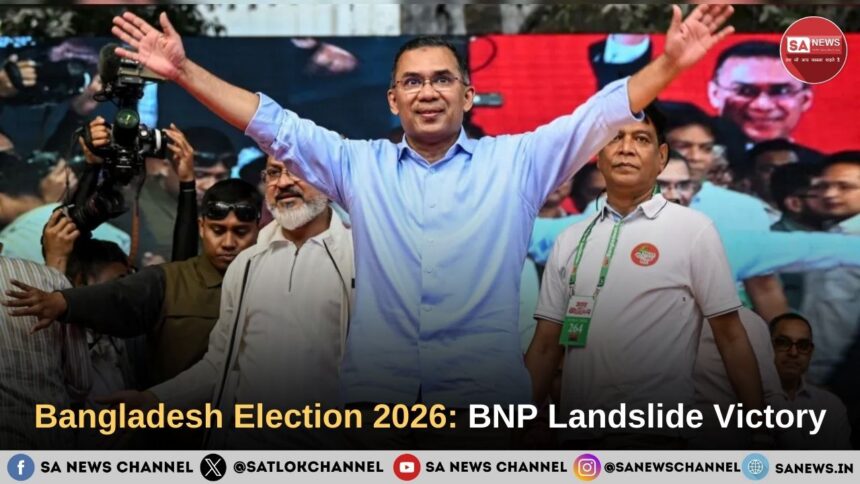
Bangladesh Election Result 2026: Bangladesh’s political landscape has witnessed a historic transformation as the Bangladesh Nationalist Party (BNP) secured a commanding two-thirds majority in the 13th parliamentary elections held on February 12, 2026. Party chairman Tarique Rahman is now poised to lead the nation as its next prime minister.
- BNP Secures Historic Majority in Bangladesh Parliamentary Election 2026
- Tarique Rahman: Bangladesh’s Prime Minister-Designate Returns After 17 Years in Exile
- Voter Turnout and Electoral Participation in Bangladesh Election 2026
- Constitutional Referendum Results: Voters Endorse Major Reforms
- International Reactions to Bangladesh Election Results 2026
- BNP’s Policy Priorities and Future Governance Plans
- Political Analysts React to Bangladesh’s Democratic Transition
- Conclusion: A New Chapter for Bangladesh Democracy
BNP Secures Historic Majority in Bangladesh Parliamentary Election 2026
The Bangladesh Nationalist Party (BNP), led by Tarique Rahman, has won a two-thirds majority in the South Asian country’s historic elections — the first since the 2024 student-led uprising that ousted former Prime Minister Sheikh Hasina. The Election Commission (EC) released the latest results from the elections, showing that the BNP had won 209 seats out of the 297 announced.
These unofficial results, confirmed by election officials, showed the BNP winning 209 seats, easily crossing the 151-seat threshold needed for a majority in parliament. Jamaat-e-Islami, which was banned by the Hasina government, registered its best performance, winning 68 seats and emerging as the main opposition party in the 350-member parliament, the Jatiya Sangsad.
The BNP and its allies have secured 212 seats, while Jamaat-e-Islami and its 11 allies managed to get 77 seats.
Tarique Rahman: Bangladesh’s Prime Minister-Designate Returns After 17 Years in Exile
Tarique Rahman, who has never held government office, returned to Bangladesh in December after 17 years of self-imposed exile in the United Kingdom. Tarique is the son of former Bangladeshi President Gen. Ziaur Rahman, who rose to power following a series of coups and later founded the Bangladesh Nationalist Party. He is also the son of former Prime Minister Khaleda Zia, who governed Bangladesh during two separate tenures from 1991 to 1996 and from 2001 to 2006.
Following Khaleda Zia’s death in December last year, Tarique assumed leadership of the BNP and is now set to lead the nation. His appointment marks the return of a male Prime Minister in Bangladesh after almost 35 years.
BNP officials said the party expected to form a government by Sunday.
Voter Turnout and Electoral Participation in Bangladesh Election 2026
Turnout stood at almost 60 percent of registered voters, according to the Election Commission — well above the nearly 42 percent recorded in the 2024 election. The election featured a record number of parties, more than 50, and at least 2,000 candidates, many of them independents.
More than 127.6 million people were eligible to vote in the election, which also included a referendum on constitutional reforms. This is the first time postal voting was facilitated, benefitting about 15 million overseas workers whose remittances form a vital part of the Bangladeshi economy.
Constitutional Referendum Results: Voters Endorse Major Reforms
The Election Commission said some 48 million voters chose “Yes” while about 23 million said “No” in a referendum on constitutional reforms held alongside the election. The changes include:
- Two-term limits for prime ministers
- Stronger judicial independence
- Enhanced women’s representation
- Provision for neutral interim governments during election periods
International Reactions to Bangladesh Election Results 2026
Indian Prime Minister Narendra Modi, Pakistan Prime Minister Shehbaz Sharif, and the US ambassador to Bangladesh, Brent T. Christensen, were among the first to congratulate Rahman on his party’s victory. China’s embassy in Dhaka also congratulated the BNP over its election showing.
“I conveyed my best wishes and support in his endeavour to fulfil the aspirations of the people of Bangladesh.” Modi said in a post on X. “As two close neighbours with deep-rooted historical and cultural ties, I reaffirmed India’s continued commitment to the peace, progress, and prosperity of both our peoples.”
The United States Embassy in Dhaka stated:
“Congratulations to the people of Bangladesh on a successful election and to the Bangladesh Nationalist Party and Tarique Rahman on your historic victory.”
BNP’s Policy Priorities and Future Governance Plans
In its manifesto, the BNP promised to:
- Prioritise job creation
- Protect low-income and marginal households
- Ensure fair prices to farmers
- Revive a stagnant economy
- Reset regional diplomatic ties
- Crack down on corruption
In a statement, the BNP asked people to refrain from large celebrations and offer special prayers instead:
“Despite winning … by a large margin of votes, no celebratory procession or rally shall be organised.”
Political Analysts React to Bangladesh’s Democratic Transition
Rezaul Karim Rony, a Dhaka-based political analyst, told Al Jazeera that the BNP win represents a “victory of a democratic force.”
“The challenge now is to ensure good governance, law and order, and public safety, and to establish a rights-based state, which was at the heart of the aspirations of the 2024 mass uprising.”
Abbas Faiz, an independent South Asia researcher, said the election was a test of Bangladesh’s democratic readiness:
“Also, a test of the political parties which have been able to take part in the elections. They have actually understood the aspirations and the wishes of the people of their country for the removal of corrupt practices in the administration and parliament.”
Conclusion: A New Chapter for Bangladesh Democracy
The Bangladesh Election Result 2026 marks a watershed moment in the nation’s democratic journey. The BNP is set to return to power after a two-decade gap, following landmark parliamentary polls held amid a period of political vacuum, instability, and fragile security after the student-led protests that ended Sheikh Hasina’s 15-year rule in August 2024.
As Bangladesh moves toward forming its next government, all indications point to Tarique Rahman becoming the country’s next prime minister. His leadership is expected to shape domestic policies and regional relationships in the coming years, marking one of the most significant political transitions in the nation’s recent history.