

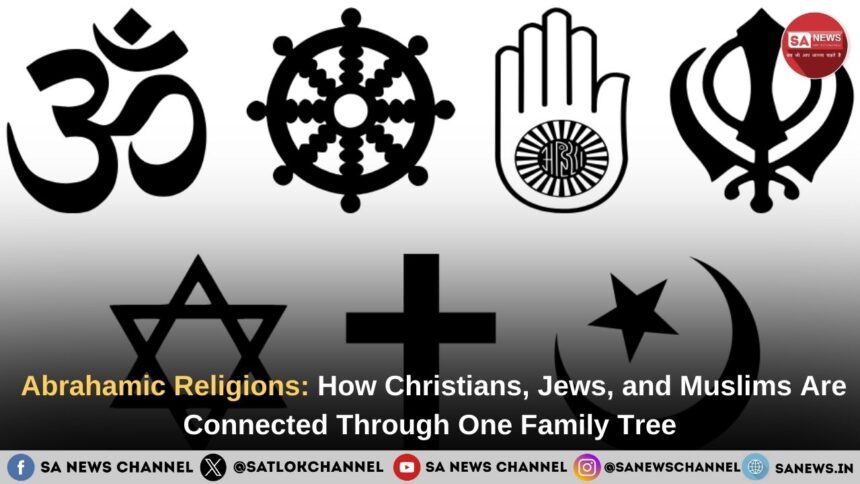
Imagine a single family dinner, roughly 4,000 years ago in ancient Mesopotamia, where a man named Abraham sat with his two sons, Isaac and Ishmael. Those two boys, born of different mothers, had no idea that their descendants would one day form three of the world’s largest religions, commanding the faith of over 4.4 billion people, more than half the planet. Christianity, Judaism, and Islam did not emerge in a vacuum. They are literally branches of the same family tree. Yet most followers of these religions today have never traced the bloodline that binds them. This article lays out the complete lineage, from Abraham’s household to the rise of Judaism, Christianity, and Islam, name by name, generation by generation. No filler. Just the story of how one ancient family split into three civilisations.
- Who Was Abraham? The Patriarch of All Three Abrahamic Religions
- Sarah, Hagar, and the Birth of Two Nations: The Great Divergence
- The Birth of Ishmael: Abraham’s Firstborn
- God’s Covenant and the Birth of Isaac
- The Banishment of Hagar and Ishmael
- The Lineage of Isaac: From Jacob to the 12 Tribes of Israel, Judaism, and Christianity
- Isaac and His Twin Sons
- Jacob Becomes “Israel”
- The 12 Sons Who Became the 12 Tribes
- From the Tribe of Judah to King David to Jesus
- The Lineage of Ishmael: From the Arabian Desert to Prophet Muhammad and Islam
- Ishmael’s 12 Sons: The Arabian Tribal Princes
- From Kedar to Adnan: The Bridge to Muhammad
- The Full Chain: Abraham to Muhammad
- The Complete Abrahamic Family Tree: Judaism, Christianity, and Islam Side by Side
- Abraham’s Third Wife Keturah: The Forgotten Branches of the Family
- Isaac and Ishmael Reunited: What Happened When Abraham Died
- Why Do These Religions Disagree If They Share the Same Father?
- The Spiritual Quest That Unites All Seekers: Beyond Religion, Toward Truth
Who Was Abraham? The Patriarch of All Three Abrahamic Religions
The story begins in Ur of the Chaldeans, in modern day southern Iraq, approximately 2,000 BCE. Abraham’s father Terah, at seventy years of age, had three sons: Abraham, Nahor, and Haran. Terah embarked on a journey from his native land, Ur of the Chaldeans, to the land of Canaan and took some family members with him.
Abraham is said to have been called by God to leave the house of his father Terah and settle in the land of Canaan, which God promised to Abraham and his progeny. This divine covenant, a promise of innumerable descendants and a promised land, is the foundation stone upon which Judaism, Christianity, and Islam are all built.
In Judaism, he is the founding father who began the covenantal relationship between the Jewish people and God. In Christianity, he is the spiritual progenitor of all believers, whether Jewish or non Jewish. In Islam, he is a link in the chain of Islamic prophets that begins with Adam and culminates in Muhammad.
But how did one man’s family split into three global religions? The answer lies in his two wives and their two sons.
Sarah, Hagar, and the Birth of Two Nations: The Great Divergence
Abraham’s wife Sarah, originally Sarai, was barren for decades. God had promised Abraham many descendants, but ten years after the promise, Sarah was still unable to have children. Sarah chose to give her servant Hagar to Abraham, in accordance with the custom of the day, so that Sarah could have a child through her, as recorded in Genesis 16:2.
The Birth of Ishmael: Abraham’s Firstborn
Hagar bore Abram a son, and Abram named his son, whom Hagar bore, Ishmael. Abram was eighty six years old when Hagar bore him Ishmael. The name Ishmael literally means “God hears”, a theophoric name translated as “God, El, has hearkened”, suggesting that a child so named was regarded as the fulfilment of a divine promise.
God’s Covenant and the Birth of Isaac
Thirteen years later, everything changed. When Abram was ninety nine years old, the Lord appeared to Abram and said, “I am God almighty; walk before me and be blameless. And I will make my covenant between me and you.” God then renamed Abram “Abraham” and Sarai “Sarah”.
Sarah conceived and bore Isaac, the son of the promise, when she was ninety years old and Abraham one hundred years old.
Now Abraham had two sons, Ishmael from Hagar and Isaac from Sarah. This is where the Abrahamic family tree splits into the lineages that would produce Judaism, Christianity, and Islam.
The Banishment of Hagar and Ishmael
Tension between Sarah and Hagar became unbearable. Sarah saw the son of Hagar the Egyptian playing with her son Isaac. So she said to Abraham, “Cast out this slave woman with her son; for the son of this slave woman shall not inherit along with my son Isaac.”
God said to Abraham, “Do not be distressed, for it is through Isaac that offspring shall be named for you. As for the son of the slave woman, I will make a nation of him also, because he is your offspring.” So Abraham sent Hagar and Ishmael away.
According to Islamic tradition, after Ishmael and Hagar were banished, they settled in Mecca, near which they found relief and water at the Well of Zamzam Water. This moment, a single family separating at a desert crossroads, is the origin point of the divergence between the Abrahamic faiths.
The Lineage of Isaac: From Jacob to the 12 Tribes of Israel, Judaism, and Christianity
Isaac’s line is the bloodline through which both Judaism and Christianity trace their origins. Here is the chain:
Abraham → Isaac → Jacob, also called Israel → 12 Sons → 12 Tribes of Israel
Isaac and His Twin Sons
Isaac was forty years old when he took Rebekah as wife. Like Sarah, Rebekah was barren and later conceived, becoming pregnant with twins. Isaac was sixty years old when she gave birth to them. The twins were Esau and Jacob.
God spoke to Rebekah and told her that the older twin, Esau, would serve the younger, Jacob. Esau despised his birthright as firstborn and sold it to Jacob for a bowl of lentils.
Jacob Becomes “Israel”
Jacob was later renamed “Israel” by God after a pivotal encounter. Jacob, later called Israel, was the second born son of Isaac and Rebekah, the younger twin brother of Esau, and the grandson of Abraham and Sarah. According to biblical texts, he was chosen by God to be the patriarch of the Israelite nation.
The 12 Sons Who Became the 12 Tribes
From what is known of Jacob, he had two wives, the sisters Leah and Rachel, and two concubines, Bilhah and Zilpah. The twelve sons form the basis for the twelve tribes of Israel: Reuben, Simeon, Levi, Judah, Dan, Naphtali, Gad, Asher, Issachar, Zebulun, Joseph, and Benjamin.
Biblical tradition holds that the twelve tribes of Israel are descended from the sons and grandsons of the Jewish forefather Jacob. These twelve tribes became the nation of Israel, the foundation of Judaism.
From the Tribe of Judah to King David to Jesus
Among the twelve sons, Judah holds the most monumental significance for both Judaism and Christianity.
Judah emerged as a leader among his brothers. His lineage led to King David, making him one of the most significant sons in biblical history.
The lineage of Jacob played a crucial role in biblical history, leading to the birth of King David and ultimately, Christians believe, Jesus. Among Jacob’s twelve sons, Judah emerged as the forefather of the royal line. God’s promise that a ruler would come from Judah’s descendants was fulfilled in David, Israel’s greatest king, and later in Jesus.
Also Read: The History of the Persian Empire: A Journey Through Time
Jesus is of the tribe of Judah, as described in Matthew 1:1 to 2. Matthew chapter 1 provides Jesus’ lineage beginning with Abraham, tracing it forward through David, his son Solomon, and on to Joseph, the husband of Mary.
So the complete Christian lineage runs:
Abraham → Isaac → Jacob → Judah → many generations → King David → many generations → Jesus of Nazareth
This is exactly how Christianity emerged from within Judaism. Jesus was a Jewish man from the Tribe of Judah, and Christianity began as a movement within the Jewish community.
| Generation | Key Figure | Significance |
| 1st | Abraham | Patriarch of all three faiths |
| 2nd | Isaac | Son of promise through Sarah |
| 3rd | Jacob, also called Israel | Father of the 12 Tribes |
| 4th | Judah, 4th son of Jacob | Ancestor of the royal and messianic line |
| Approximately 30th | King David, around 1000 BCE | Greatest king of Israel, established Jerusalem |
| Approximately 75th | Jesus of Nazareth, around 4 BCE | Central figure of Christianity; Jews still await their Messiah |
The Lineage of Ishmael: From the Arabian Desert to Prophet Muhammad and Islam
While Isaac’s line built the nation of Israel, Ishmael’s line expanded across the Arabian Peninsula and eventually gave rise to Islam.
Ishmael’s 12 Sons: The Arabian Tribal Princes
The sons of Ishmael, by their names according to their generations, were: the firstborn Nebajoth; then Kedar, Adbeel, Mibsam, Mishma, Dumah, Massa, Hadar, Tema, Jetur, Naphish, and Kedemah. These were the sons of Ishmael, twelve princes according to their nations.
Abraham’s first son Ishmael was born to him and Hagar, and twelve princes descended from him. Ishmael is the ancestor of the Ishmaelites, a neighbouring nomadic people from whom various Arab peoples trace their descent.
From Kedar to Adnan: The Bridge to Muhammad
Prophet Muhammad belonged to the generation of Prophet Ishmael, usually called Banu Ismail, meaning Children of Ishmael. One of the sons of Prophet Ishmael was Qaidar, also known as Kedar, in whose progeny a man named Adnan emerged to prominence. Adnan was the ancestor of the Adnanite tribes of Arabia. Prophet Muhammad belonged to the Quraysh branch of the Adnanites.
Adnan is considered a direct descendant of the prophet Abraham through his son Ishmael. His genealogy is of great significance in Arab and Islamic tradition, as the Islamic prophet Muhammad is said to descend from him.
The Full Chain: Abraham to Muhammad
According to Islamic prophetic tradition, Muhammad descended from Adnan. Tradition records that the genealogy from Adnan to Muhammad comprises twenty one generations.
The authenticated lineage from Muhammad to Adnan, as agreed upon by Islamic scholars, runs:
Muhammad ← Abdullah ← Abdul Muttalib ← Hashim ← Abd Manaf ← Qusayy ← Kilab ← Murrah ← Ka’ab ← Lu’ayy ← Ghalib ← Fihr, also known as Quraysh ← Malik ← al Nadr ← Kinana ← Khuzayma ← Mudrikah ← Ilyas ← Mudar ← Nizar ← Ma’ad ← Adnan
And then from Adnan back: Adnan ← … ← Kedar ← Ishmael ← Abraham
The lineage of Prophet Muhammad has three versions. The first was authenticated by biographers and genealogists and states that Prophet Muhammad’s genealogy has been traced to Adnan. The second is subject to controversies and doubt. It traces his lineage beyond Adnan back to Prophet Abraham.
Historians anticipate that Prophet Abraham and Ishmael lived in the early second millennium BCE. Thus, the estimated time period between Prophet Muhammad and Prophet Abraham is around 2,500 years.
The Complete Abrahamic Family Tree: Judaism, Christianity, and Islam Side by Side
Here is the clearest possible visual of how one household became three world religions:
| Branch | Line of Descent | Religion Founded | Key Prophet or Figure | Approximate Timeline |
| Common Root | Abraham from Ur, Mesopotamia | Not applicable | Abraham | Around 2000 BCE |
| Isaac’s Line | Abraham → Isaac → Jacob → 12 Tribes of Israel | Judaism | Moses, around 1300 BCE | Around 1800 BCE onward |
| Isaac’s Line, continued | Jacob → Judah → David → Jesus | Christianity | Jesus of Nazareth | Around 4 BCE to 30 CE |
| Ishmael’s Line | Abraham → Ishmael → Kedar → Adnan → Quraysh → Muhammad | Islam | Prophet Muhammad | 570 to 632 CE |
Jewish tradition claims that the Twelve Tribes of Israel are descended from Abraham through his son Isaac and grandson Jacob, whose sons formed the nation of the Israelites in Canaan. Islamic tradition claims that twelve Arab tribes known as Ishmaelites descended from Abraham through Ishmael.
This is the fundamental fact: Christianity did not start as a separate religion. It was born as a movement within Judaism, founded by Jesus, a Jewish man from the Tribe of Judah. And Islam did not emerge in a vacuum. It traces its lineage through Ishmael back to the same Abraham that Jews and Christians revere.
Abraham’s Third Wife Keturah: The Forgotten Branches of the Family
Most people do not know Abraham had a third wife. After the death of his wife Sarah and after Isaac married Rebekah, Abraham married Keturah, who bore him six more sons: Zimran, Jokshan, Medan, Midian, Ishbak, and Shuah.
The Midianites, often mentioned in Scripture, descended from Midian, who was one of six sons of Abraham by Keturah. Jethro, Moses’ father in law, as well as his daughter Zipporah, Moses’ wife, were Midianites of the Kenite clan.
Also Read: The History of the Crusades: A Journey Through Faith and Conflict
So Abraham fathered children through three women, Sarah, Hagar, and Keturah, making his family tree far wider than most people realise. When all of these descendants are taken into account, the size of Abraham’s family, encompassing ancient Israel and numerous peoples of the Arabian Peninsula, is enormous.
Isaac and Ishmael Reunited: What Happened When Abraham Died
Despite the rivalry between the two lineages, there is a deeply moving detail in scripture. Ishmael is seen once again in Scripture when he returned to help bury his father Abraham, as recorded in Genesis 25:7 to 10.
Both brothers, Isaac and Ishmael, the ancestors of Jews and Arabs, came together one final time to lay their father to rest. This single moment is perhaps the most powerful symbol of the bond between these faiths. No matter how far apart the branches grow, the roots remain the same.
Ishmael, commonly regarded by both Jews and Arabs as the progenitor of the Arabs, is considered a messenger and a prophet in the Quran. Meanwhile, in Jewish tradition, the Twelve Tribes of Israel were descended from Abraham and his wife Sarah’s son Isaac, via Isaac’s son Jacob. These traditions are accepted by both Islam and Judaism.
Why Do These Religions Disagree If They Share the Same Father?
The shared lineage is undeniable. But the theological divergence comes from which son carries the covenant.
Judaism and Christianity hold that God’s covenant was established through Isaac, the son of the free woman Sarah, and that the messianic line runs through Isaac’s descendant, the Tribe of Judah.
Islam holds that Ishmael was the favoured firstborn, and in Islamic tradition, Ishmael was banished to Mecca, where he helped Abraham build the Kaaba. Muslims regard Abraham as a prophet and patriarch, the archetype of the perfect Muslim, and the revered reformer of the Kaaba in Mecca. Islamic tradition considers Abraham the first pioneer of Islam and teaches that his purpose throughout his life was to proclaim the oneness of God.
The sacrifice story is another key point of divergence. In nearby Mina, Abraham attempted to sacrifice Ishmael, rather than Isaac as stated in the Old Testament, an event commemorated on Eid al Adha and in the rituals of the Hajj.
Each faith reads the same family story through a different lens, and that lens has shaped civilisations, empires, wars, and peace treaties for over three millennia.
The Spiritual Quest That Unites All Seekers: Beyond Religion, Toward Truth
From Ancient Lineage to Eternal Purpose
The story of Abraham’s family reveals something both humbling and extraordinary: Christians, Jews, and Muslims are theological cousins, descendants of the same patriarch, worshipping the same one God, divided primarily by questions of which son inherited the covenant. The shared blood is real. The shared God is real. The shared longing for divine truth is real.
But this very longing raises the deepest question of all. Beyond the lineage and the history, who is the Supreme God, and what does He truly want from us?
For those seeking answers that transcend the boundaries of any single tradition, the books “Gyan Ganga” and “Way of Living” by Saint Rampal Ji Maharaj provide a remarkable scriptural analysis, drawing evidence from the Bible, the Quran, the Torah, the Vedas, and other holy texts to present a unified spiritual truth about God and the path to salvation.
When three faiths share one father, perhaps the truth they all seek is also one. The journey from knowing about God to truly knowing God begins with the courage to look beyond inherited boundaries.
Disclaimer: This article is written for educational and informational purposes. It respects all faith traditions and encourages interfaith understanding and genuine spiritual inquiry.