


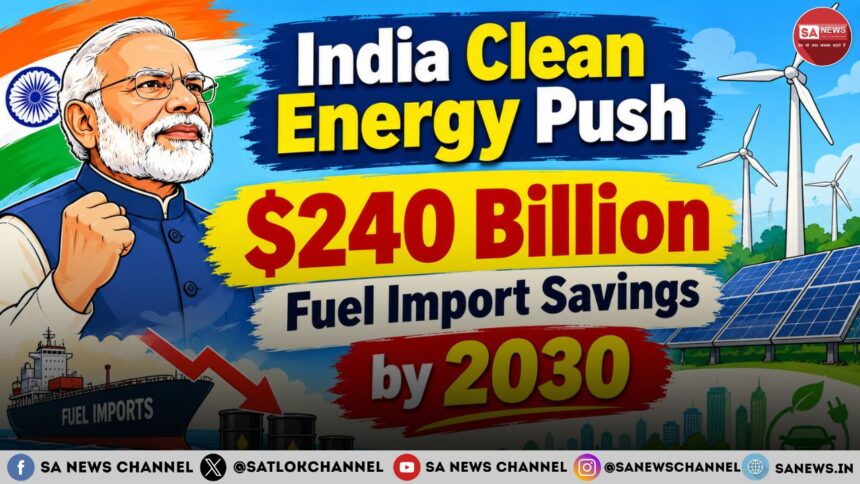
Thanks to growing investment into renewable energy sources in India, the country could see significant economic benefits thanks to its increased clean energy electricity generation. According to the International Energy Agency (IEA), the country could see close to $240 billion saved on coal and natural gas imports by 2030.
- Renewable energy is becoming a significant part of India’s economic strategy.
- How can renewable energy save India’s Fuel Imports?
- Solar and Wind Generation will See Largest Savings
- This could reduce the amount of fossil fuels that need to be imported.
- Clean energy can improve India’s Energy Security
- What issues could hinder India’s Clean Energy Growth?
- India’s Clean Energy Transition Has Economic Benefits
Renewable energy is becoming a significant part of India’s economic strategy.
India has a large dependency on fossil Fuel Imports to meet its energy demands. Fluctuations in international fuel prices can place pressure on the country’s economy. However, increased solar and wind generation can reduce this reliance and help preserve precious foreign exchange.
The IEA’s India Renewable Energy Market Report 2026, released on November 3, shows how India is seeing a shift in its energy mix.
How can renewable energy save India’s Fuel Imports?
India has a large reliance on coal and natural gas generation. With a large proportion of these fuels being imported, the country is exposed to fluctuations in the international energy market.
Solar and wind generation can help to mitigate this issue. Since renewable energy projects are in operation, they can generate electricity without importing fuel regularly.
Between 2011 and 2025, the IEA estimates that India has saved more than $100 billion on coal and natural gas imports thanks to renewable electricity generation. This could double by 2030.
The IEA also estimates that if fuel prices remain around average levels seen in 2024-25, close to $240 billion could be saved by 2030.
Approximately $35 billion could be saved annually in fossil Fuel Imports by 2030.
Solar and Wind Generation will See Largest Savings
Solar and wind generation will see the largest reductions in Fuel Imports.
Solar PV could contribute to close to 60% of the total savings, whilst wind could contribute close to 30%.
Solar generation is set to see the largest growth in India’s renewable electricity generation. The country has had growing solar production facilities, competitive project construction and ongoing investment.
The IEA has projected that by 2030 India’s renewable energy capacity could hit around 530 gigawatts (GW), with solar PV capacities alone reaching over 350 GW.
This could reduce the amount of fossil fuels that need to be imported.
India has made great strides in renewable energies
Over the last decade, India has seen significant growth in its renewable energy sector.
The IEA says that renewable energy capacity now exceeds 300 GW in the 4th quarter of 2026, almost four times greater than a decade ago.
India also reached its 50% target for non-fossil fuels in its installed electricity capacity in 2025 — five years ahead of schedule.
Without these additions to solar, wind and bioenergy, India would have imported 110 million extra tonnes of coal in 2025.
This demonstrates how relying on domestically produced renewable energy can reduce Fuel Imports.
Clean energy can improve India’s Energy Security
India has a large reliance on imported fuels, meaning it can be vulnerable to international issues. Conflicts, supply issues and rapid price changes can affect the cost of energy.
Renewable energy can help to reduce this risk. Increasing domestic electricity generation reduces the risks.
IEA Executive Director Fatih Birol has highlighted how India’s increasing renewable energy usage is improving energy security within an uncertain global energy market. Consistent policies can also help to reduce costs of renewables and attract investment.
As the IEA report states, India also saw the addition of domestically produced biofuels reduce its crude oil import reliance by around 4 percentage points in 2025.
Compressed biogas and green hydrogen could also give further opportunities to replace imported fossil fuels.
What issues could hinder India’s Clean Energy Growth?
Whilst solar panels and wind farms will increase, India will also need infrastructure in place to ensure renewable energy can be delivered effectively to homes, businesses and industries.
The IEA has identified a few areas that still need investment:
New transmission infrastructure will be needed to send electricity generated from renewable projects to high demand areas.
Energy storage can help to manage irregularities in solar and wind generation.
Flexible electricity networks.
Timely approvals, funding and infrastructure connections will be needed for projects.
If these areas do not develop, some renewable energy will not be used.
India’s Clean Energy Transition Has Economic Benefits
The forecast of $240 billion in fuel savings demonstrates how important renewable energy can be economically. Reducing reliance on imported coal and natural gas can reduce pressure on foreign exchange and make India less vulnerable to fluctuations in international energy prices.
It can boost local manufacturing and provide opportunities for investment. However, this is dependent on ongoing growth in renewables, infrastructure, policy and fuel prices.
The next step for India will be to ensure that its increasing renewable capacity can provide a reliable and affordable source of energy. If investment continues into generation, transmission and energy storage, clean energy could become a key part of the country’s economic and energy security strategy.
India’s journey into renewable energy is not just about creating cleaner electricity, but reducing reliance on imports, keeping the economy stable and creating a more secure energy future.