


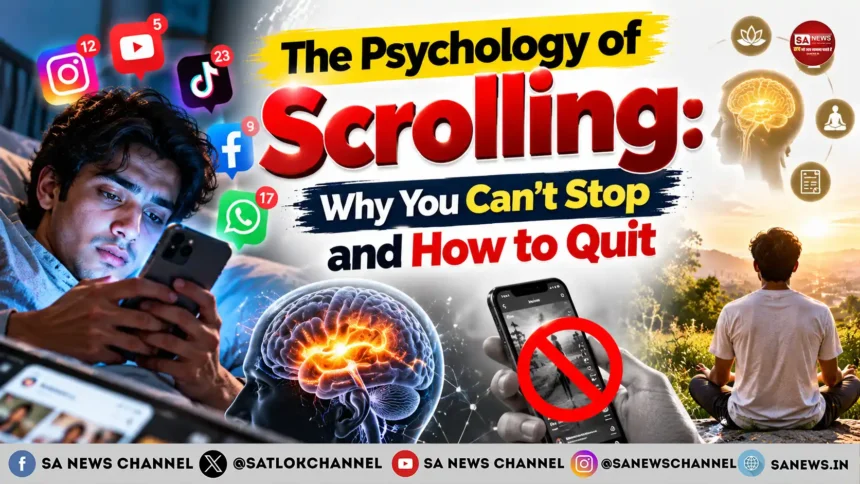
You open your phone to check one text. Forty minutes later, your thumb is still swiping. You can’t even recall what you’ve been watching. This ubiquitous problem is the psychology of scrolling at work: primal rewards meeting an infinite feed.
- The Psychology of Scrolling Simplified
- Scrolling vs Doomscrolling
- The Psychology of Wanting vs Liking and Dopamine Detox
- Variable Rewards and the Slot Machine Analogy
- Why Infinite Scroll and Algorithms Are So Powerful
- The Psychology of Endless Scrolling and Mental Health
- How Scrolling Impacts Attention and Sleep
- How to Stop Scrolling
- Step 1: Identify Triggers
- Step 2: Create Barriers
- Step 3: Devalue Rewards
- Step 4: Reinstall a Stop Cue
- Step 5: Replace and Protect
- Step 6: Curate Your Feed
- Step 7: Ride Out the Wave
- Quitting Scrolling: A Step-by-Step Practical Guide
- The Psychology of Scrolling: By the Numbers
- Beyond the Psychology of Scrolling: Finding What Truly Fills You
The scale of the issue is colossal. The global average for social media use stands at 141 minutes per day, with Indians spending nearly 5 hours per day on their phones, 70% of which is spent on social media, games and video. Researchers have started to document compulsive scrolling as a measurable phenomenon associated with anxiety, stress and poor well-being.
This article will walk you through the psychology of scrolling, the latest research on its impact from anxiety to sleep patterns, and what interventions really work. We’ll give you a practical step-by-step plan to quit scrolling for good.
The Psychology of Scrolling Simplified
Scrolling refers to the ubiquitous swiping up and down on a smartphone to view a continuous stream of content. The psychology of scrolling refers to the reasons why we do it, and why it can become so difficult to stop.
The most common reason for scrolling is boredom, but this is only one potential trigger. Other triggers can be stress, a feeling of wasted time, or even a specific urge for connection.
Once triggered, scrolling provides an almost instant reward in the form of novel content. After multiple associations between a trigger, an action (scrolling) and a reward, the urge to scroll can happen automatically. The act of scrolling itself becomes reinforcing.
Scrolling vs Doomscrolling
While doomscrolling is a relatively new term, it describes a behaviour pattern that has been extensively studied. A scoping review of 50 empirical studies found that doomscrolling consists of repetitive, prolonged and difficult to stop engagement with threatening content.
Doomscrolling differs from general scrolling in that it has uncertainty, information-seeking and unpleasant content as underlying factors. The mechanics of doomscrolling are the same as regular scrolling, but with negative content fuelling the urge to continue.
The Psychology of Wanting vs Liking and Dopamine Detox
The dopamine detox concept assumes that you need to stop scrolling entirely in order to get a dopamine reset. This is not an accurate understanding of how dopamine works.
Reward circuitry in the brain is complex, but one established finding is that dopamine is primarily associated with wanting rather than liking. Dopamine levels are increased not only when we achieve a goal, but also when we anticipate a reward.
This means that you may continue to scroll even when you’re not actively enjoying the content, because your brain is conditioned to associate scrolling with rewards.
An academic paper published by Public Health England in 2026 provides a plausible framework for understanding why dopamine detoxes may not be effective. The paper suggests that brief increases in dopamine followed by gradual tolerance development could potentially be engineered into a scrolling cessation plan, but this remains an emerging area of research.
Variable Rewards and the Slot Machine Analogy
The famous psychological experiments conducted by B. F. Skinner demonstrated that variable-ratio reinforcement schedules are the most powerful in terms of encouraging behaviour. This means that unpredictable rewards are far more compelling than consistent ones. This principle is applied in gambling machines, where the reinforcement schedule is randomised.
The infinite scrolling feature on social media feeds operates on the same principle. Some posts are more rewarding than others, but you never know which one it will be. An Indian psychology study found similar reinforcement patterns in Indian social media users. The study suggests that intermittent reinforcement with occasional high-value rewards may explain the addictive potential of social media. Autoplay and pull-to-refresh features essentially turn your phone into a gambling machine.
Some of the most common variable-reinforcement triggers in scrolling are:
Pull to refresh: Something interesting might appear.
New notifications: You might have received a reply or a like.
Likes and comments: Your post might be doing well.
Autoplay: The next video might be good.
Why Infinite Scroll and Algorithms Are So Powerful
Traditional media had definite “ends”, but social media feeds and many digital publications now use infinite scrolls that remove this stopping point. A paper published in the International Journal of Indian Psychology argued that infinite scroll exploits the psychological challenge of recognising when a task is complete.
The creator of infinite scroll, Aza Raskin, has stated that he regrets the design because it removes the pause built into traditional media that lets the user reflect. Without this pause, the only reason to stop is an external factor like hunger or an incoming call.
The algorithms used by social media platforms further fuel the cycle. A 2026 scoping review found that doomscrolling was reinforced by habitual engagement with content, with features like infinite scroll and algorithmic recommendations playing a key role. The recommendation engine learns what content keeps you engaged and shows you more of it, while negative content like sensationalised news increases the sense of urgency to continue scrolling.
Also Read: The Death of Privacy: Does AI Know You Better Than You Know Yourself?
The Psychology of Endless Scrolling and Mental Health
Anxiety, Stress and Low Mood
Across the 50 studies included in the doomscrolling scoping review, anxiety, depression, stress, and poor psychological well-being were frequently reported outcomes of doomscrolling. Several studies identified intolerance of uncertainty and poor emotion regulation as potential individual risk factors.
A 2026 Indian study of 390 Chandigarh University students found that 87.8% had mild doomscrolling tendencies, with 1.1% (four students) showing signs of severe doomscrolling. The study associated doomscrolling with higher levels of anxiety, stress and depressive symptoms.
Cause or Effect?
It’s important to remember that correlation does not equal causation. The studies on doomscrolling and mental health do not indicate whether poor well-being causes doomscrolling or if doomscrolling causes poor well-being. However, the authors of the 2026 Indian study note that the relationship is likely bidirectional.
Similarly, two cross-sectional studies on Polish adults found that doomscrolling acted as a mediator between social media addiction and war-related anxiety, but the inability to establish causation remains an important limitation.
Who Is Most at Risk?
Certain individuals are more vulnerable to doomscrolling than others. One 2026 review identified intolerance of uncertainty as a significant risk factor for doomscrolling. Another study on Indian adolescents suggested that poor self-regulation abilities contribute to doomscrolling as a coping mechanism for stress.
A World Health Organization survey of 280,000 adolescents across Europe, Central Asia and Canada found that problematic social media use increased steadily across the four-year period between 2018 and 2022, from 7% to 11%. Individuals struggling with existing mental health issues are also more likely to use social media as a coping mechanism, which can exacerbate their problems.
How Scrolling Impacts Attention and Sleep
Attention and Notifications
The psychology of scrolling is not exclusively about the length of a session. It also affects attention.
A study of 180 university students found that a smartphone notification can disrupt attention for up to 7 seconds. Beyond the sheer number of interruptions, researchers noted an association between notification burden and attention problems as well as increased checking frequency.
Another study of 221 University of British Columbia students provides additional evidence on the impact of interruptions. Students who kept their phones on and within reach for a week reported higher rates of inattention and hyperactivity compared to those who had their phones off. The lead author cautioned that the results should not be interpreted as smartphone use causing ADHD, but acknowledged the disruptive impact of interruptions.
The ability to focus is impacted not only by the length of phone sessions but also by how often you have to pick up your phone.
Short-Form Video and Focus
Short-form video represents a growing threat to attention. A 2026 survey of 55 participants found that uncontrollable scrolling on a short-form video platform led to poorer attention and increased fatigue. Withdrawing from short-form video can be challenging. Some research suggests that short-form video viewing can lead to cravings similar to substance use.
It is important to interpret these results with care. While several studies associate short-form video use with poorer attention, they are correlational and cannot establish causation. There is no proof that short-form video causes reduced attention, but there is evidence that short attention spans lead to greater engagement with short-form video.
Scrolling and Sleep
The impact of screen time on sleep schedules is well-established, but the evidence on the impact of scrolling specifically is more nuanced than many headlines suggest.
A 2026 scoping review of longitudinal studies identified mixed associations between social media use and sleep schedules, with approximately 70% of studies reporting negative effects. However, the review notes that much of the evidence was based on self-reported measures.
A 2026 study of teenage social media users found that an additional hour of daytime social media use only pushed bedtime back by about two minutes and had no measurable impact on sleep efficiency. However, social media was associated with later wake-up times and irregular schedules.
The study presented at the SLEEP 2026 meeting also found that pre-sleep smartphone use predicted increased overnight phone use in adolescents. Night scrolling is rarely a one-night affair. It usually sets the stage for subsequent nights.
How to Stop Scrolling
Your willpower is not going to be enough when it comes to breaking a scroll-cessation habit. Here is our evidence-based step-by-step approach.
Step 1: Identify Triggers
All behaviours have triggers that turn them from conscious choices into unconscious habits. During the first three days, write down a single word every time you find yourself mindlessly opening a social media app.
Common triggers include boredom, stress, loneliness, or trying to avoid responsibilities. If you can’t identify any, then you can’t move forward.
Step 2: Create Barriers
Move social media apps to the last screen.
Log out after every session.
Change display settings to grayscale.
Avoid social media apps in favour of the browser.
Set app limits.
The best-proven method for creating barriers is changing display settings to grayscale. A University of Amsterdam study of 84 participants found that a one-week intervention reduced overall screen time by approximately 20 minutes per day, but the number of phone unlocks was unchanged. In other words, users were spending less time on their phones but were not checking their phones any less frequently.
Earlier research has shown decreases in screen time between 22 and 50 minutes per day after a similar grayscale intervention. You may want to consider other barriers, but grayscale is universally available and doesn’t require any special permissions.
The effectiveness of barriers is difficult to overestimate. A large randomised trial of full-screen personalised notifications among 70 participants found mixed results for overall well-being, but the mere act of inserting interruptions can be sufficient to disrupt the scroll loop.
Step 3: Devalue Rewards
The main attraction of scrolling is the reward schedule. The most effective reward schedule is the variable one, which essentially turns any scroll session into a game of slot machine.
To devalue rewards, disable all notifications except for calls and messages, and try to check social media only at two or three predetermined times per day. If possible, disable autoplay features and other suggestions.
Step 4: Reinstall a Stop Cue
Many digital products use a visible timer at the top of the page or app to help users track how long they’ve spent there. Set a visible phone timer before opening a social media app, and put your phone down when the timer goes off.
Another essential change is to replace infinite scrolls with more traditional formats. Choose email newsletters over social media feeds, and try to engage with news at a fixed time every day rather than in random moments throughout the day. If you must watch videos, commit to a specific length for each video.
Psychology researcher Alexander Sharpe of the University of Chichester notes that one approach to stop doomscrolling would be to combat the infinite scroll design. Until the design changes, you can replicate the boundaries of a physical page with a phone timer.
Step 5: Replace and Protect
If you’re removing a habit without replacing it, you’re setting yourself up for failure. Match common triggers with suitable alternatives.
When boredom sets in, go for a walk.
When loneliness strikes, call a friend.
When you’re ready to sleep, read a book.
Keep your phone away from the bedroom and use a traditional alarm clock to wake up in the morning.
The same principle applies to adults as well. Use a finite, non-scroll activity to replace an infinite one.
Also Read: Why 15 Minutes of Bedtime Reading Can Shape Your Child’s Future
Step 6: Curate Your Feed
You can’t leave, but you can change what the algorithm shows you. Unfollow or mute any accounts that make you feel anxious, and use the “following” tab instead of the algorithmically curated one where possible.
Report accounts that consistently post negative content as “not interesting”, and give the algorithm time to adjust. Many psychology researchers believe that the ability to detect accounts with disproportionately negative content is an intuitive skill, and it’s worth using it.
Step 7: Ride Out the Wave
Urges to scroll are like waves. They come, and if you wait patiently, they will subside.
When you feel an urge to scroll, wait for 10 minutes, and if the urge doesn’t go away, engage in a minor physical activity like stretching or getting a glass of water. If the urge still hasn’t gone away, consciously scroll with your phone timer on. The urge is unlikely to last long enough for you to reach the end of your scroll session.
Quitting Scrolling: A Step-by-Step Practical Guide
Go Slow and Measure
Quitting scrolling cold turkey is rarely an effective strategy. Cut your scrolling time by approximately 20% per week, and measure the impact. Some research suggests that restricting social media entirely could potentially have adverse effects by provoking cravings in users.
Measure as you go. Summarise your weekly report every Sunday, and make one small change to your behaviour based on what you’ve observed. Be prepared to accept setbacks, and when one occurs, examine what may have triggered it rather than beating yourself up over it.
When to Seek Professional Help
Seek professional help when social media starts to take precedence over other activities that you enjoy or find important. If you feel restless or irritable when you can’t scroll, if your attempts to limit your social media use have failed, or if you prioritise social media over other responsibilities, it may be a sign that social media is negatively impacting your life.
Social media addiction is not officially recognised as a mental health condition in the same way substance use disorders are, but the patterns of compulsive use bear similarities to behavioural addictions. The psychological treatment options, particularly Cognitive Behavioural Therapy, are similar to existing treatments for internet addiction.
If social media is negatively affecting your mental health, affecting sleep patterns, or contributing to feelings of anxiety or depression, it may be worth consulting with a healthcare professional or counsellor.
The Psychology of Scrolling: By the Numbers
How Much Are We Really Scrolling?
| Metric | Figure | Source and Year |
| Global average daily social media time | 141 minutes | DataReportal via Statista, 2025 |
| Average daily mobile screen time in India | About 5 hours | EY, 2024 |
| Share of Indian mobile time spent on social media, games and video | Nearly 70% | EY, 2024 |
| Students with mild doomscrolling, out of 390 | 87.8% | International Journal of Indian Psychology, 2026 |
| Students with severe doomscrolling | 1.1% | International Journal of Indian Psychology, 2026 |
| Adolescents with problematic social media use | 11% in 2022, up from 7% in 2018 | WHO survey, 2026 |
| Monthly mobile data use per user in India, 2025 | 24 GB, compared with 62 MB in 2014 | Story Board18, government data, 2026 |
The global average of time spent on social media stands at 141 minutes per day as of February 2025, down slightly from 143 minutes per day in the previous year. Analysts suggest that daily social media use has peaked and is now characterised by shorter, more frequent sessions. The number of short sessions fits the pattern of a variable reinforcement schedule. The rise in adolescent problematic social media use demonstrates that average time spent can be misleading.
In India, EY estimated that Indians collectively spent 1.1 trillion hours on their smartphones during 2024. The availability of cheap data has contributed to this trend, as reflected in India’s smartphone data consumption figures: 24 GB per user per month as of 2025, compared to just 62 MB per month in 2014.
Does Quitting Really Work?
| Study | Design | Conclusion |
| Wolgast et al., Journal of Technology in Behavioral Science, 2023 | Randomised trial, 30-minute social media use limit for young adults | Reduced social media use was linked to less stress, depression, and increased self-esteem |
| Journal of Technology in Behavioral Science trial | Randomised “reduce” group | Use decreased by approximately 37 minutes per day, with reduced social media addiction |
| University of Amsterdam grayscale study, 2024 | One-week intervention, 84 participants | Approximately 20 minutes less screen time per day, with number of unlocks unchanged |
| Full-screen nudge trial, Carleton University, 2026 | Randomised trial, 70 participants | Mixed well-being results |
| Carleton University study, 2026 | 30-minute social media limit for three weeks | Most participants failed to comply, with no additional well-being benefits for those who did |
| Kindness-scrolling experiment, 2026 review | Experiment | Short-term positive mood benefits only |
The results are mixed, and this is the most important finding. Wolgast and his colleagues found that both reduced social media use and unrestricted use had positive effects on present-focused awareness, while a 2026 review of three studies found that most young adults who volunteered to reduce their social media use by 30 minutes per day failed to do so, and those who succeeded did not report any additional well-being benefits.
The researchers also note that socially anxious or motivated individuals may benefit from a more structured approach to reducing social media use. Grayscale has limited utility as an intervention, as the one-week University of Amsterdam study found that the number of unlocks was virtually unchanged, which means that the psychological reward of checking was still present.
A combination of interventions is likely to be more effective, with a comprehensive plan to reduce social media use being significantly more beneficial than any one measure.
Beyond the Psychology of Scrolling: Finding What Truly Fills You
The psychology of scrolling shows that endless feeds succeed by exploiting anticipation, not by satisfying us. Break the loop with friction, schedules and finite replacements, and the hours you reclaim will ask a bigger question: what deserves your attention?
Many people find that once the noise quiets, a deeper hunger for purpose and peace becomes audible. Reflecting on who we are and why we are here is among the oldest human practices. Readers who wish to explore that journey may find “Gyan Ganga“ and “Way of Living” by Saint Rampal Ji Maharaj thoughtful companions, offering a lens on meaning, devotion and conduct. Take a quiet hour this week, put the phone in another room, and begin.