


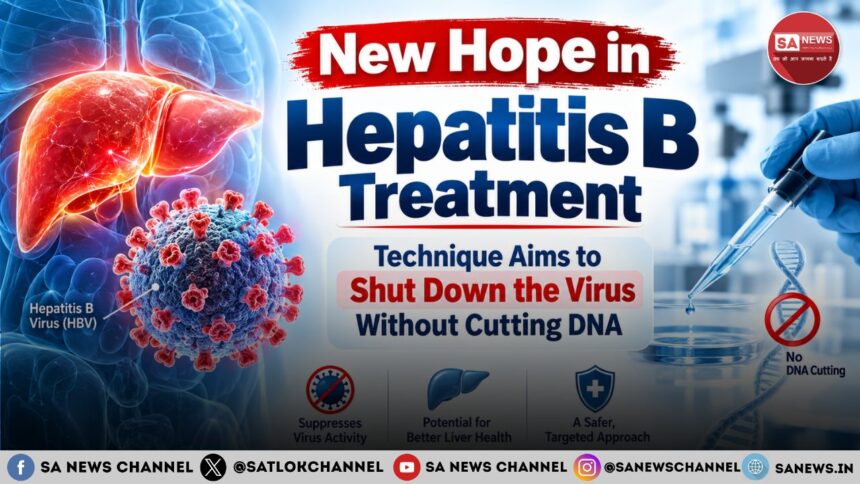
Scientists have developed a new and potentially significant technique in the treatment of Hepatitis B. According to a report by Nature, the experimental treatment called CRMA-1001 attempts to suppress the activity of the virus by making chemical changes to its DNA instead of cutting the DNA or altering its genetic structure. This technique has been developed as an epigenetic editing approach.
- News Highlights
- Why Does Hepatitis B Treatment Remain a Challenge?
- A ‘Silencing Tag’ Instead of Cutting DNA
- Drug Components Remain for a Short Time, While the Effect Is Intended to Last Longer
- Important Results Seen in Animal Studies
- Reduction in Virus-Related Activity Also Seen in Human Cells
- Investigation of Unintended Effects on Human Genes
- Safety Results in Non-Human Primates
- Possibility of Combination with Existing Treatment
- Treatment Not Yet Confirmed, Human Trials Will Be Decisive
- Permanent Relief from Diseases Through True Devotion to the Supreme God
- FAQs
Researchers tested its effects on human cells and various animal models, where a significant reduction in key virus-related markers was observed. In some studies, this effect continued for several months after three doses. However, the treatment is still in the experimental stage, and clinical trials will be necessary to confirm its effectiveness, safety, and long-term outcomes in humans.
News Highlights
- The name of the new technique is CRMA-1001.
- It attempts to add a chemical DNA-methylation tag to the virus instead of cutting its DNA.
- Its aim is to silence the active DNA of Hepatitis B.
- CRMA-1001 delivers guide RNA and mRNA to liver cells through a lipid nanoparticle.
- A reduction of more than 3-log was recorded in key virus-related markers in animal models.
- After three doses, HBsAg and HBV DNA remained below the detection limit in up to 90% of animals at 6 months in some studies.
- A reduction of up to 98% in HBsAg and HBeAg was observed during testing in human cells.
- In non-human primate studies, a temporary increase in liver transaminase was observed at the highest dose.
- Researchers did not find related unintended effects on human genes in the human cells tested.
- Scientists stated that the actual effect and long-term safety of the treatment in humans will become clear through clinical trials.
Why Does Hepatitis B Treatment Remain a Challenge?
Hepatitis B virus is an infection that affects the liver, and more than 250 million people worldwide are considered to be affected by chronic Hepatitis B. Current treatments can suppress viral activity, but permanently silencing all active DNA sources of the virus has remained difficult. This is why achieving a functional cure despite long-term treatment continues to be a challenge.
In HBV infection, viral DNA can exist in different forms inside liver cells. The challenge for scientists is to not only suppress the virus but also reduce the activity of those DNA sources from which viral proteins and material related to new viruses can be produced.
A ‘Silencing Tag’ Instead of Cutting DNA
The key feature of CRMA-1001 is its Epigenetic Silencing approach. In conventional gene-editing techniques, attempts may be made to cut or alter the DNA sequence, but this treatment does not cut the DNA sequence.
In this approach, a guide RNA identifies the targeted HBV DNA region. The effector protein associated with it causes DNA methylation at that region. This chemical change works to suppress transcription from the viral DNA. In other words, the aim is not to destroy the virus’s genetic code but to shut down its activity.
Drug Components Remain for a Short Time, While the Effect Is Intended to Last Longer
In CRMA-1001, guide RNA and mRNA are packaged into a lipid nanoparticle, or LNP, to deliver them to liver cells. Inside the cells, the mRNA produces an epigenetic effector protein, which reaches the targeted part of the HBV DNA with the help of the guide RNA.
According to the research, the treatment components remained present for a relatively short period, while the DNA methylation and gene-silencing effects generated by them may last longer. This characteristic creates a scientific possibility of developing the technique as a treatment that may require a limited treatment period.
Important Results Seen in Animal Studies
CRMA-1001 was tested in several HBV mouse models. Researchers reported that a single dose resulted in a reduction of more than 3-log in HBV biomarkers. The effect increased after three monthly doses.
In one study, approximately 90% of animals in the groups receiving three doses had both HBsAg and HBV DNA below the lower limit of quantification of the assay after 6 months. This result is considered important because the aim of the treatment is not only to suppress the virus for a short period but to keep its transcriptional activity silent for a longer period.
Reduction in Virus-Related Activity Also Seen in Human Cells
CRMA-1001 was also tested on human hepatocytes infected with Hepatitis B in laboratory settings. According to researchers, treatment resulted in a reduction of up to 98% in HBsAg and HBeAg in HepG2-hNTCP cells and primary human hepatocytes.
The study also found increased methylation in specific regions of HBV DNA after treatment. This supports the scientific mechanism according to which targeted methylation can suppress viral transcription.
Investigation of Unintended Effects on Human Genes
Safety and specificity are important issues in the development of any gene-targeting therapy. For CRMA-1001, researchers used primary cells obtained from different human tissues to examine gene expression and DNA methylation.
In analyses of three types of human primary cells and samples from a total of nine donors, researchers did not find any human gene that showed both DNA hypermethylation and a corresponding change in gene expression. However, this is preclinical evidence and cannot be considered final proof of broad safety in the human body.
Safety Results in Non-Human Primates
The study also examined the safety and distribution of CRMA-1001 in non-human primates. A temporary increase in liver transaminase levels was observed at the highest dose tested, but the study found that the increase returned to normal after treatment.
Researchers also reported that germline distribution was not detected in the study. Nevertheless, clinical trials will be necessary to determine the actual safety profile in humans.
Possibility of Combination with Existing Treatment
Researchers also examined CRMA-1001 in combination with a nucleoside analogue therapy such as entecavir. The study found an additive effect on HBV DNA suppression when the two treatments were combined.
This is because the two treatments affect the virus at different levels. However, this does not mean that patients should stop or change their current medicines. Any treatment change should be decided only on the basis of medical advice.
Treatment Not Yet Confirmed, Human Trials Will Be Decisive
It would be premature to consider this discovery a definitive cure for Hepatitis B. The research published in Nature mainly presents preclinical evidence. The researchers themselves acknowledged that available animal models cannot completely reproduce human Hepatitis B infection and its full biology.
In particular, non-human primates are not naturally infected with HBV. Therefore, it is not clear whether the epigenetic silencing observed in animal models will remain at the same level and for the same duration in human patients.
Nevertheless, the study of CRMA-1001 presents an important scientific direction in this field—silencing active viral genes through epigenetic methods without cutting the virus’s DNA. If future human trials confirm its effectiveness and safety, it could open a new possibility for a limited-duration treatment approach for chronic Hepatitis B. For now, it is necessary to wait for clinical data to determine its actual benefits and long-term outcomes.
Permanent Relief from Diseases Through True Devotion to the Supreme God
A person spends most of their life in the race to accumulate wealth and property, and in this rush, they gradually move away from the real purpose of life. They continue accumulating wealth believing that this property will help them with their body, food and upcoming illnesses. But can money cure every disease? Even today, there are many serious diseases in the world for which medical science does not have a permanent solution.
Sant Rampal Ji Maharaj explains that according to the evidence in the holy Vedas, the Supreme God can remove even the most severe suffering of His true devotee and grant them a lifespan of 100 years. Many devotees who have adopted the true devotion taught by Him share their experiences of receiving relief from serious diseases such as cancer and experiencing happiness and peace in their lives.
FAQs
1. What is CRMA-1001?
CRMA-1001 is an investigational epigenetic silencer therapy being developed for Hepatitis B, with the aim of suppressing HBV DNA transcriptional activity.
2. Does CRMA-1001 cut DNA?
No. Its mechanism is based on suppressing transcription through epigenetic changes such as methylation on targeted HBV DNA rather than cutting the DNA sequence.
3. Has Hepatitis B been completely cured by this?
It would not be correct to say so at present. The current results come from preclinical studies. Results from clinical trials are necessary to confirm a functional cure in humans.
4. What were the results of the animal testing?
After three doses, some mouse studies found HBsAg and HBV DNA below the detection/quantification limit in approximately 90% of animals at 6 months.
5. Can it replace existing Hepatitis B medicines?
No such conclusion can be drawn at present. The study also examined its combination with entecavir, but any change in patient treatment should be based only on clinical evidence and medical advice.