

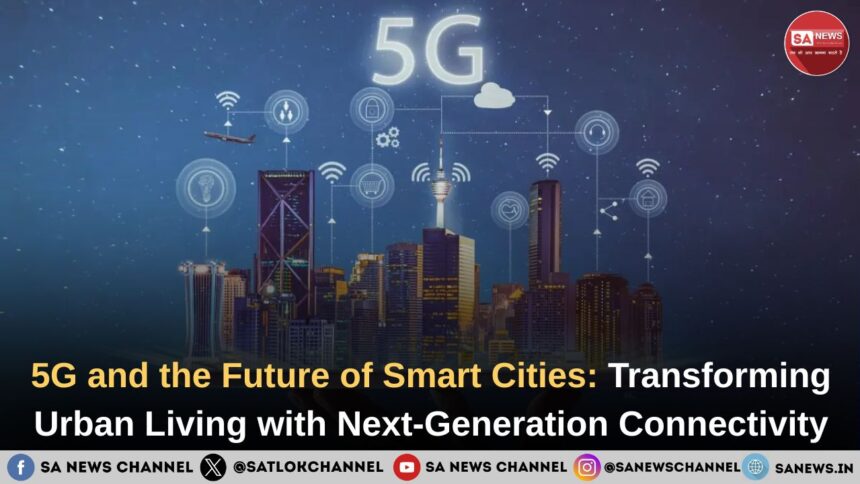
The rapid evolution of digital technology is changing the way cities function. As urban populations continue to grow, governments around the world are investing in smart city initiatives to improve the quality of life for citizens. One of the most significant technologies driving this transformation is 5G, the fifth generation of wireless communication.
- What is 5G?
- Understanding Smart Cities:
- Why 5G is Essential for Smart Cities:
- Applications of 5G in Smart Cities:
- 1. Intelligent Transportation
- 2. Autonomous Vehicles
- 3. Smart Healthcare
- 4. Public Safety
- 5. Smart Energy Management
- 6. Smart Water Management
- 7. Smart Waste Management
- 8. Environmental Monitoring
- 9. Smart Buildings
- 10. Education
- Role of Artificial Intelligence:
- Internet of Things (IoT):
- Economic Benefits:
- Environmental Benefits:
- Challenges:
- The Future of Smart Cities:
- Role of Sant Rampal Ji Maharaj in human welfare:
- Final Thoughts:
- FAQs:
Unlike previous generations of mobile networks, 5G offers ultra-fast internet speeds, extremely low latency, and the ability to connect millions of devices simultaneously. These capabilities make it the foundation of future smart cities, where traffic lights communicate with vehicles, hospitals monitor patients remotely, waste bins notify collection services when full, and public safety systems respond instantly to emergencies.
The future of smart cities depends on reliable, intelligent, and high-speed connectivity, and 5G provides exactly that.
What is 5G?
5G is the latest generation of mobile communication technology, succeeding 4G LTE. It is designed to support massive data traffic while delivering high-speed, secure, and reliable connections.
Key Features of 5G:
- Peak download speeds can reach up to 10–20 Gbps under ideal conditions, although real-world speeds are typically much lower
- Latency can be as low as 1 millisecond in ideal deployments
- Supports over one million connected devices per square kilometre
- Improved network reliability
- 5G supports energy-efficient communication for many IoT devices through technologies such as NB-IoT and optimized power-saving modes
- Enhanced security and network efficiency
These features enable technologies that were previously impossible or impractical.
Understanding Smart Cities:
A smart city uses digital technologies, sensors, artificial intelligence (AI), cloud computing, and the Internet of Things (IoT) to improve public services and infrastructure.
The primary objectives of a smart city include:
- Better transportation
- Efficient energy usage
- Reduced pollution
- Improved healthcare
- Enhanced public safety
- Sustainable urban development
- Faster government services
- Better quality of life
Why 5G is Essential for Smart Cities:
Smart cities generate enormous amounts of data every second. Traffic cameras, surveillance systems, smart meters, connected vehicles, environmental sensors, and healthcare devices all require instant communication.
5G enables:
- Near real-time communication
- High-speed data transfer
- Massive IoT connectivity
- AI-powered automation
- Reliable cloud computing
- Intelligent infrastructure
Without 5G, many smart city applications would experience delays and limited performance.
Applications of 5G in Smart Cities:
1. Intelligent Transportation
Traffic congestion is one of the biggest urban problems.
With 5G:
- Smart traffic lights adjust automatically.
- Vehicles communicate with each other.
- Emergency vehicles receive priority.
- Public transport becomes more efficient.
- Real-time navigation reduces travel time.
Benefits include fewer accidents, lower fuel consumption, and cleaner air.
2. Autonomous Vehicles
Self-driving vehicles require ultra-low-latency communication.
5G enables:
- Vehicle-to-vehicle communication
- Vehicle-to-infrastructure communication
- Real-time obstacle detection
- High-definition mapping
- Remote monitoring
This significantly improves road safety.
3. Smart Healthcare
Hospitals benefit greatly from 5G.
Applications include:
- Remote patient monitoring
- Telemedicine consultations
- AI-assisted diagnosis
- Connected ambulances
- Wearable health devices
Doctors can monitor patients remotely in near real time, depending on network availability and medical systems.
4. Public Safety
5G strengthens emergency response by enabling:
- Smart surveillance cameras
- AI-assisted video analytics and anomaly detection
- Real-time emergency alerts
- Disaster management systems
- Faster communication between emergency services
This helps save lives and improve city security.
5. Smart Energy Management
Energy demand is increasing every year.
5G supports:
- Smart electricity grids
- Automated power distribution
- Renewable energy integration
- Smart street lighting
- Energy consumption monitoring
Cities become more energy-efficient and environmentally friendly.
6. Smart Water Management
Water shortages are becoming a global concern.
5G enables:
- Leak detection
- Water quality monitoring
- Smart irrigation
- Automated water distribution
- Flood prediction systems
These technologies help conserve water resources.
7. Smart Waste Management
Waste collection becomes more efficient with:
- Smart garbage bins
- Route optimisation
- Fill-level sensors
- Automated scheduling
- Reduced fuel usage
- Cleaner cities with lower operational costs
8. Environmental Monitoring
Air pollution and climate change require constant monitoring.
5G-connected sensors measure:
- Air quality
- Noise pollution
- Temperature
- Humidity
- Carbon emissions
Authorities can respond quickly to environmental issues.
9. Smart Buildings
Modern buildings use 5G for:
- Automated lighting
- Smart security
- Energy management
- Occupancy monitoring
- Predictive maintenance
This reduces operating costs and improves comfort.
10. Education
Educational institutions benefit through:
- Virtual classrooms
- Augmented Reality (AR)
- Virtual Reality (VR)
- Remote laboratories
- High-quality online learning
- Students benefit from more engaging and accessible educational experiences.
Role of Artificial Intelligence:
AI and 5G work together to create intelligent cities.
AI analyses massive datasets collected by connected devices to:
- Predict traffic
- Detect crimes
- Manage energy
- Forecast weather
- Improve healthcare
- Optimise public services
Internet of Things (IoT):
Millions of IoT devices form the backbone of smart cities.
Examples include:
- Smart parking sensors
- CCTV cameras
- Traffic sensors
- Weather stations
- Smart meters
- Streetlights
- Connected buses
- Wearable health devices
5G allows all these devices to communicate simultaneously.
Economic Benefits:
5G-enabled smart cities create economic growth by:
- Creating new jobs
- Attracting investment
- Increasing productivity
- Supporting startups
- Encouraging innovation
- Reducing infrastructure costs
Environmental Benefits:
5G contributes to sustainability by:
- Lowering energy consumption
- Reducing traffic congestion
- Improving waste management
- Conserving water
- Supporting renewable energy
- Lowering carbon emissions
Challenges:
Despite its benefits, several challenges remain:
- High infrastructure costs
- Cybersecurity threats
- Privacy concerns
- Digital divide
- Network coverage issues
- Regulatory challenges
- Skilled workforce shortages
Governments and technology companies must work together to address these issues.
The Future of Smart Cities:
In the coming years, cities will become increasingly intelligent through:
- AI-driven governance
- Autonomous public transport
- Smart airports
- Connected hospitals
- Digital twins
- Drone delivery systems
- Robotics
- Edge computing
- 6G research
- Sustainable infrastructure
5G will continue to be the foundation for these innovations.
Role of Sant Rampal Ji Maharaj in human welfare:
Although 5G and smart city technologies represent remarkable scientific progress, their true value depends on how they are used for the welfare of humanity. Sant Rampal Ji Maharaj Ji not only explains the true path of salvation according to our holy scriptures, but also runs several social welfare campaigns such as Annapurna Muhim, Kisan Majdur Bachao Abhiyan, Shuddha Jal Pilao Abhiyan, and Pashu Dhan Bachao Abhiyan, which are aimed at the upliftment and well-being of people across the world. He teaches that material development should be accompanied by spiritual wisdom and moral values so that technology benefits society in a positive way.
Sant Rampal Ji Maharaj Ji says, “Manav janm durlabh hai mile na barambar, taruvar se patta tut gire bahur na lagta dar.” This means that human life is extremely precious and does not come again and again. Therefore, every human being should connect with Sant Rampal Ji Maharaj Ji to bring true welfare and peace into their life. For more information, readers can study the book “Gyan Ganga”.
Final Thoughts:
5G is much more than a faster mobile network; it is a transformative technology that will power the next generation of smart cities. By enabling seamless communication between people, devices, and infrastructure, 5G can improve transportation, healthcare, public safety, energy management, and environmental sustainability.
While challenges such as cybersecurity, infrastructure investment, and privacy must be addressed, the long-term benefits are significant. As countries continue to deploy 5G networks, smart cities will become more efficient, connected, sustainable, and citizen-centric, shaping a better future for urban living.
FAQs:
Q1. What is 5G?
5G is the fifth generation of wireless mobile technology that provides faster speeds, lower latency, and greater capacity than previous networks.
Q2. What is a smart city?
A smart city uses digital technologies, IoT, AI, and data analytics to improve public services, infrastructure, and the quality of life for residents.
Q3. How does 5G help smart cities?
It enables real-time communication, supports millions of connected devices, and powers applications such as smart transportation, healthcare, energy management, and public safety.
Q4. What are the biggest challenges of implementing 5G in smart cities?
Major challenges include high infrastructure costs, cybersecurity risks, privacy concerns, regulatory issues, and ensuring equal access to high-speed connectivity.
Q5. Why is low latency important for smart cities?
Low latency allows devices and systems to communicate almost instantly, which is essential for applications like autonomous vehicles, remote healthcare, and emergency response systems.