

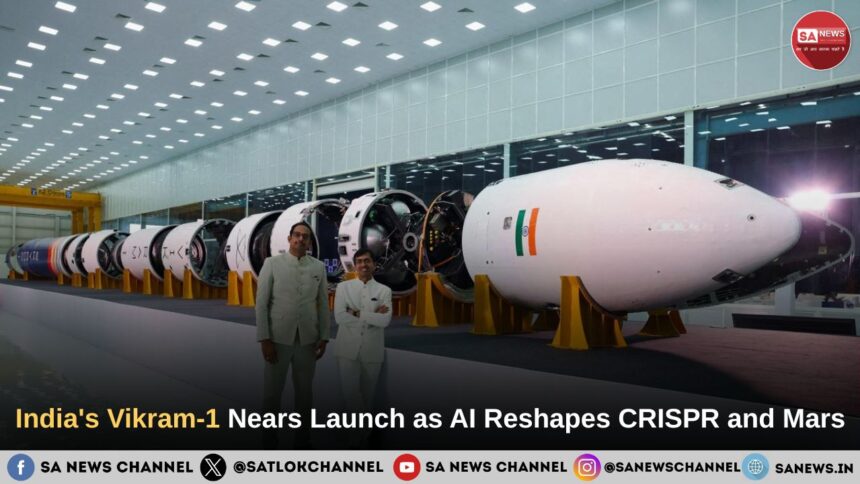
Skyroot Aerospace, a Hyderabad-based startup, is preparing to launch Vikram-1, described as India’s first privately developed orbital-class rocket, in a mission named “Mission Aagaman.” The company has targeted a launch window between July 12 and August 4, 2026, from the Satish Dhawan Space Centre in Sriharikota, with a specific target of July 18 at 11:30 a.m. IST (2 a.m. EDT). The rocket will fly to a 450-kilometer, 60-degree-inclination low Earth orbit.
Vikram-1 follows Skyroot’s earlier Vikram-S mission, which in November 2022 became the first private rocket launch from India, reaching a peak altitude of 88.8 kilometers and a maximum velocity of Mach 5.07 during its flight, before splashing down in the Bay of Bengal. The upcoming flight will be a partially commercial mission, with Skyroot planning to begin full commercial flights after one or two successful demonstrations to orbit, carrying a mix of domestic and international customers.
India has already sent spacecraft to Mars and the moon and put hundreds of satellites into orbit, and its space economy, valued at $8.4 billion, has expanded rapidly since the sector opened to private investment in 2020, attracting more than 400 space startups. The sector opened following a 2020 government decision, with the Indian National Space Promotion and Authorization Centre established that year to guide and authorize private participation in the space sector.
Skyroot announced the launch window through its official account, stating the vehicle is fully stacked at the historic First Launch Pad at Sriharikota, and thanked ISRO and IN-SPACe for enabling the mission.
AI-Designed Tools Improve CRISPR Gene-Editing Precision
Separately in biotechnology, researchers have turned to artificial intelligence to address long-standing safety concerns around CRISPR gene editing. A team of Melbourne scientists used AI to develop a fast and accurate way to keep CRISPR activity in check, addressing the technology’s known tendency toward inconsistency and potential harm to healthy genes. CRISPR’s active enzyme can linger in cells and cause unintended damage to DNA or RNA, known as off-target effects, which may trigger harmful mutations in otherwise healthy genes. The new AI-designed molecules work as inhibitors of CRISPR activity, effective in both bacterial and human cells, and the approach also significantly cuts the time needed to develop such inhibitors.
This builds on broader progress in AI-assisted genome editing. CRISPR uses a guide RNA to direct the Cas9 enzyme to a precise genome location, where it cuts both DNA strands, after which the cell’s repair mechanisms either disable the target gene or insert a corrected sequence if a template is supplied. AI is increasingly used across the field to design more efficient guide RNAs, predict off-target effects, and identify new therapeutic targets, reflecting a broader convergence of gene editing with artificial intelligence, single-cell genomics, and synthetic biology.
Separately, fully AI-designed CRISPR editors have also emerged. OpenCRISPR-1, described as the first fully AI-designed CRISPR-Cas editor, was built using a generative large language model and enables high-efficiency, high-specificity genome and base editing in human cells. Researchers at Profluent Bio used large language models to expand the sequence diversity of CRISPR-Cas proteins, producing novel, functional genome editors with properties comparable to or improved over natural systems.
New Findings Deepen Understanding of Mars and Distant Exoplanet Atmospheres
On Mars, NASA’s Curiosity rover has continued to return significant findings from Gale Crater. Curiosity has detected a surprising variety of organic molecules on the planet, including compounds tied to the chemistry of life, some of which may be billions of years old and preserved in ancient clay-rich rocks that once held water. One standout molecule resembles a building block of DNA, raising questions about Mars’s past, though the discovery is not proof of life and instead suggests the planet may once have been more biologically promising than previously thought.
The Curiosity rover detected an unprecedented 21 carbon-containing organic molecules within a single Martian rock sample, published in Nature Communications in April 2026, including a nitrogen-bearing molecule structurally similar to DNA precursors never before detected on the Martian surface. These molecular building blocks are estimated to have been preserved for approximately 3.5 billion years within the clay-bearing sandstones of Gale Crater. Separately, earlier research found organic compounds in a Martian crater containing building blocks of life, according to a study led by University of Florida geological sciences professor Amy Williams, who is also a mission scientist for both the Curiosity and Perseverance rovers.
Beyond Mars, the James Webb Space Telescope has continued expanding what is known about exoplanet atmospheres. Astronomers led by Cyril Gapp, a PhD student at the Max Planck Institute for Astronomy, used JWST to reveal distinct atmospheric differences between the morning and evening terminator zones of the ultra-hot exoplanet WASP-121 b, a finding published in Nature Astronomy. On another world, scientists directly imaging the exoplanet Epsilon Indi Ab with JWST discovered unexpected water-ice clouds and found less ammonia than predicted, challenging existing atmospheric models for Jupiter-like planets.
JWST observations also identified a strange new class of exoplanet in L 98-59 d, which appears to hold a vast ocean of molten rock beneath its surface trapping large amounts of sulfur, alongside unusual sulfur-rich atmospheric gases and a surprisingly low density for its size. Together, these findings across India’s private space sector, gene-editing research, and planetary science mark a wide-ranging week of scientific progress.