

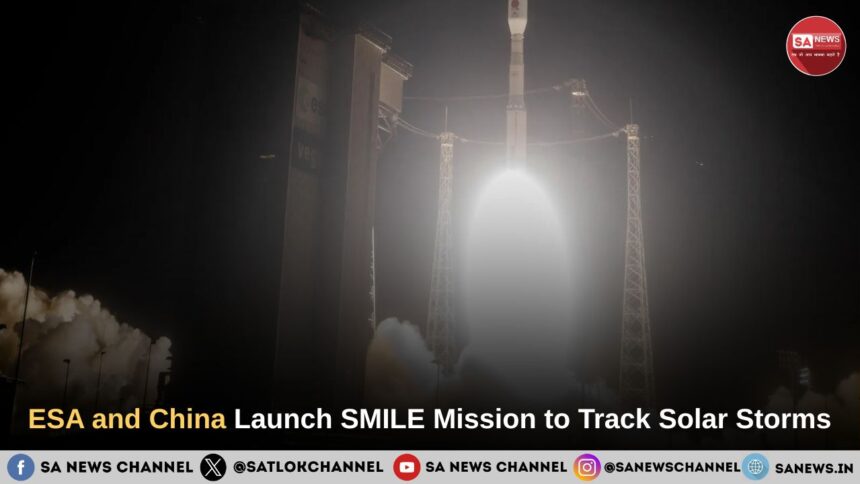
In a major triumph for global space exploration and international diplomacy, the European Space Agency (ESA) and the Chinese Academy of Sciences (CAS) successfully launched the Solar Wind Magnetosphere Ionosphere Link Explorer (SMILE) mission on May 19, 2026. Lifting off aboard a European Vega-C rocket from Europe’s Spaceport in Kourou, French Guiana, the 2,600 kg spacecraft safely deployed its solar arrays and established communication with ground stations. This milestone marks the first time ESA and China have jointly designed, built, launched, and operated a deep-space science mission throughout its entire lifecycle.
SMILE Mission Specifications: At a Glance
| Parameters | Mission Metrics |
| Official Launch Date | May 19, 2026 |
| Launch Vehicle | Vega-C (Flight VV29) |
| Collaborating Entities | European Space Agency (ESA) & Chinese Academy of Sciences (CAS) |
| Spacecraft Total Mass | ~2,600 kg (including 1,580 kg propellant) |
| Target Orbit (Polar) | Highly Elliptical Orbit (Apogee: ~121,000 km over the North Pole) |
| Baseline Mission Life | 3 Years (Scientific data collection starts September 2026) |
Scientific Breakthrough: Visualizing Earth’s Invisible Armour
Earth is surrounded by a vast, comet-shaped magnetic bubble known as the magnetosphere. This shield blocks the relentless stream of charged particles blasted by the Sun, known as solar wind.
When solar flares and Coronal Mass Ejections (CMEs) smash into this shield, they create violent space weather events called geomagnetic storms. These storms can damage orbiting satellites, endanger astronauts, corrupt GPS data, and trigger blackouts in electrical power grids on Earth.
The “Wide-Angle” Advantage
While previous space missions (like ESA’s Cluster or NASA’s thematic probes) gathered precise localized measurements-akin to examining a few leaves in a massive forest-SMILE is built to capture the entire forest. Operating far out in space, it will take the first-ever global, panoramic X-ray and ultraviolet videos showing the exact moments our magnetic shield buckles, deforms, and absorbs solar energy.
The Four Specialized Payloads
The mission splits its 70 kg of core scientific hardware into a mix of remote-sensing cameras and in-situ (on-site) particle measurement devices:
- Soft X-ray Imager (SXI): Developed by ESA. This revolutionary camera tracks soft X-rays emitted when solar wind ions collide with Earth’s neutral upper atmosphere. This creates a literal visual outline-resembling a “smiley face”-of the outer edge where the solar wind meets our magnetic line.
- Ultraviolet Aurora Imager (UVI): Developed by China. Focused directly on the Earth’s polar zones, it will capture the entire northern auroral oval at high resolution, monitoring the behavior of the Northern Lights continuously for up to 45 hours at a single stretch.
- Light Ion Analyser (LIA): Developed by China. This dual electrostatic instrument continuously counts the speed, temperature, and density of protons and alpha particles flying directly past the spacecraft.
- Magnetometer (MAG): Developed by China. It measures the strength and direction of the surrounding magnetic field to detect incoming solar shockwaves instantly.
Also Read: ISRO’s “Baahubali” Roars Into Orbit: A Landmark Commercial Launch Signals India’s Rising Space Power
Strategic Elliptical Path and Next Steps
Over the next 42 days, the spacecraft will use its 490-Newton main engine to execute orbital maneuvers. It is heading toward a highly inclined polar orbit.
At its perigee (lowest point), it will dip within 5,000 km of the South Pole to beam high-bandwidth scientific files down to ground stations. At its apogee (highest point), it will soar to a staggering 121,000 km above the North Pole-nearly a third of the distance to the Moon. This extreme altitude gives SMILE the wide-angle vantage point required to see the Sun-facing boundary of Earth’s shield in its entirety. Following a two-month in-orbit testing phase, regular data collection will begin in September 2026.
The True Protection: Looking Beyond the Cosmic Umbrella
Sant Rampal Ji Maharaj clarifies in his spiritual discourses that the physical universe, along with its stellar movements and protective atmospheric layers, operates under the unyielding laws established by the Supreme Almighty Kabir. While human civilizations exhaust billions of dollars to build temporary warning monitors against solar flares, they overlook the invisible “spiritual storms” of vices-anger, greed, and attachment-that corrupt human consciousness daily.
The True Spiritual Knowledge (Tatvagyan) acts as an impenetrable shield for the soul against karmic degradation. Aligning oneself with the guidance of a Complete Saint provides the spiritual compass needed to navigate this transient world and secure a permanent home under the direct grace of the Creator.
For further information, please request a free copy of this book via this link.
FAQs on The Cosmic Shield
1. Who are the primary partners behind the SMILE space mission?
The SMILE mission is a completely collaborative venture between the European Space Agency (ESA) and the Chinese Academy of Sciences (CAS).
2. What is the main objective of the SMILE mission launched in 2026?
Its goal is to capture the first-ever global panoramic images and videos of the solar wind interacting with Earth’s magnetic shield (magnetosphere) using X-ray and ultraviolet wavelengths.
3. Why does the SMILE spacecraft use a highly elliptical orbit?
The highly elliptical orbit allows the satellite to travel up to 121,000 km above the North Pole, giving its cameras a broad, unobstructed view of the sun-facing side of Earth’s magnetosphere for long periods.
4. What rocket was used to launch the SMILE mission?
SMILE was launched into space using a European Vega-C rocket from Europe’s Spaceport located in Kourou, French Guiana.
5. How long will the SMILE mission operate?
The mission has a baseline operational shelf-life of three years, with routine scientific data collection scheduled to begin in September 2026.