


Have you ever promised yourself that this time would be different? Wake up earlier, eat cleaner, exercise consistently, read more, procrastinate less. You were motivated. Maybe for three days, even a full week. Then life crept back in, the excitement faded, and you were exactly where you started, feeling worse than before because you had a fresh reminder that you could not stick to your own plans.
- The 1% Rule: Why Tiny Improvements Are More Powerful Than Big Leaps
- Systems Versus Goals: Why Winners and Losers Often Share the Same Goals
- Identity-Based Habits: The Most Important Idea in the Book
- The Habit Loop: Cue, Craving, Response, Reward
- The Four Laws of Behaviour Change: Your Complete Operating System
- Law 1: Make It Obvious (Cue)
- Law 2: Make It Attractive (Craving)
- Law 3: Make It Easy (Response)
- Law 4: Make It Satisfying (Reward)
- Breaking Bad Habits: The Inversion of the Four Laws
- The Plateau of Latent Potential
- The Goldilocks Rule: Staying Motivated Through Boredom
- Habit Stacking in Depth: Building Chains of Behaviour
- Environment Design: The Invisible Architecture of Your Life
- Motivation, Willpower, and the Motivation Myth
- Keystone Habits: The Habits That Change Everything Else
- Habit Tracking and Reflection
- The Aggregation of Marginal Gains: The British Cycling Story
- Reflection, Review, and Avoiding the Traps
- Key Data: The Science of Habit Formation at a Glance
- Conclusion: The Only Way Change Actually Works
If that sounds familiar, you are not broken, lazy, or lacking willpower. You are simply operating without the right system.
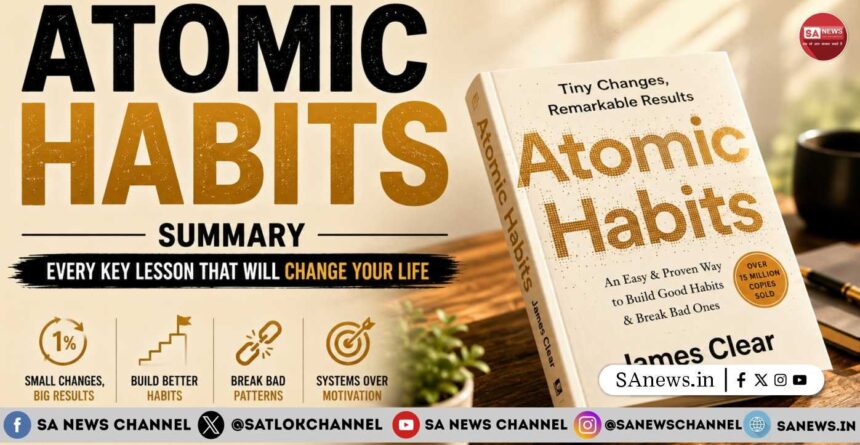
Atomic Habits by James Clear is one of the most practically powerful books written on the science of behaviour change. It has sold over 25 million copies and been translated into more than 60 languages, not because it offers hollow motivation, but because it offers a framework grounded in biology, psychology, and neuroscience that anyone can apply immediately.
The word “atomic” carries two meanings. An atom is tiny, almost invisible. But atoms are also the fundamental building blocks of everything that exists. Clear uses this dual meaning to make a deceptively simple argument: the smallest, most unremarkable daily actions are the actual raw material of extraordinary results. Not giant breakthroughs. Not dramatic transformations. Just consistent, tiny improvements compounding silently over time.
The 1% Rule: Why Tiny Improvements Are More Powerful Than Big Leaps
Most people overestimate what one intense effort can do, and underestimate what daily small improvements accumulate into over time.
If you improve by 1% every day, the mathematics are startling: over a year, that compounds to more than 37 times your original ability (1.01 to the power of 365 equals approximately 37.78). The number itself matters less than the concept behind it. We are conditioned to seek immediate, visible results. When progress is invisible, most people quit.
This connects to what Clear calls the valley of disappointment. When you start a new habit, you expect a linear rise in results. You go to the gym for two weeks and expect to look visibly fitter. You journal for a month and expect calm and clarity. But real results do not arrive on schedule. They arrive after a threshold of accumulated effort is crossed, all at once, in a way that looks sudden from the outside but was built quietly underneath for months.
Clear illustrates this with the ice cube metaphor. You hold an ice cube at 20 degrees and raise the temperature slowly. Nothing visible happens until 32 degrees, when the ice melts. Not because the last degree was special, but because all the previous degrees built toward the threshold. Most people quit before they reach 32.
Practical application: Stop measuring habits by outcomes. Measure them by consistency. Track streaks, not results. Results will follow, but only after a delay you cannot shorten by rushing.
Systems Versus Goals: Why Winners and Losers Often Share the Same Goals
Every athlete at the Olympics wants to win gold. Every company wants to grow revenue. If goals were the mechanism behind success, everyone who wanted the same thing would achieve it at the same rate. Obviously, that does not happen.
As Clear writes, you do not rise to the level of your goals; you fall to the level of your systems. A goal is an outcome you want. A system is the daily process — the habits, decisions, and behaviours that produce that outcome. Goals provide direction. Systems provide the vehicle.
Relying on goals alone creates a binary problem. Either you achieve the goal and feel briefly satisfied, or you do not and feel like a failure. Neither state sustains continued behaviour. The satisfaction from accomplishing a goal is by definition fleeting. Almost all your satisfaction ends up located somewhere in the future.
Systems embed satisfaction into the daily process itself. When you fall in love with writing 300 words per day, you do not need to wait for a finished book to feel successful. You are succeeding every single day you sit down and write.
Identity-Based Habits: The Most Important Idea in the Book
Clear identifies three levels at which change can be attempted.
The outermost layer is outcomes: what you want to achieve. Most people try to change here.
The middle layer is processes: the habits and systems you follow.
The innermost layer is identity: your beliefs about yourself and the kind of person you are. This is where durable change actually lives.
The core argument is that any long-term transformation is the product of identity change, not goal-setting. Rather than deciding what you want to achieve, decide what kind of person naturally achieves those ends.
Consider two people trying to quit smoking. One says, “No thanks, I am trying to quit.” The other says, “No thanks, I am not a smoker.” The first still sees themselves as a smoker fighting against their nature. The second has rewritten their identity. The difference matters enormously because our behaviour is deeply consistent with our self-concept.
How to Build a New Identity
Identity is not something you declare. It is something you prove to yourself through accumulated evidence. Every action you take is a vote for the type of person you want to become. No single instance transforms your beliefs, but as the votes accumulate, so does the evidence of your new identity.
Instead of saying “I want to read more,” ask: what would a reader do? A reader picks up a book for five minutes before bed. A reader keeps a book on the kitchen counter. Each small action is a vote. Over time, the accumulated evidence reshapes your self-image.
Practical application: Before starting any new habit, write down the identity you want to build. “I am someone who takes care of their health.” Then design the smallest possible daily action that casts a vote for that identity.
The Habit Loop: Cue, Craving, Response, Reward
Every habit follows the same four-step neurological sequence.
Cue: A trigger that tells your brain a reward is available. Your phone buzzes. You smell coffee. You sit on the sofa.
Craving: The motivational force created by the cue. You do not crave the habit itself, you crave the change in state it delivers. You do not crave scrolling social media; you crave the relief from boredom or anxiety that scrolling temporarily provides.
Response: The actual behaviour you perform.
Reward: The end goal of every habit. Rewards satisfy the craving and signal to the brain that the loop is worth repeating.
Understanding this loop reveals exactly where to intervene to change any behaviour. Clear’s entire practical framework, the Four Laws of Behaviour Change, is built on it.
Read More: 6 Benefits of a Plant-based Diet for Human Health
The Four Laws of Behaviour Change: Your Complete Operating System
Each law corresponds to one step of the habit loop.
Law 1: Make It Obvious (Cue)
You cannot respond to a cue you do not notice. Most habits fail not because people are weak-willed, but because the cue for the desired behaviour is absent.
Implementation Intentions: People who specify exactly when and where they will perform a behaviour are far more likely to follow through. Instead of “I will exercise more,” use: “I will exercise for thirty minutes at 7:00 AM on the roof.” The specificity removes ambiguity and pre-decides the action before willpower is needed.
Habit Stacking: Link a new habit to an existing one using the formula: After I [current habit], I will [new habit]. After you brew your morning coffee, you will write three things you are grateful for. The existing habit becomes the cue for the new one, requiring no additional decision-making.
Environment Design: People with strong self-control are not fighting harder against temptation. They have designed their environments so temptation rarely appears. If you want to read more, leave a book on your pillow. If you want to eat healthier, put fruit on the counter and move unhealthy snacks out of reach. Make cues for good behaviours visible; make cues for bad behaviours invisible.
The Habit Scorecard: Write down all your daily habits and mark each as positive (+), negative (−), or neutral (=). Most people have never audited their own automatic behaviours. This exercise makes the unconscious conscious.
Law 2: Make It Attractive (Craving)
The more attractive a habit is, the more motivated you will be to perform it. Attractiveness is driven by dopamine — and dopamine is released not just when you receive a reward, but when you anticipate one. This is why gambling and social media are so compelling: the possibility of a reward keeps the brain in a loop of anticipation.
Temptation Bundling: Pair a habit you need to do with something you already enjoy. Only listen to your favourite podcast while exercising. Only watch your favourite show while folding laundry. You begin to associate the previously unattractive habit with something pleasurable, and the craving shifts.
Reframing: The language you use about habits changes how they feel. “I have to go to the gym” creates resistance. “I get to go to the gym” activates a sense of opportunity. Small reframe, large psychological difference.
Social Norms: We adopt habits that earn approval from our closest groups. Joining a culture where your desired behaviour is already normal is one of the most powerful changes you can make. You stop fighting resistance and start riding social momentum.
Law 3: Make It Easy (Response)
Motivation gets you started. Friction determines whether you continue.
The Law of Least Effort: The brain gravitates toward the behaviour that requires the least energy. This is not laziness; it is efficient design. Reducing friction for good habits and adding friction to bad ones is far more effective than relying on willpower.
Want to exercise in the morning? Sleep in your workout clothes. Want to spend less time on your phone? Delete social media apps and require yourself to log in through a browser each time. You are not fighting your nature, you are working with it.
The Two-Minute Rule: When starting a new habit, shrink it until it takes less than two minutes. “Read before bed” becomes “Read one page.” “Meditate” becomes “Sit in the meditation spot for two minutes.” The goal is to establish the identity of someone who shows up consistently, not to produce massive output every session.
Decisive Moments: Some choices determine the trajectory of the next hour or day. Deciding to pick up your phone triggers a chain of scrolling. Deciding to lace up your shoes triggers a chain of exercise. Identify your decisive moments and design the environment around them.
Commitment Devices: A commitment device is a choice made in the present that controls behaviour in the future. App blockers, leaving cash at home, preparing ingredients in advance. These reduce the need for in-the-moment willpower.
Law 4: Make It Satisfying (Reward)
Behaviours that are immediately rewarded get repeated. The fundamental problem with many good habits is that the reward is delayed while the cost is immediate. Exercise is uncomfortable now; health benefits arrive months later. The brain is wired to prioritise immediate rewards over future ones.
Habit Tracking: A habit tracker, a calendar where you mark off each day you complete the habit. It creates an immediate visual reward. It makes progress visible and creates what Clear calls “not breaking the chain,” a motivating streak you do not want to interrupt.
The real rule, though, is never miss twice. Missing once is an accident. Missing twice is the beginning of a new habit. The key is to avoid the all-or-nothing failure pattern where one missed day triggers complete abandonment.
Reinforcement and Identity: Rewards work best when they reinforce your desired identity. If you are building the identity of a healthy person, rewarding a workout with something that undermines health defeats both the habit and the identity.
Accountability Partners: Making the consequences of your habits social adds another layer of feedback. Telling someone about your commitment makes breaking it feel costly.
Breaking Bad Habits: The Inversion of the Four Laws
Everything above can be reversed to make unwanted behaviours harder to maintain.
| Bad Habit Strategy | Principle | Action |
| Make it invisible | Remove the cue | Delete apps, remove junk food from home |
| Make it unattractive | Reframe the cost | Focus on what the habit takes from you |
| Make it difficult | Add friction | Unplug the TV, create barriers to access |
| Make it unsatisfying | Add social cost | Tell someone you will pay them if you slip |
You rarely eliminate bad habits through willpower alone. Willpower is a finite resource that depletes with use. Environment redesign, friction creation, and identity reframing are far more durable tools.
The Plateau of Latent Potential
Change is not linear. You plant seeds in spring and wait months before anything emerges. The seeds are not failing, they are building the root system that will support everything above ground later.
Small habits are invisible at first. Most people quit during this plateau. They have been doing the right things for weeks or months without seeing meaningful progress and conclude the approach is not working. What they cannot see is that every action was contributing to the threshold they were approaching. They quit at 29 degrees, one degree before the ice melts.
Understanding this changes how you endure periods of invisible progress. Stop asking “Is this working?” and start asking “Am I doing the right things consistently?” Trust the process with the same confidence you would trust a seed planted in good soil.
The Goldilocks Rule: Staying Motivated Through Boredom
The greatest threat to long-term habit maintenance is not failure. It is boring.
After the initial novelty of a new habit fades, you have to keep doing it even when it is neither exciting nor painful — just unremarkable. Most people mistake this absence of excitement for a signal that they have chosen the wrong habit. They abandon it and start something new, which restarts the excitement cycle but produces no long-term growth.
Clear’s Goldilocks Rule explains the optimal zone for maintaining motivation. Habits that are too easy become boring; habits that are too hard lead to giving up. The sweet spot is tasks pitched at the edge of your current ability, hard enough to require engagement, easy enough that success is achievable.
When a habit becomes automatic, the solution is to layer progressive challenges on top of it. The runner who has made running automatic should now be improving pace, distance, or form.
The difference between professionals and amateurs is not that professionals never feel bored. It is that they have accepted boredom as a non-negotiable part of mastery and show up despite it. They do not wait to feel inspired. Inspiration often follows action rather than preceding it.
Habit Stacking in Depth: Building Chains of Behaviour
The formula is: After I [CURRENT HABIT], I will [NEW HABIT].
You can build elaborate stacks. After waking, you drink a glass of water. After drinking water, you stretch for ten minutes. After stretching, you write in your journal for five minutes. Each habit acts as the cue for the next, creating a morning routine that feels like one flowing behaviour rather than a collection of separate willpower-dependent decisions.
The most common mistake is building stacks that are too ambitious too quickly. Each individual link should be so small it feels almost trivial. As each link becomes automatic, you add to it. The chain grows gradually in strength and length.
Environment Design: The Invisible Architecture of Your Life
Our habits are triggered by cues in our surroundings. An environment rich with cues for good habits makes those habits easier. An environment stripped of cues for bad habits makes those behaviours harder to maintain. This is often more powerful than motivation.
Consider: you almost certainly wash your hands after using the toilet, not because of iron discipline, but because the soap is right there. Now imagine the soap was in another room. How often would you wash your hands? The behaviour is the same. The environment is different. The outcome is dramatically different.
One space, one use: Assign specific locations to specific habits. Work at the desk. Read in the armchair. Rest in bed. Your brain builds context-dependent associations powerfully. If you eat, watch TV, and work in the same spot, your brain associates that location with all three. If you only work at your desk, sitting down triggers the work mindset automatically.
Context switching: A new environment resets habits that are hard to break in familiar settings. Many people find it easier to start new habits when they move cities or start a new job, because the old environment-based cues for bad habits are absent.
Read More: Educational – SA News
Motivation, Willpower, and the Motivation Myth
Most people believe the key to changing behaviour is finding more motivation. This belief accounts for an enormous amount of wasted effort and unnecessary self-blame.
Motivation is real, but unreliable. It is an emotional state, and emotional states fluctuate with sleep, stress, hunger, and a hundred other variables. Building a life transformation on motivation is like building a house on sand.
What high-performing people have is not more motivation. They have better systems, better environments, and more deeply embedded identities. They have automated the decision to act, so they do not rely on feeling motivated in the moment.
Motivation also does not always precede action, action often creates motivation. Forcing yourself to write one sentence frequently breaks the resistance and produces flow. Lacing up your shoes and walking to the gym without motivation often generates the energy and drive once you start.
Do not wait to feel ready. Act, and readiness will often follow.
Keystone Habits: The Habits That Change Everything Else
Some habits create a ripple effect across multiple areas of life. Clear calls these keystone habits. They are not more virtuous than other habits; they trigger a cascade of other positive behaviours.
Regular exercise is the most well-documented example. People who establish consistent exercise routines tend to spontaneously eat better, sleep better, work more productively, and report higher emotional resilience. The exercise did not directly cause these improvements, it created a new identity: someone who takes care of themselves. That identity then influenced choices across every domain.
Journaling, meal planning, making your bed in the morning, and meditating have all functioned as keystone habits for different people. Find the one habit that creates momentum in other areas of your life and invest disproportionately in cementing that one first.
Habit Tracking and Reflection
What gets measured tends to improve because measurement makes progress visible, which activates the reward response. A physical habit tracker works on multiple psychological levels: it creates a visible record of progress, makes streaks prominent, and provides data for intelligent adjustment.
Clear explicitly warns against Goodhart’s Law. When a measure becomes a target, it ceases to be a good measure. If you track meditation minutes and start meditating for 30 mindless minutes just to hit the number, you have optimised for the measurement at the cost of the actual habit. The tracker is a tool, not the goal.
Periodic reflection, quarterly or annually, prevents the gradual drift that can undermine even the most dedicated habit builders. Without it, unconscious pattern drift can slowly erode the systems you worked to build.
The Aggregation of Marginal Gains: The British Cycling Story
From 1908 to 2003, the British professional cycling team performed notoriously poorly. When coach Dave Brailsford was hired in 2003, he implemented the philosophy of marginal gains: searching for tiny improvements in every possible variable.
He improved the obvious things: training, nutrition, tyre pressure. But he also improved things that seemed trivial — the shape of the bike seat, the alcohol used to clean tyres for better grip, the colour of the truck interior (painted white so mechanical problems were easier to spot), even the pillows athletes slept on when travelling.
No single change was significant. The aggregated effect was extraordinary. Within five years, British cycling dominated the Tour de France and the Olympics.
This story is not primarily about sports. It is about systems thinking. When you stop asking “what is the single breakthrough move?” and start asking “where can I find 1% improvements in every part of this system?”, the compounding effect becomes transformational.
Reflection, Review, and Avoiding the Traps
The downside of habits: Once a behaviour becomes fully automatic, you stop paying active attention to it. This is beneficial for effortless execution, but it creates a risk — you stop improving. An athlete who has automated their technique will plateau unless they deliberately inject conscious attention back into their practice to identify and correct subtle inefficiencies.
Reflection and review systems exist precisely to prevent this. They force you to periodically zoom out and ask: is this still serving me? Am I still growing? Where have I drifted?
Identity rigidity: The durability of identity-based habits becomes a vulnerability if you hold the identity too rigidly. “I am a writer” might prevent you from trying other creative expressions. The solution is to define your identity around values rather than specific behaviours: “I am someone who explores creative expression” is more flexible than “I am a writer.”
Key Data: The Science of Habit Formation at a Glance
| Concept | Research Finding |
| Daily behaviour that is habitual | Approximately 40–66% of daily behaviours are habit-driven |
| Average time to form a habit | Research shows an average of around 66 days (range: 18 to 254 days) |
| Motivation vs systems | Motivation initiates; systems sustain |
| Identity change | Long-term transformation requires identity change, not just behaviour change |
| Environment impact | Friction explains behaviour more reliably than willpower |
The widely cited “21 days to form a habit” claim has been thoroughly debunked. Research found that automaticity plateaued on average around 66 days after first performing the behaviour, with a wide range from 18 to 254 days depending on the complexity of the behaviour and individual differences. Expecting a habit to be fully automatic after three weeks sets up unrealistic expectations that lead to premature abandonment.
Conclusion: The Only Way Change Actually Works
Every major idea in Atomic Habits points toward the same underlying truth. Behaviour change is not a willpower problem. It is a system design problem. You are not the obstacle. Your environment, your identity, your cues, your rewards, and your friction levels are the variables that determine what you do and who you become.
The book does not promise overnight transformation. It promises something more valuable: a reliable, science-backed architecture for building the life you want, one small decision at a time. Small consistent actions, sustained over time, will produce results that look extraordinary from the outside but feel simply like who you are to the person living them.
In this pursuit of self-improvement, there is a deeper dimension worth contemplating — the quality of who we are becoming, not just what we are achieving. The ancient sages and saints understood that true transformation goes beyond habits of body and mind. The spiritual knowledge found in books like Gyan Ganga and Way of Living by Saint Rampal Ji Maharaj invites a deeper reflection on the purpose behind our self-improvement journey, offering timeless wisdom on aligning our actions with eternal values — a worthy companion to any system of personal growth.