

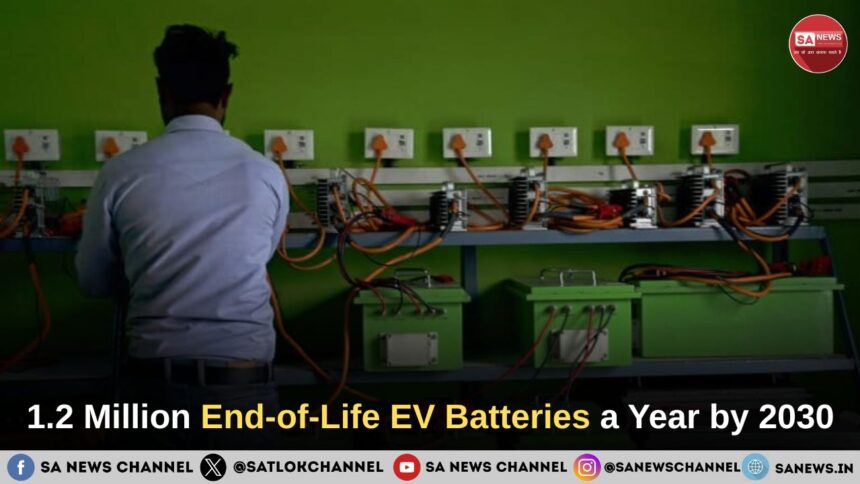
India’s electric vehicle (EV) adoption is accelerating, but this transition brings a critical challenge: battery waste. By 2030, the country is projected to manage 1.2 million end-of-life EV batteries annually. While these lithium-ion batteries contain hazardous materials that risk polluting soil and water, they also offer significant economic potential through mineral recovery and second-life applications. Addressing this requires urgent infrastructure scaling to build a sustainable circular battery economy.
- India’s EV Boom and the Rising Battery Waste Challenge
- Why End-of-Life EV Batteries Pose Serious Risks
- Environmental Impact of Poor Battery Disposal
- Economic Opportunities in EV Battery Recycling India
- What Are Second-Life Batteries?
- Current Battery Recycling Infrastructure in India
- NITI Aayog Projections on Battery Waste
- Government Policies for Battery Waste Management
- Recent Developments (2025–2026)
- Major Challenges for India’s Preparedness
- Turning EV Battery Waste into Wealth
- Spiritual Wisdom for Responsible EV Battery Management
- The Road Ahead
- FAQ on End-of-Life EV Batteries
India’s EV Boom and the Rising Battery Waste Challenge
India is rapidly adopting electric vehicles to combat air pollution and reduce dependence on oil imports. Two-wheelers and three-wheelers are leading this transition.
EV batteries typically last 8–10 years. Once their capacity drops to around 70–80%, they are considered end-of-life batteries.
Estimates suggest that India could face around 1.2 million end-of-life EV batteries annually by 2030, and this number is expected to increase significantly in the following decade.
If not managed properly, this growing battery waste could create serious environmental challenges and undermine the benefits of clean mobility.
Why End-of-Life EV Batteries Pose Serious Risks
Lithium-ion batteries contain hazardous materials. Improper disposal or informal recycling can lead to leakage of toxic chemicals into soil and groundwater.
They also pose fire hazards. Informal recycling practices may release harmful emissions into the air.
At the same time, these batteries contain valuable minerals such as lithium, cobalt, nickel, and manganese-resources that India largely imports. Losing them increases costs and dependency on global supply chains.
Environmental Impact of Poor Battery Disposal
Mismanaged battery waste can harm ecosystems and human health. Heavy metals may enter the food chain through contaminated water sources.
Proper recycling prevents such pollution and reduces the carbon footprint of manufacturing new batteries by reusing recovered materials.
Also Read: World Ozone Day: The Global Mission To Heal The Ozone Layer
Economic Opportunities in EV Battery Recycling India
According to industry estimates, India’s battery recycling market was valued at around USD 152 million in 2025 and is expected to grow steadily in the coming years.
The EV battery recycling segment offers even greater potential. Recovered materials can meet a significant share of future demand, reduce import dependence, and create employment opportunities.
What Are Second-Life Batteries?
Many end-of-life EV batteries still retain 70–80% of their capacity. These can be repurposed for second-life applications.
Common uses include home energy storage, renewable energy backup systems, and grid stabilization.
This approach extends battery life before final recycling and supports clean energy integration.
Also Read: India AI Impact Summit 2026: Strengthening the AI Ecosystem
Current Battery Recycling Infrastructure in India
India currently has a limited but growing number of formal lithium-ion recycling facilities. However, overall capacity is still insufficient to handle future demand.
Key players include:
- Attero
- Lohum
- Tata Chemicals
Advanced methods like hydrometallurgy are being used to achieve higher recovery rates with lower environmental impact.
NITI Aayog Projections on Battery Waste
NITI Aayog estimates a large cumulative recycling potential by 2030 from multiple battery sources, with EVs contributing a significant share.
This highlights the urgent need to scale up infrastructure and collection systems.
Government Policies for Battery Waste Management
India introduced the Battery Waste Management Rules (BWMR) 2022, with recent updates strengthening the framework.
These rules promote Extended Producer Responsibility (EPR), requiring manufacturers to ensure battery collection and recycling.
As per the latest policy framework, recycling targets are set to progressively increase up to 90% in the coming years. Digital tracking systems are also being implemented to improve transparency and compliance.
Recent Developments (2025–2026)
Government initiatives such as the ACC PLI scheme and the National Mission on Transformative Mobility are supporting both battery manufacturing and recycling.
States like Delhi are also working on updated EV policies with a stronger focus on battery lifecycle management.
Major Challenges for India’s Preparedness
India still faces several key challenges:
- Recycling capacity needs rapid expansion
- Battery collection systems remain weak
- Low public awareness leads to improper disposal
- Informal sector dominance poses safety risks
- Handling multiple battery chemistries requires advanced technology
- Economic viability depends on fluctuating material prices
- Stronger enforcement, investment, and consumer incentives are needed.
Turning EV Battery Waste into Wealth
Battery recycling has the potential to create jobs and reduce India’s dependence on imported minerals.
Recovered materials could meet a significant share of future demand, supporting a circular economy and sustainability goals.
Global Lessons for India
Countries in Europe have implemented strict recycling targets and traceability systems.
India can adapt these models while leveraging its manufacturing capabilities, innovation ecosystem, and growing EV market.
Spiritual Wisdom for Responsible EV Battery Management
According to his spiritual discourses, humans have a moral obligation to manage resources responsibly to prevent the degradation of the Earth, which He describes as the creation of the Supreme God Kabir.
This philosophy is translated into large-scale humanitarian and environmental initiatives. A prime example is the massive tree plantation drives conducted by his followers across India, aimed at restoring ecological balance and combating air pollution. Beyond plantation, His mission focuses on active environmental protection during crises. For instance, through the Annapurna Muhim, Sant Rampal Ji Maharaj has provided critical flood relief to save thousands of acres of fertile farmland. When administrative systems struggled, He provided powerful motors and thousands of feet of pipeline at no cost to rural villages like Matrashyam and Nehla to drain floodwaters, demonstrating a practical model for protecting the planet’s vital resources.
The Road Ahead
The projection of around 1.2 million end-of-life EV batteries annually by 2030 serves as a clear wake-up call. India has made a promising start with strong policies and growing industry participation. However, rapid infrastructure development, efficient collection systems, and stricter enforcement are still needed. With coordinated efforts, India can turn this challenge into a significant opportunity in the global circular economy.
FAQ on End-of-Life EV Batteries
1. How many end-of-life EV batteries will India have by 2030?
India is projected to generate around 1.2 million end-of-life EV batteries annually by 2030.
2. Why is EV battery recycling important in India?
EV battery recycling helps recover valuable minerals, reduce imports, prevent soil and water pollution, create jobs, and build a circular economy.
3. What are India’s Battery Waste Management Rules (BWMR)?
The BWMR 2022 (with updates) enforce Extended Producer Responsibility (EPR), set recycling targets up to 90%, and mandate digital traceability.
4. Can old EV batteries be reused instead of recycled?
Yes, batteries with 70–80% remaining capacity can be repurposed for second-life applications like home energy storage and grid backup.
5. Is India prepared for the 2030 EV battery waste wave?
India has taken important policy steps, but recycling infrastructure, collection systems, and awareness still need significant improvement.