

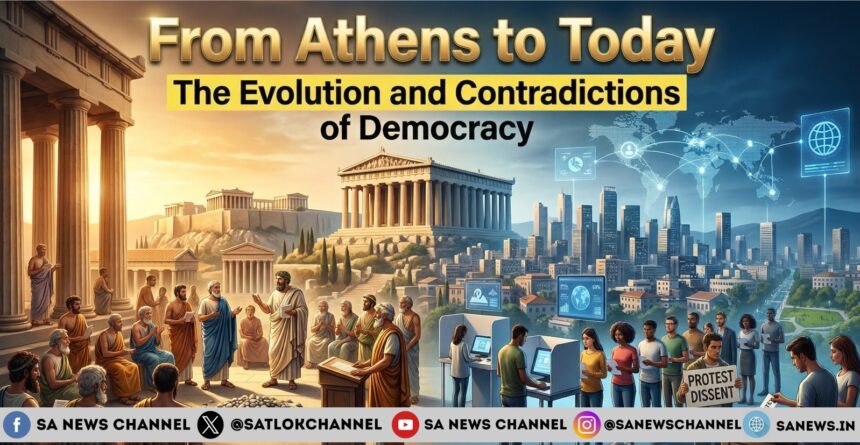
Democracy is often described as ‘rule by the people’ – a simple idea that has shaped some of the most complex societies in human history. Today, it stands as a foundation of modern governance, yet its journey from a radical experiment in ancient times to a global political system has been anything but smooth. To truly understand democracy, we take you back over two thousand years to its birthplace Ancient Greece and follow its evolution through revolutions, struggles and defining moments that brought its principles to life.
- What Is Democracy?
- Where Did Democracy Begin?
- How Did Democracy Start in Ancient Greece?
- Why Did Early Democracies Fail?
- Democracy’s Decline and the Rise of Empires
- The Middle Ages: Seeds of Change
- What Role Did the Magna Carta Play in the Evolution of Democracy?
- The Enlightenment and the Power of Ideas
- How Did Revolutions Shape Modern Democracy?
- Expanding Democracy in the 19th Century
- How Did Voting Rights Expand Over Time?
- The 20th Century: Democracy Tested and Reclaimed
- Democracy in the Modern World
- What Challenges Does Democracy Face Today?
- A Real Analysis of Today’s Global Democratic and Geopolitical Stage
- The Middle East: Interconnected Conflicts and Rising Tensions
- Europe: War and Geopolitical Rivalry
- Africa: Overlooked but Devastating Conflicts
- Asia: Internal Struggles and Strategic Pressures
- A Shared Pattern Across Conflicts
- When Democracy Falls Short: The Prophetic Vision of a Unified and Righteous World
- FAQs: Democracy
What Is Democracy?
Essentially, democracy is a system of governance in which power rests with the people. Rather than being ruled by a monarch or a select elite, citizens have the authority to influence decisions, either directly or through elected representatives.
The word ‘democracy’ comes from the Greek terms demos (people) and kratos (power), meaning ‘rule by the people’.
However, in practice, democracy is more than just voting. It is built on a set of fundamental principles, including equality before the law, protection of individual rights, freedom of expression and accountability of those in power.
Modern democracies typically function as representative systems, where citizens elect leaders to make decisions on their behalf. This allows large and diverse populations to participate in governance while maintaining practical decision-making structures.
But, democracy is not a fixed model. It evolves over time, adapting to social, cultural and technological changes. What has, until now, remained the constant ideology, however, is its central idea that legitimate authority comes from the consent of the governed.
To gather a more holistic understanding of democracy lets trace its roots first.
Where Did Democracy Begin?
The origins of democracy can be traced back to the ancient world, specifically to the city-state of Athens in the 5th century BCE. It was here that one of the earliest known democratic systems was developed – a bold and radical departure from the monarchies and oligarchies that dominated the time.
Though the birth period of democracy is most often stated as 5th century BCE, the process of laying down its foundations was visible as early as 6th century BCE, gaining prominence in 5th century BCE.
In Athens, citizens gathered in public assemblies to debate and decide on important matters such as laws, war and governance. This form of direct participation was unprecedented, giving ordinary citizens a voice in shaping their society.
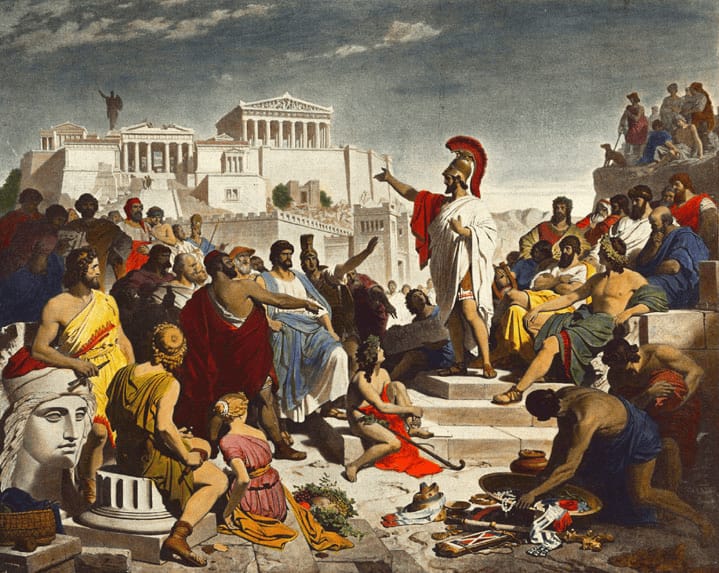
However, Only free adult male citizens were allowed to participate, excluding women, slaves and foreigners. Despite these restrictions, the Athenian model introduced a revolutionary concept that political power could be shared among citizens rather than concentrated in the hands of a ruler.
This early experiment laid the foundation for democratic thought, influencing political systems and ideas that would continue to evolve over centuries.
How Did Democracy Start in Ancient Greece?
As discussed earlier, the story of democracy begins in Athens in the 5th century BCE. Unlike modern systems, Athenian democracy was direct where citizens gathered to debate and vote on laws themselves.
Though the term comes from demos (people) and kratos (power), meaning ‘power of the people’, these ‘people’ excluded women, slaves and foreigners. Therefore, it is important to recognise that this early democracy was limited.
Participation was seen as a civic duty, yet this early democracy also revealed its limitations:
- A striking example is the trial of Socrates, the renowned Greek philosopher. Accused of corrupting the youth and challenging traditional beliefs, Socrates was judged by a jury of citizens and sentenced to death.
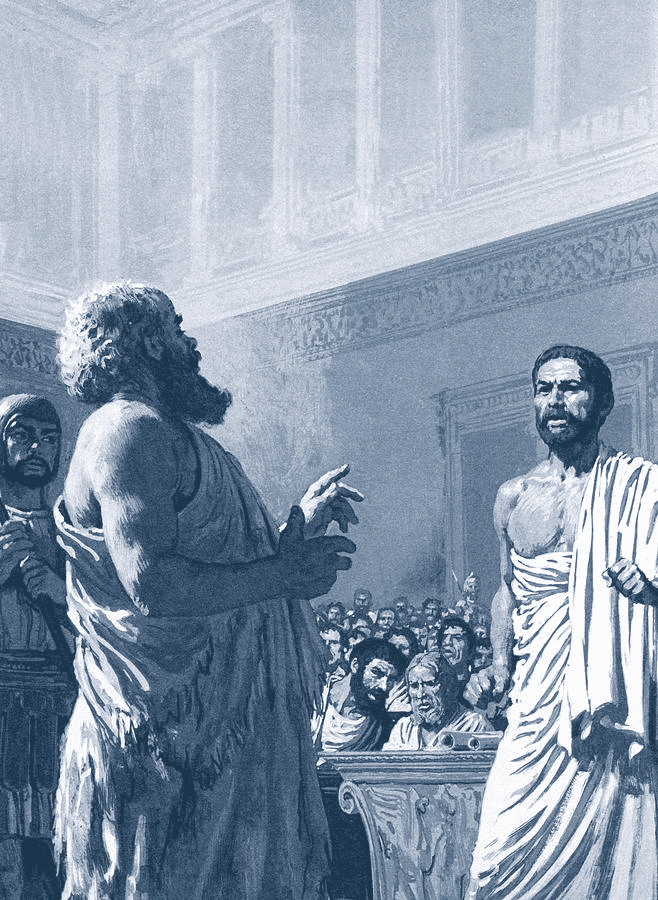
Title: ‘Trial of Socrates by English School’
- His execution highlights a difficult truth: even democratic systems can be shaped by public emotion, fear and majority pressure.
- To draw a parallel in more recent times, one need only look at incidents in Bangladesh, where even within a democratic framework, mob sentiment has, at moments, overridden reason and due process. Lives such as that of Dipu Chandra Das stand as stark reminders of how easily public emotion, when unchecked, can shape and sometimes shatter the fate of individuals.
Therefore, as we trace the evolution of democracy, it becomes essential to confront this parallel. Have democratic systems truly grown more just and equitable, or have they, at times, merely refined their outward form while leaving deeper inconsistencies untouched? The question is no longer whether democracy exists, but whether its promise is fully realised, or simply sustained at the level of appearance.
Let us investigate further into the failure of earlier democracies.
Why Did Early Democracies Fail?
Despite their groundbreaking nature, early democratic systems were fragile and often short-lived.
- One of the primary reasons was their limited inclusivity. In places like Athens, democracy applied only to a small segment of the population, excluding women, slaves and foreigners. This meant that large portions of society had no stake in sustaining the system.
- Internal instability also played a major role. Decision-making in direct democracies could be influenced by emotion, persuasive rhetoric or shifting public opinion.
- The trial of Socrates illustrates how majority rule could sometimes lead to controversial or unjust outcomes.
- External pressures further weakened early democracies. Conflicts such as the Peloponnesian War drained resources and destabilised political structures. Over time, these vulnerabilities made democratic systems susceptible to takeover by more centralised forms of power.
Ultimately, early democracies lacked the institutional strength and inclusivity needed for long-term survival. However, even in their decline, they left behind ideas that would inspire future generations much later in time.
Democracy’s Decline and the Rise of Empires
Despite its innovation, Athenian democracy weakened over time, particularly during the Peloponnesian War. Eventually, it fell under external control and democratic practices faded.
In ancient Rome, the Roman Republic introduced representative elements, allowing citizens to elect officials. However, power remained concentrated among elites, and the Republic eventually gave way to imperial rule under leaders such as Julius Caesar.
For centuries, monarchy and empire dominated, and democracy seemed more like a forgotten experiment than a future system.
The Middle Ages: Seeds of Change
During the Middle Ages, kings ruled with near-absolute authority. But, the idea that power could be limited slowly began to emerge.
A defining moment came in 1215, when King John of England was forced by rebellious barons to sign the Magna Carta. For the first time, a monarch formally accepted that his power was subject to the law.
Although far from democratic, this moment planted a crucial seed that even rulers could be held accountable.
What Role Did the Magna Carta Play in the Evolution of Democracy?
The journey towards modern democracy did not progress in a straight line. After the fall of early democratic systems, centuries passed under monarchies before new ideas began to emerge.
- When King John of England was compelled to sign the Magna Carta under pressure from rebellious barons, it introduced a transformative principle that the ruler was not above the law.
- While the document did not establish democracy, the Magna Carta placed limits on royal authority and recognised certain legal rights, particularly for the nobility. More importantly, it set a precedent for constitutional governance and the idea that power must be exercised within agreed rules and constraints.
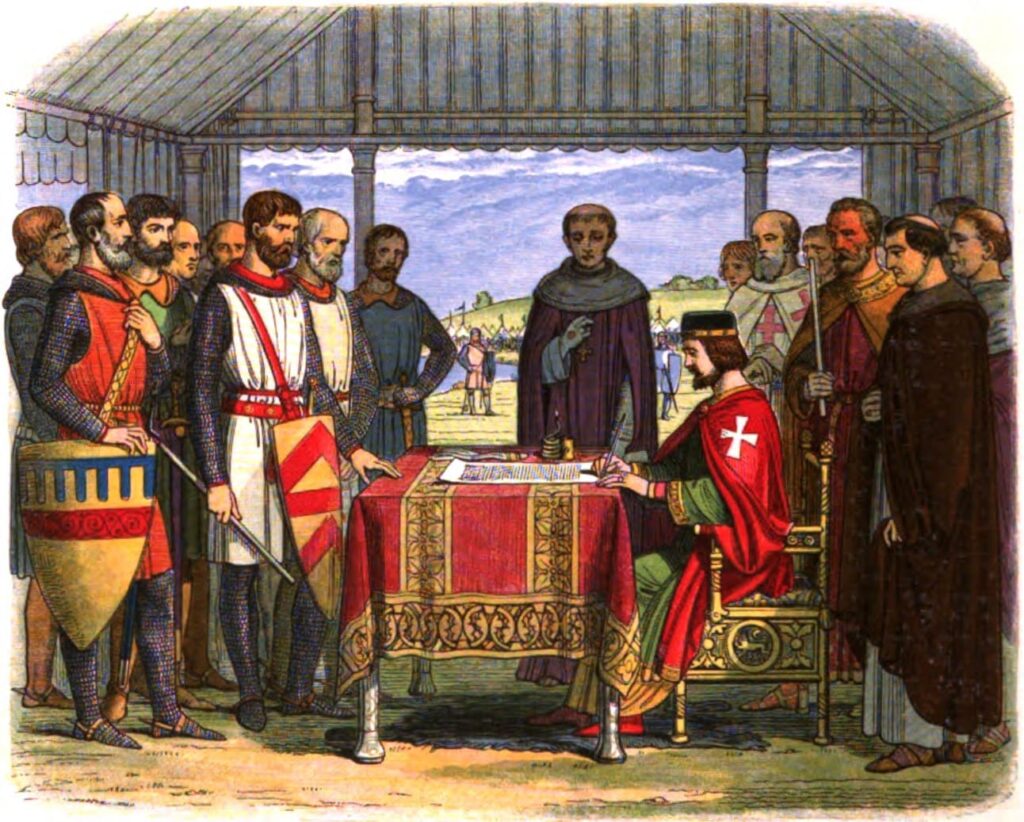
Over time, this principle evolved and expanded, influencing the development of parliamentary systems and the rule of law. In this sense, the Magna Carta served as a crucial bridge between absolute monarchy and the more accountable systems that would follow.
The Enlightenment and the Power of Ideas
The revival of democracy gained momentum during the Enlightenment. Philosophers began to argue that authority should come from the people, not tradition.
Thinkers like John Locke emphasised natural rights, while Jean-Jacques Rousseau introduced the idea of the social contract.
These ideas transformed political thought and set the stage for revolutions that would bring democracy out of theory and into reality.
How Did Revolutions Shape Modern Democracy?
By the 18th century, democratic ideas had gained intellectual momentum, but it was revolutions that turned them into reality. These movements challenged long-standing systems of authority and demonstrated that power could be redefined through collective action.
- In the American colonies, growing dissatisfaction with British rule led to acts of resistance such as the Boston Tea Party, where protesters openly defied taxation policies. This unrest eventually sparked the American Revolution, resulting in the creation of a new political system grounded in representation and constitutional principles.
- Soon after, the French Revolution unfolded in France. Events like the storming of the Bastille symbolised the people’s rejection of absolute monarchy and their demand for equality and participation.
These revolutions were not without conflict or contradiction, but they fundamentally reshaped political thought. They proved that governments could derive legitimacy from the people rather than inherited power, setting a precedent for modern democratic systems across the world.
These revolutions proved that governments could be challenged and reshaped by ordinary citizens.
Expanding Democracy in the 19th Century
Democracy continued to evolve, though progress was uneven. Voting rights gradually expanded, moving beyond wealthy elites.
In the United Kingdom and the United States, reforms extended suffrage to broader sections of society. One of the most significant and hard-fought movements in the journey of democracy was the demand for women to be granted the right to vote.
Across countries, women organised protests, marched in the streets, and in some cases endured imprisonment and hunger strikes. Their determination eventually led to a historic shift, recognising that democracy must include all citizens, not just a select few.
How Did Voting Rights Expand Over Time?
While early democratic systems and revolutionary governments introduced the idea of popular participation, voting rights were initially restricted to a privileged few, as discussed already. Expanding these rights became one of the most significant and hard-fought aspects of democratic development.
- During the 19th century, countries such as the United Kingdom and the United States began to remove property requirements, allowing a broader segment of men to vote. However, true inclusivity remained a distant goal.
- One of the most powerful movements for change came from women demanding the right to vote.
- A defining breakthrough in the expansion of democratic rights came with the fight for women’s suffrage – a movement that challenged centuries of exclusion.
- In 1893, New Zealand became the first self-governing country to grant women the right to vote, setting a historic precedent. This achievement was not handed down easily. It was won through relentless effort.
- Activists organised petitions, addressed public gatherings and pushed against deeply rooted societal norms that denied women a political voice. Among them, leaders like Kate Sheppard played a crucial role, mobilising support and transforming public opinion.
- What made this moment so powerful was not just the legal change, but the drastic shift in perception. It redefined who counted as a citizen.
- The success of this movement sent ripples across the world, inspiring similar struggles in other countries. Over time, more nations followed, gradually reshaping democracy into a system that was more inclusive in principle, even if equality in practice remained a work in progress.
- India took a decisive step at independence in 1947, granting universal adult franchise under the Constitution of India, ensuring that women had the right to vote from the very beginning, without the prolonged struggle seen in many other nations.
- The expansion of voting rights also extended to marginalised racial and social groups, although progress was often slow and uneven.
These struggles highlight a key reality of democracy – it is not fully formed but is continually shaped by those who demand inclusion.
The 20th Century: Democracy Tested and Reclaimed
The 20th century brought both expansion and crisis. After World War I, new democracies emerged, but many proved fragile.
- Authoritarian regimes rose in places like Germany and Italy, showing how quickly democratic systems could collapse.
- Following the devastation of World War II, there was a renewed global commitment to democratic values, reflected in institutions like the United Nations.
- One of the most symbolic moments of this era came in 1989 with the fall of the Berlin Wall. As citizens gathered and physically dismantled the barrier dividing East and West Berlin, the world witnessed a powerful expression of the human desire for freedom and democratic participation.
Democracy in the Modern World
Today, democracy exists in many forms, primarily as representative systems where citizens elect leaders.
Countries like India demonstrate the scale and diversity of modern democracy. With its vast population, multiple languages, and cultural complexity, India highlights both the strengths and challenges of democratic governance.
Technology has also reshaped participation, allowing citizens to engage with politics through digital platforms, social media and real-time communication.
What Challenges Does Democracy Face Today?
Despite its global spread, democracy faces serious challenges.
- Misinformation, political polarisation, capitalist goals and declining trust in institutions have raised concerns about its stability.
- In some regions, democratic norms are weakening, with power becoming increasingly concentrated.
- Economic inequality adds further strain. When people feel excluded, their faith in democratic systems can erode.
These contradictions challenge the moral foundation of democracy itself. If democracy is built on fairness, representation and respect for rights, can it remain credible if those principles are not extended globally?
To further examine this question, let us quickly take a look at the world geopolitical situation today.
Also Read: Importance of Fundamental Rights in Democracy
A Real Analysis of Today’s Global Democratic and Geopolitical Stage
To understand the state of democracy today, one must look beyond institutions and elections, and instead examine the world as it currently stands – marked by ongoing conflicts that are shaped by global power dynamics. These wars are rarely isolated. They are interconnected, layered and often influenced by nations that identify themselves as democratic.
One may wonder about the connection between wars and democracy. We’ll return to this point in the final part of the analysis.
The Middle East: Interconnected Conflicts and Rising Tensions
Tensions involving Iran, Israel and the United States have created a fragile and rapidly shifting situation. What may have begun as ‘targeted military action’ has expanded into a wider network of confrontations involving allied states and non-state groups.
At the same time, the long-standing tensions between Israel and Palestinian territories continue to influence regional stability, often drawing in neighbouring countries such as Lebanon and Syria. These overlapping conflicts demonstrate how historical disputes, political interests and strategic alliances can merge into prolonged instability.
Europe: War and Geopolitical Rivalry
In Europe, the ongoing conflict between Russia and Ukraine has become a defining geopolitical crisis of our time.
Its impact extends far beyond the battlefield, affecting global energy supplies, economic stability and international relations.
Africa: Overlooked but Devastating Conflicts
Several parts of Africa are experiencing severe conflicts that receive comparatively less global attention but have equally profound consequences. In Sudan, ongoing internal fighting has led to widespread displacement and humanitarian distress.
Elsewhere, regions such as the Sahel and central Africa are witnessing complex struggles involving armed groups, fragile governments and also external interests. These conflicts are often intensified by competition over natural resources, as well as the involvement of international actors seeking influence.
Asia: Internal Struggles and Strategic Pressures
Across Asia, conflicts tend to combine internal political instability with broader regional tensions. In Myanmar, prolonged internal unrest has disrupted governance and daily life.
The current war between Afghanistan and Pakistan is also a matter of concern in the region. Other areas in South and East Asia continue to experience border tensions, insurgencies and strategic rivalries.
These situations reflect how historical grievances, national interests and global politics often intersect, making peaceful resolution more difficult.
A Shared Pattern Across Conflicts
Despite differences in geography and context, many of today’s conflicts share common features:
- They frequently involve multiple stakeholders, including external powers and proxy groups
- Strategic interests such as resources, trade routes, regional influence play a crucial role
- Civilian populations face the greatest consequences, including displacement and economic hardship
Nations that promote democratic ideals often participate in or influence conflicts beyond their borders.
A Question That Cannot Be Ignored
Taken together, these realities raise a deeper and more uncomfortable question. If democracy is grounded in fairness, representation and respect for human rights, can it remain meaningful when its principles are not applied consistently across borders?
When countries uphold democratic values domestically but act strategically or even aggressively on the global stage, a contradiction emerges. It challenges the idea of democracy as a universal ideal and forces us to reconsider whether it is being practised fully or selectively.
As we reflect on the long journey of democracy, its ideals, its achievements and its visible limitations, it becomes increasingly clear that humanity’s search for a truly just and unified system is still ongoing. While democracy has given voice to millions, it has not always succeeded in ensuring fairness, consistency or even harmony on a global scale.
Amid this uncertainty, a remarkable convergence of belief can be observed across the world. In times of conflict and instability, societies often turn not only to political solutions, but to something far greater.
When Democracy Falls Short: The Prophetic Vision of a Unified and Righteous World
Amidst the ongoing war, as we seem to be propelling towards World War III, in Israel, there is a growing anticipation of the coming of the Mashiach (a figure expected to bring peace and restoration). In Islamic traditions, the arrival of the Messiah is awaited as a moment when justice will prevail over oppression. Within Christianity, many interpret present-day wars and global unrest as part of biblical prophecy, signalling the return of God. In India, too, there is a long-standing belief in the arrival of the Kalki Avatar, who is said to restore righteousness and bring an end to injustice.
Though these beliefs differ in form, they point towards a shared human expectation that the ultimate resolution to conflict and injustice will not come from political systems, but from God. It is as though humanity, despite its divisions, is collectively looking beyond its own institutions for answers.
Here, it is important to draw attention to the prophetic writings of famed astrologers and prophets worldwide, such as Nostradamus, pointing towards the emergence of a Supreme Spiritual Leader in India, Who would lead humanity towards unity and truth. All prophecies about Nostradamus’s Chyren and the Messiah of this world, the one who will end a terrible war (World War III) identify Jagatguru Tatvdarshi Sant Rampal Ji as that Invincible Divine Guiding Power.
Predictions reveal that Sant Rampal Ji Maharaj will emerge as the one who advocates a path rooted not in political power, but in spiritual knowledge and moral clarity – a path that is already taking shape through his rapidly growing following.
This vision speaks of a world no longer divided by borders, ideologies or competing interests, but united under a single, benevolent order. In such a world, the limitations of democracy as we see them today, its inconsistencies, its susceptibility to influence and its uneven application, would give way to something far more complete. Not merely governance. Not just representation. Sant Rampal Ji Maharaj will usher in Satyug within the shadows of Kalyug.
To understand how such an unthinkable situation will turn into a reality soon, watch this eye-opening video:
FAQs: Democracy
Q1) What is the evolution of democracy?
Answer: The evolution of democracy traces how governance shifted from direct rule in Athens to modern representative systems.
Q2) Why is the history of democracy important today?
Answer: The history of democracy helps us understand current political systems and their challenges.