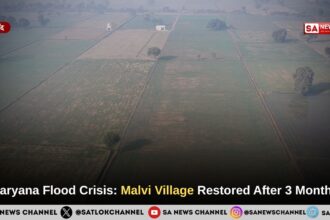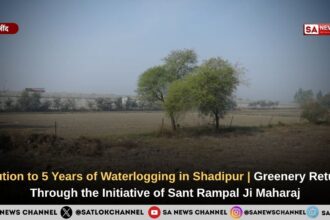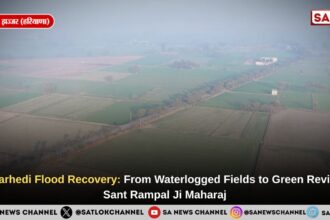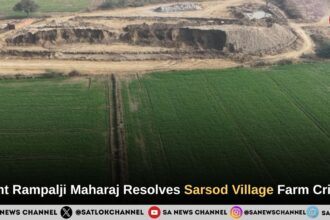


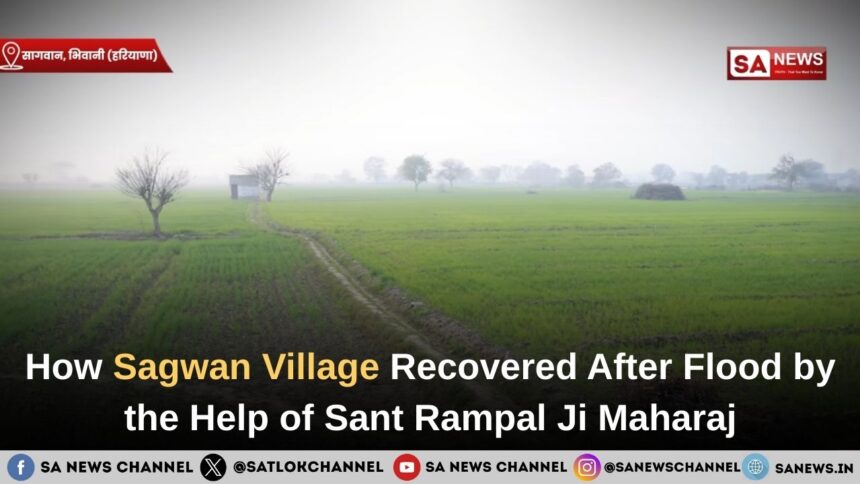
Sagwan village in Tosham tehsil of Haryana’s Bhiwani district became the center of a severe flood tragedy in 2025, when the entire settlement was submerged under water. The village, home to nearly 1,500 houses and around 6,000–7,000 residents, was completely inundated, forcing a large part of the population to migrate. Homes, schools, fields, temples and public spaces were flooded, leaving the village deserted and devastated. With relief equipment including long pipelines and high-capacity motors later reaching the area, the water was gradually pumped out. Today, the village has begun recovering, residents have returned, and farming activities have resumed.
- Key Takeaways: Sagwan Village Flood Crisis and Recovery
- Sagwan Village Submerged After Severe Flood
- Local Efforts to Stop Floodwater
- Tragedies During the Flood
- Request for Assistance and Arrival of Equipment
- Continuous Pumping Operation Removes Floodwater
- Agriculture Begins Recovering
- Residents Return and Village Life Resumes
Villagers later said that when the situation worsened and local efforts failed, a delegation from the village went with a prayer request seeking help.
Key Takeaways: Sagwan Village Flood Crisis and Recovery
- Sagwan village in Tosham, Bhiwani district, was 100% submerged during the 2025 flood
- Around 1,500 houses and nearly 7,000 residents were affected
- Nearly 80–90% of villagers migrated after homes and fields flooded
- Floodwater in several areas reached 10 to 15 feet, while higher fields had about 5 feet water
- Villagers spent around ₹87 lakh building embankments in attempts to stop the water
- Relief assistance included 20,000 feet of pipeline and 10 motors of 20 horsepower
- Pumping equipment helped drain the floodwater and restore agricultural activity
- Many residents have now returned, schools have reopened, and fields have been sown again
Sagwan Village Submerged After Severe Flood
Sagwan village in Tosham tehsil of Bhiwani district faced one of the most severe flood situations in Haryana during 2025. The village, which was known as a lively rural settlement, was completely submerged as floodwater entered homes, fields and public buildings.
The settlement consists of nearly 1,500 homes and has a population of around 6,000 to 7,000 people. According to villagers, the floodwater covered the entire village area and in some places reached rooftops. The local school building, temple and cremation ground were also submerged.
Residents described the situation as extremely difficult. Many families were forced to leave their homes and move to relatives’ houses, temporary tents on higher fields, rented rooms in Tosham, or nearby shelters. Livestock was sold at reduced prices as people struggled to survive.
Also Read: Sant Rampal Ji Maharaj Resolves Decades of Waterlogging in Ratangarh Village Sonipat
Villagers said that by the time the situation worsened, nearly 80% to 90% of the population had migrated, leaving the village largely deserted.
Local Efforts to Stop Floodwater
Before seeking external assistance, villagers tried to control the floodwater themselves.
Community members collected funds and attempted to build embankments around the village to prevent water from entering. According to residents, the village spent approximately ₹87 lakh during these efforts and worked continuously for about a month constructing barriers.
Despite these efforts, the water could not be stopped. The flooding continued to spread into residential areas and fields.
Residents said they also approached authorities seeking support, requesting arrangements such as fuel for tractors that were being used to manage the situation. However, they claimed that their requests did not lead to immediate relief.
As the floodwater remained stagnant, homes collapsed, infrastructure was damaged, and daily life became increasingly difficult.
Tragedies During the Flood
The disaster also brought personal tragedies to several families.
Villagers said that one body from the nearby Balliyari village was found in the flooded area. Another resident, Rohtas, aged around 55–56, died after suffering shock caused by the flood situation.
In another case described by residents, a villager said his mother died during the flood period when the cremation ground remained submerged. Her last rites had to be performed in agricultural fields because water had flooded the usual cremation site.
Also Watch : https://youtu.be/X3CpjUkXo9Y?si=FDH85EpeYIW2uARu
Residents also reported major losses of livestock, vehicles, household goods and property as the water remained trapped in homes and fields.
Request for Assistance and Arrival of Equipment
When the flood situation continued without improvement, the village leadership sought help.
Early in the morning, a seven-member committee from the village visited the Muninder Dharmarth Trust office in Barwala of Jagatguru Tatvdarshi Sant Rampal Ji Maharaj to submit a written request.
According to villagers, the delegation reached around 5:00 AM and submitted their request around 8:00 AM.
Later that same day, at around 5:15 PM, approval was granted and instructions were issued to prioritise assistance for Sagwan village.
Within about 24 hours, relief equipment reached the village. The assistance included:
| Equipment Provided | Details |
| Pipeline | Approximately 20,000 feet long |
| Motors | 10 motors of 20 horsepower each |
| Additional equipment | starters, heavy-duty cables, and related fittings |
Villagers said the scale of the assistance surprised them because they expected such equipment to arrive only after several days.
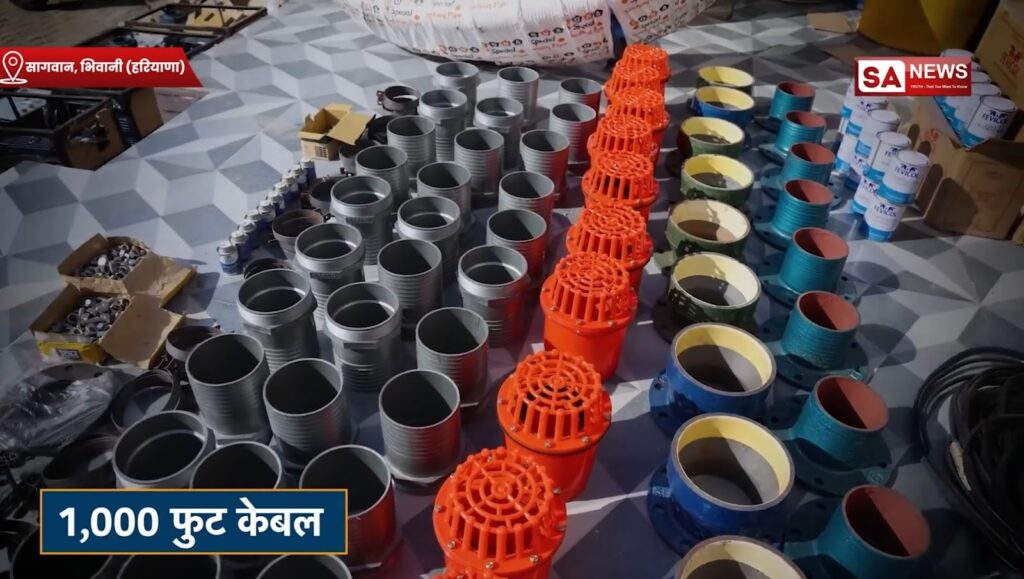
The help was provided by Tatvdarshi Sant Rampal Ji Maharaj under the Annapurna Muhim.
Continuous Pumping Operation Removes Floodwater
After the equipment arrived, the motors were installed to pump out the floodwater.
Villagers said the machines worked continuously day and night to remove stagnant water from the village and surrounding fields. In several places, the floodwater was about 15 feet deep, making drainage extremely difficult.
Gradually, the pumping process began clearing the water from residential areas and agricultural land.
Also Read: Sant Rampal Ji Maharaj Resolves 30-Year Waterlogging Crisis in Kamai Village Mathura
The government school building in the village, which had previously been completely submerged, eventually reopened once the water receded. Children resumed their studies there.
Agriculture Begins Recovering
With water gradually drained from the fields, farmers started preparing their land again.
In some areas tractors became stuck in mud because the soil remained waterlogged. However, villagers continued efforts to restore farmland.
Farmers said that about 80% to 90% of agricultural land has now been sown again, while some fields still have standing water.
During the flood, around 70% of farmland had been submerged, and in higher areas the water level had reached about five feet. The drainage process continued for months before farming could resume.
Today, wheat sowing has been completed in large parts of the village, and green crops are visible across fields that were once under water.
Residents Return and Village Life Resumes
As floodwater receded, villagers gradually began returning to Sagwan.
Many houses had developed cracks due to prolonged water exposure, and some buildings had collapsed. Because of this damage, some residents are still unable to return.
However, villagers said around 70% of residents have now come back, and normal activities are slowly returning.
Movement has resumed in village streets, tractors are working in fields, and reconstruction activities are ongoing. The school premises and other public areas are being restored.
Residents said the village, which once appeared deserted and silent during the flood, is gradually regaining its earlier rhythm.
For More Information Please Visit:
Website: www.jagatgururampalji.org
YouTube: Sant Rampal Ji Maharaj
Facebook: Spiritual Leader Saint Rampal Ji
‘X’ handle: @SaintRampalJiM