


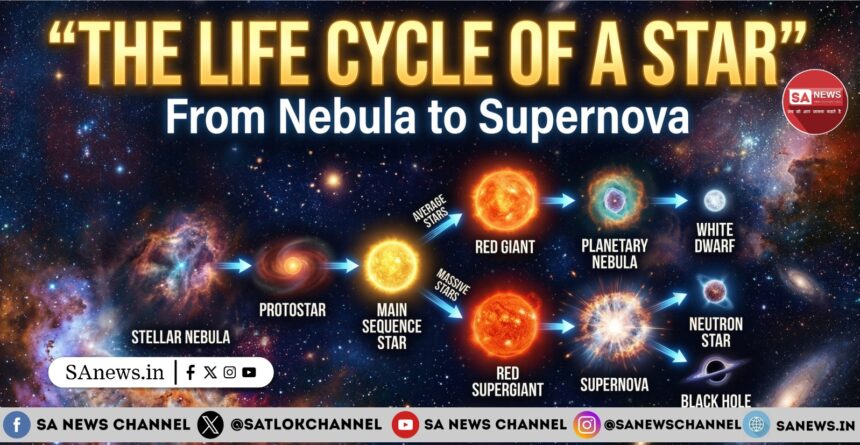
Life Cycle of a Star: When we look up at the night sky, the stars appear calm and permanent, shining steadily as if they have always existed and always will. In reality, every star has a life story. Stars are born, evolve, and eventually die after millions or even billions of years. Their life cycle is one of the most fascinating processes studied in Astrophysics.
- Birth of a Star: The Stellar Nursery
- Ignition of Nuclear Fusion
- The Main Sequence Phase
- Transformation into a Red Giant
- The Fate of Small and Medium Stars
- The Dramatic Fate of Massive Stars
- Creation of Cosmic Elements
- Neutron Stars and Black Holes
- Observing Stellar Evolution
- The Cosmic Cycle Continues
- The Remarkable Journey of a Star
- Spiritual Reflection: The Temporary Universe and the Search for Eternal Truth
- FAQs related to The Life Cycle of a Star: From Nebula to Supernova:
The journey of a star begins inside vast clouds of gas and dust and may end in a spectacular explosion that briefly outshines an entire galaxy. Along the way, stars produce the elements that form planets, oceans, and even the atoms in the human body. In this sense, understanding stellar evolution is also a way of understanding our own cosmic origins.
From the birth of a star in a nebula to its dramatic death as a supernova, the stellar life cycle is a story of gravity, nuclear energy, and cosmic transformation.
Birth of a Star: The Stellar Nursery
The story of a star begins in a Nebula, a massive cloud composed mainly of hydrogen and helium. Nebulae can stretch across dozens or even hundreds of light-years. Although they appear quiet and diffuse, these regions are dynamic environments where gravity slowly gathers matter together.
A disturbance often triggers star formation. This disturbance may come from nearby stellar explosions, collisions between gas clouds, or gravitational waves traveling through the galaxy. When such an event compresses part of the nebula, the gas begins to collapse under its own gravity.
As the cloud contracts, its center becomes denser and hotter. Over time, the collapsing region forms a dense core known as a Protostar. At this stage, the object is not yet a true star because nuclear fusion has not started. However, the growing mass and increasing pressure prepare the conditions needed for the next stage of stellar evolution.
Protostars often form in clusters, meaning that many stars are born together in the same nebula. Famous stellar nurseries, such as the Orion Nebula, allow astronomers to observe these early stages of star birth in remarkable detail.
Ignition of Nuclear Fusion
As the protostar continues to accumulate material, the temperature and pressure in its core rise dramatically. When the core temperature reaches about 10 million degrees Celsius, hydrogen atoms begin to collide with enough force to fuse together.
This process is known as Nuclear Fusion.
In nuclear fusion, hydrogen nuclei combine to form helium, releasing enormous amounts of energy. This energy travels outward from the core and pushes against the inward pull of gravity. When the outward pressure from fusion balances gravity, the star reaches a stable phase called Main Sequence.
This moment marks the true birth of a star.
The Main Sequence Phase
The main sequence stage is the longest and most stable period in a star’s life. During this phase, hydrogen fusion steadily powers the star’s luminosity.
A well-known example of a main sequence star is the Sun, which has been shining for about 4.6 billion years and is expected to remain stable for another 5 billion years.
Stars on the main sequence vary widely in size and brightness. Astronomers classify them according to their mass and temperature. Massive stars burn through their fuel quickly and shine intensely, while smaller stars burn slowly and can survive for trillions of years.
The relationship between stellar temperature and brightness is often illustrated using the Hertzsprung–Russell Diagram. This diagram helps astronomers track how stars evolve over time.
A star spends most of its life in this stage because hydrogen is the most abundant element in the universe. However, eventually the supply of hydrogen in the core begins to run out.
Transformation into a Red Giant
Once the hydrogen fuel in the core becomes depleted, nuclear fusion slows down. Without enough outward pressure to counter gravity, the core begins to collapse.
This collapse increases the temperature in the surrounding layers, causing hydrogen fusion to occur outside the core in a shell. As a result, the outer layers of the star expand dramatically.
The star becomes a Red Giant.
During this stage, the star grows enormously. In the case of the Sun, scientists estimate that it may expand far enough to engulf the inner planets, possibly including Mercury and Venus.
Inside the red giant, temperatures rise high enough to fuse helium into heavier elements such as carbon and oxygen. This process marks a significant transformation in the star’s internal structure.
The Fate of Small and Medium Stars
Not all stars end their lives in the same way. Stars with masses similar to or slightly larger than the Sun follow a relatively gentle path toward their final stage.
After the red giant phase, these stars shed their outer layers into space, forming a glowing cloud known as a Planetary Nebula.
Despite the name, planetary nebulae have nothing to do with planets. The term originated centuries ago when early astronomers observed these round shapes through telescopes.
What remains at the center of the nebula is a dense stellar core called a White Dwarf. White dwarfs are incredibly compact objects. Although roughly the size of Earth, they contain nearly the same mass as the Sun.
Over billions of years, a white dwarf slowly cools and fades, eventually becoming a dark and cold remnant.
The Dramatic Fate of Massive Stars
Stars that are much more massive than the Sun follow a far more violent path.
After becoming red giants, these stars evolve into Red Supergiant stars. Their cores reach temperatures high enough to fuse progressively heavier elements, including neon, silicon, and iron.
However, fusion stops once iron forms in the core. Unlike earlier reactions, fusing iron consumes energy instead of releasing it. This causes the core to collapse suddenly under the force of gravity.
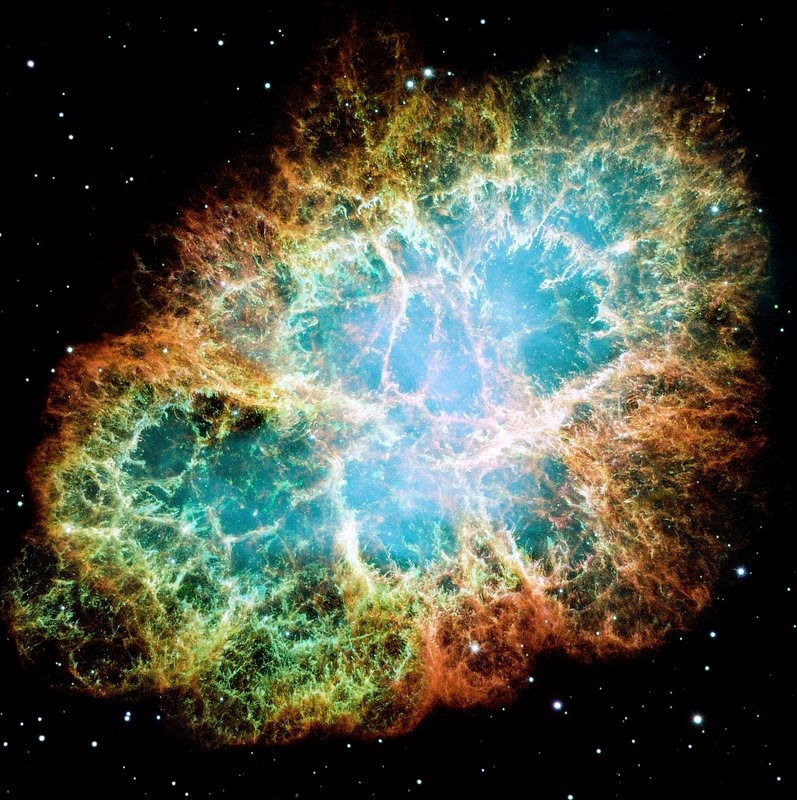
Within seconds, the collapse triggers one of the most powerful events in the universe: a Supernova.
During a supernova explosion, the outer layers of the star are blasted into space at tremendous speeds. For a brief period, the explosion can shine brighter than billions of stars combined.
Supernovae play a crucial role in the cosmic ecosystem because they scatter heavy elements throughout the galaxy.
Creation of Cosmic Elements
Many of the elements essential for life originate inside stars. While lighter elements such as hydrogen and helium formed shortly after the Big Bang, heavier elements were created through nuclear reactions in stellar cores.
Supernova explosions distribute these elements across interstellar space. Materials such as carbon, oxygen, iron, and calcium eventually become part of new stars, planets, and even living organisms.
This idea is often summarized in the famous phrase: “We are made of stardust.”
Every atom of calcium in human bones and every iron atom in human blood was forged inside ancient stars long before the formation of Earth.
Neutron Stars and Black Holes
After a supernova explosion, the remaining core may collapse into an extremely dense object.
If the core’s mass is moderate, it becomes a Neutron Star. Neutron stars pack more mass than the Sun into a sphere only about 20 kilometers wide. A teaspoon of neutron star material would weigh billions of tons on Earth.
Some neutron stars rotate rapidly and emit beams of radiation, forming objects known as Pulsar.
If the collapsing core is extremely massive, gravity becomes so intense that nothing can escape from it. The result is a Black Hole.
Black holes represent one of the most mysterious objects in the universe. Their gravitational pull can trap light itself, making them invisible except for their effects on nearby matter.
Observing Stellar Evolution
Modern astronomy has made it possible to observe stars at different stages of their life cycle. Because stars evolve over millions or billions of years, astronomers cannot watch a single star progress through every stage. Instead, they study large populations of stars at various ages.
Space telescopes such as the Hubble Space Telescope and the James Webb Space Telescope allow scientists to peer into distant stellar nurseries and ancient galaxies.
These instruments have revealed stunning images of star-forming regions, supernova remnants, and the complex structures created by dying stars.
Advances in spectroscopy and computer modeling also help researchers understand the internal processes occurring inside stars.
The Cosmic Cycle Continues
The end of one star often marks the beginning of another. Gas and dust expelled during stellar death eventually merge with interstellar clouds, contributing to the formation of new stars.
In this way, the universe operates through an ongoing cycle of birth, transformation, and renewal.
Regions of space enriched by previous generations of stars become fertile grounds for new solar systems. Our own Solar System formed from such recycled material approximately 4.6 billion years ago.
This cosmic recycling process has been shaping galaxies for billions of years.
The Remarkable Journey of a Star
The life cycle of a star is one of the most remarkable narratives in the universe. From its quiet birth within a nebula to its possible demise in a supernova explosion, a star undergoes dramatic changes driven by the delicate balance between gravity and nuclear energy.
Some stars fade gently into white dwarfs, while others explode violently and leave behind neutron stars or black holes. Despite their different endings, all stars contribute to the chemical enrichment of the universe.
The atoms that make up planets, oceans, and living beings were once forged in stellar furnaces. In this sense, studying stellar evolution is not merely an exploration of distant objects in the sky. It is also a deeper investigation into the cosmic processes that ultimately made life possible.
Also Read: NASA Targets 6 March Launch for Artemis II, First Crewed Lunar Flyby Since Apollo 17
The next time we look at the night sky, the stars may appear silent and eternal. Yet each one carries a long and complex history, a story written across millions or billions of years, reminding us that the universe itself is alive with change.
Spiritual Reflection: The Temporary Universe and the Search for Eternal Truth
Modern astronomy explains how stars are born, shine for millions or billions of years, and eventually perish. This grand cycle of creation and destruction in the universe also inspires deeper spiritual reflection. According to the spiritual knowledge explained by Sant Rampal Ji Maharaj, the physical universe is temporary and constantly changing. Just as stars appear, evolve, and eventually collapse, everything in the material creation is subject to time and destruction.
Scientific discoveries show that even the most powerful stars cannot exist forever. They expand, exhaust their energy, and finally disappear in dramatic events such as stellar collapse or explosions. This observation aligns with the spiritual teaching that the visible universe operates under the control of time and natural laws, and therefore it cannot provide permanent peace or stability.
The Chyren Saint Rampal Ji Maharaj ji explains that while the physical cosmos is vast and astonishing, it is still part of the perishable creation. The scriptures describe that beyond this temporary universe exists an eternal divine realm known as Satlok, the imperishable abode of the Supreme God. Unlike stars, galaxies, and planets that undergo constant transformation, that divine realm remains everlasting.
The study of stars can therefore remind humanity of an important truth. The brilliance of the universe is extraordinary, yet it is not eternal. Human life, which is even shorter than the life of a star, should not be spent only in worldly pursuits. Instead, it should be used to seek true spiritual knowledge and practice the correct method of devotion taught by a Tatvdarshi Saint.
In this way, both science and spirituality encourage humans to reflect on the deeper purpose of existence and the search for eternal reality beyond the temporary universe.
Those who wish to explore deeper questions about the origin of the universe, the purpose of human life, and the reality beyond this temporary creation can visit www.SupremeGod.org and read the insightful section “Creation of Nature.” It presents scriptural knowledge about how the universe was created, the structure of the spiritual realms, and the path toward understanding the Supreme God. Studying this knowledge can help seekers reflect on life’s true purpose and move closer to eternal truth.
FAQs related to The Life Cycle of a Star: From Nebula to Supernova:
1. What is the first stage in the life cycle of a star?
The first stage in a star’s life cycle begins in a Nebula, a vast cloud composed mainly of hydrogen and helium. Under the influence of gravity, regions within the nebula collapse and form a Protostar, which eventually develops into a fully formed star once nuclear fusion begins in its core.
2. What is the main sequence stage of a star?
The Main Sequence is the longest phase in a star’s life. During this period, the star produces energy through Nuclear Fusion, where hydrogen atoms fuse into helium in the core. This stage keeps the star stable for millions or billions of years. Our Sun is currently in the main sequence stage.
3. What happens when a star runs out of hydrogen fuel?
When hydrogen in the core is depleted, the star’s internal balance changes. The core contracts while the outer layers expand, transforming the star into a Red Giant. During this phase, the star begins fusing heavier elements such as helium.
4. What is a supernova and why is it important?
A Supernova is a powerful explosion that occurs when a massive star collapses at the end of its life. Supernovae are extremely important because they scatter heavy elements like iron, carbon, and oxygen into space. These elements later become part of new stars, planets, and even living organisms.
5. What remains after a massive star explodes?
After a supernova, the remaining core may form a Neutron Star or, if the core is extremely massive, it can collapse into a Black Hole. Both objects are among the most extreme and mysterious structures in the universe.