



Screen Time for Kids: We’ve all been there: standing in the hallway at 6:00 PM, watching the blue light of a screen wash over our kids. We’re ready to start the usual “five more minutes” routine, but something feels different now.
By 2026, the digital world has become the very air our children breathe. It’s where they learn and where they grow, which means the “just turn it off” advice of ten years ago no longer works.
To tackle the same, we’ve curated this guide for the modern day world to manage screentime for kids where they’ve become an essential part of our lives so keep on reading!
The 2026 Reality: Quality Over Quantity
For years, parents were haunted by strict “two-hour limits.” However, the American Academy of Pediatrics (AAP) recently shifted its focus. As of 2026, the experts emphasize quality, context, and conversation over the ticking clock.
Think of screen time like a diet. There is “Digital Broccoli” (educational apps, creative coding, or video chatting with Grandma) and “Digital Candy” (mindless, fast-paced “unboxing” videos or endless scrolling).
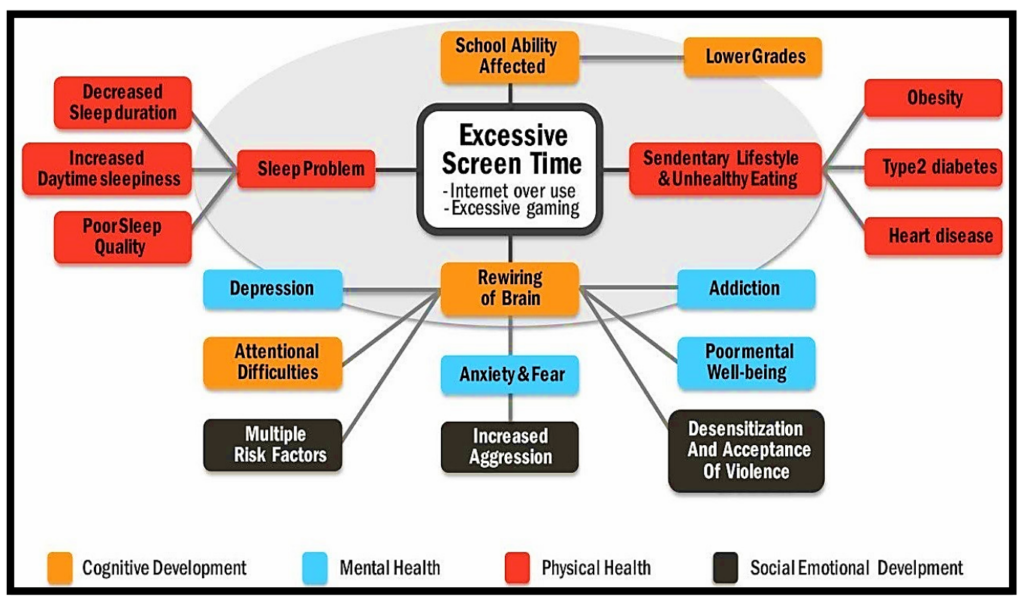
(Image Courtesy: The Surge of Screen Time: Its Profound Effect on Paediatric Oral Hygiene)
A child spending three hours coding a game is having a vastly different neurological experience than one spending thirty minutes watching high-intensity, sensory-overload clips.
The “Age and Stage” Cheat Sheet
| Age Group | Recommended Approach |
| 0–18 Months | Zero screens, except for video chatting. (Babies need faces, not pixels.) |
| 18–24 Months | High-quality programming only with an adult (Co-viewing is key). |
| 2–5 Years | Limit to 1 hour per day of high-quality content. |
| 6+ Years | Focus on consistency and ensuring screens don’t replace sleep or exercise. |
Beware of “Technoference”
One of the most fascinating (and slightly convicting) terms in modern research is Technoference. A study presented at the WISH 2026 Summit highlighted that it’s not just the child’s screen time that matters, it’s the parents.
Read a research paper about the effects of excessive screen time on child development here!
When we “phub” (phone-snub) our children to check a notification, we signal that the device is more valuable than the interaction. This often leads to increased attention-seeking behavior in kids.
“Focused attention is the purest form of love,” notes the 2026 AAP policy. “When we model healthy boundaries, our children learn to do the same.”
Active vs. Passive: The Brain’s Perspective
Not all pixels are created equal. Research from The Voice of Early Childhood (2025) distinguishes between two types of engagement:
- Active Screen Time: This involves problem-solving, creativity, or social interaction. Think of AI-driven language tools or Minecraft. The brain is “on,” making decisions and learning resilience through trial and error.
- Passive Screen Time: This is the “lean back” experience. While great for relaxing after a long day (we all need a little Bluey sometimes), excessive passive consumption is linked to lower levels of “executive function” and physical health.
The goal isn’t to eliminate passive time rather it’s to ensure that it doesn’t become the default.
Also Read: The Silent Brain Killer: Air Pollution’s Catastrophic Link to Dementia & Cognitive Loss
Practical Strategies for a Sane Household
So, how do we actually manage this without a daily battle? Here are the most effective strategies for the 2026 landscape:
- The “One-Hour-Before-Bed” Rule: Blue light suppresses melatonin. A 2026 Mayo Clinic report reiterates that keeping screens out of the bedroom is the single best thing you can do for your
child’s mental health and sleep quality.
- Device-Free “Sanctuaries”: Declare the dining table and the car “no-phone zones.” This forces the “boredom” that actually leads to creativity and conversation.
- The Shared Family Tablet: Instead of giving every child their own personal device, use a shared family tablet. This naturally encourages co-viewing and makes monitoring content much easier.
- Use the 5 C’s:
- Child: What is your child’s temperament?
- Content: Is it age-appropriate?
- Context: Why are they using it (boredom, learning, connection)?
- Connection: Are you talking about what they see?
- Community: Is the media helping them connect with others?
The AI Frontier
We can’t talk about 2026 without mentioning AI. According to Pew Research, nearly 40% of kids now interact with voice assistants or AI chatbots daily. Rather than fearing the “robot teacher,” use it as a tool for Digital Literacy.
Teach your kids to ask: Is this information true? Who created this? The Economic Survey 2025-26 recently flagged digital addiction as a major healthcare issue, recommending that schools and parents move toward “preventive wellness” rather than just reactive bans.
The Bottom Line
At the end of the day, managing screen time isn’t about being a drill sergeant; it’s about being a mentor. Technology is a tool, a powerful, shiny, sometimes addictive tool but it’s one our children must learn to master.
By shifting the conversation from “Put that away!” to “What are we doing with this?” We help them build a relationship with technology that is productive, healthy, and, most importantly, balanced.
Just like it’s very essential to be aware and cautious about the impact of screentime, it’s also important that we understand the role of spiritual discourses and bhakti in one’s life.
Importance Of Spiritual Discourses | Sant Rampal Ji English Satsang | SA NEWS
Sant Rampal Ji Maharaj goes deep down in the details by covering questions we’ve always wondered about the creation of the universe, the birth of three gods in Hinduism and the purpose of our human life.
He uncovers the complete truth by showing evidence right from our holy scriptures so go check out the article on this site to read more right now!
Birth, Marriage & Death of Brahma, Vishnu & Shiv Ji in Holy Books
FAQs (Frequently Asked Questions)
1. How much screen time is recommended for kids in 2026?
While limits vary by age (e.g., 1 hour for ages 2–5), the focus has shifted from the clock to quality. In 2026, experts prioritize what kids are doing over how long they are doing it.
2. What is the difference between active and passive screen time?
Active screen time involves creativity or problem-solving (like coding or Minecraft), which engages the brain. Passive screen time is “leaning back” to watch videos, which should be limited as it requires less cognitive effort.
3. What is “Technoference” and why does it matter?
Technoference happens when a parent’s device use interrupts interactions with their child. Research shows this “phone-snubbing” can lead to increased attention-seeking behavior and lower emotional connection.
4. Why should children avoid screens an hour before bed?
The blue light from screens suppresses melatonin, the hormone responsible for sleep. Following the “one-hour-before-bed” rule ensures better sleep quality and mental health for children.
5. Is AI interaction safe for children?
Yes, if handled with “Digital Literacy.” In 2026, parents are encouraged to mentor kids on how to use AI tools critically, questioning the source and accuracy of the information provided.