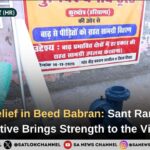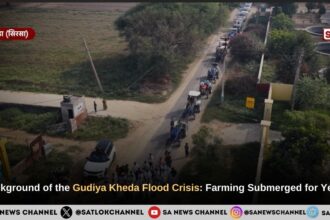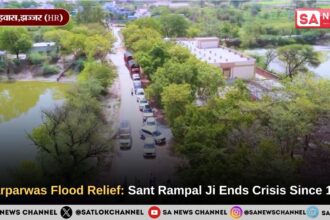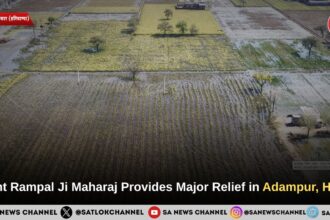


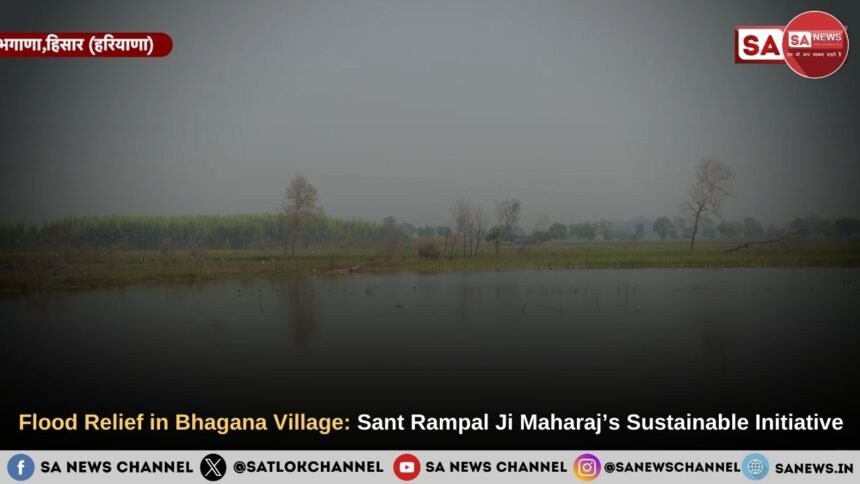
For the past few months, Bhagana Village in Haryana’s Hisar district had ceased to be just a village—it had become a living picture of pain, struggle, and collapsing morale. Water surrounded everything. Lanes were submerged, farmlands had turned into ponds, schools were shut, fodder for livestock was scarce, and deep lines of worry marked the faces of farmers. According to villagers, floodwater remained stagnant in the village for nearly three months, destroying crops spread across approximately 3,000 acres.
- Village Bhagana Receives 33,000 Feet of Pipeline in Two Phases to Address Long-Standing Waterlogging
- When Every Door Was Knocked, Yet No Answer Came
- What Followed the Application Left the Village Astonished
- A Changed Atmosphere at the Village Chaupal
- Relief Accompanied by a Message of Responsibility
- Farmers Speak: “Now There Is Hope for Wheat Sowing”
- Wider Impact of the Relief Work
- Social Impact: The Return of Trust and Self-Respect
- The Role of Sant Rampal Ji Maharaj: Service, Selflessness, and Resolve
- A New Example of Hope from Bhagana
The assistance provided at the government level proved inadequate. Two motors were supplied for a month, but against such massive waterlogging, they were like a drop in the ocean. As the village elders said, “Only the one who suffers truly understands the pain.”
Village Bhagana Receives 33,000 Feet of Pipeline in Two Phases to Address Long-Standing Waterlogging
Village Bhagana in Hisar district, Haryana, has received extensive support from Tatvdarshi Sant Rampal Ji Maharaj in two phases to address its long-standing waterlogging and flood-like conditions during the monsoon. In 2025, after the Gram Panchayat appealed for assistance, the village was provided with 23,000 feet of pipeline and four motors, enabling the drainage of accumulated water and allowing cultivation to resume on hundreds of acres of farmland. As another part of the village continued to face drainage issues, the Gram Panchayat submitted a second request.
On the instructions of Sant Rampal Ji Maharaj, a detailed drone survey and site inspection were conducted, identifying the need for approximately 10,000 feet of 8-inch pipeline. Based on the survey report, the village received 10,000 feet of pipeline along with essential installation materials, including air valves, nuts and bolts, bands, plates, Fevicol, PVC pipes, and other accessories. Two additional motors were also approved, to be handed over after the new pipeline is laid underground and verified through a follow-up inspection. With this second phase, Village Bhagana has received a total of 33,000 feet of pipeline and six motors, aiming to provide a long-term solution to waterlogging, protect agricultural land, and safeguard the village from future flood-like situations.
When Every Door Was Knocked, Yet No Answer Came
Farmers and panchayat representatives of Bhagana recount how they made repeated rounds of administrative offices. Somewhere there were assurances, somewhere files moved forward, but on the ground, the water remained unmoved. The blanket of water standing in the fields was swallowing the farmers’ future. They even traveled to Chandigarh in search of pipelines.
In this situation, the village panchayat, as a last hope, submitted an application at the court of Sant Rampal Ji Maharaj. This appeal was not for political gain or publicity, but the sobbing plea of a broken village: “We need freedom from water so that we can farm again.”
What Followed the Application Left the Village Astonished
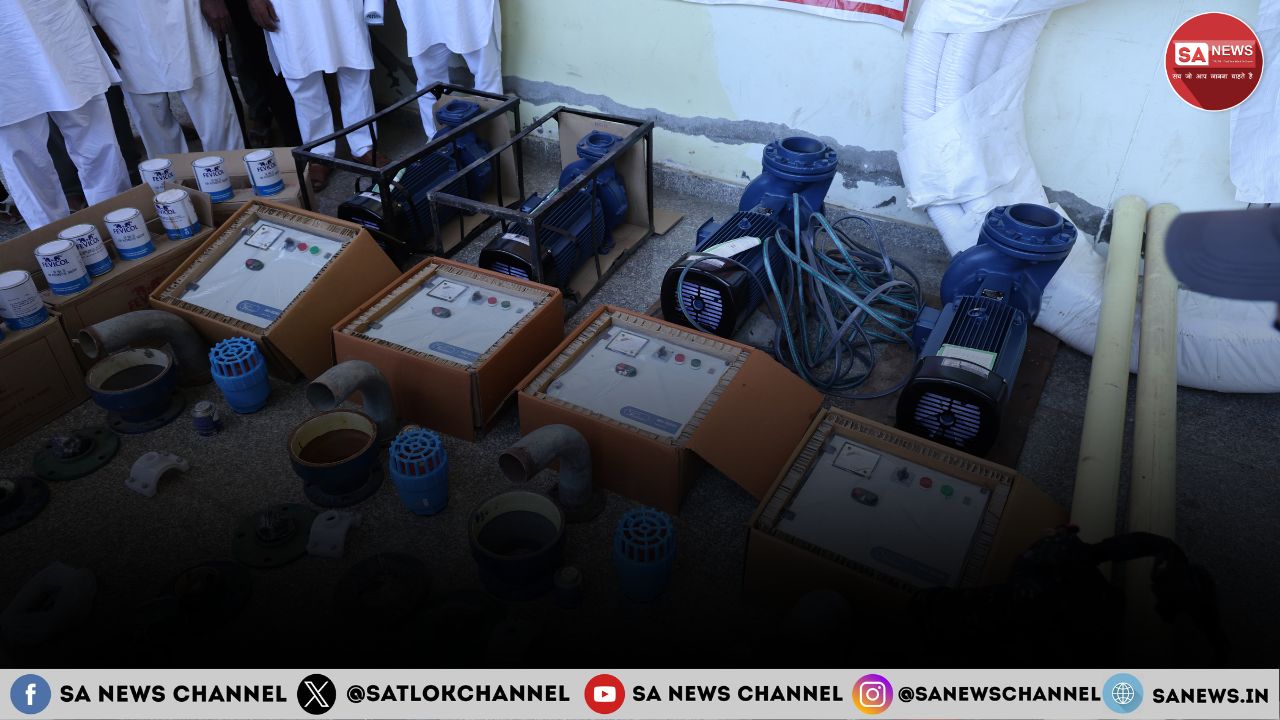
The panchayat had requested only four 15 HP motors and 23,000 feet of 8-inch pipelines. But when the relief material arrived, everyone was stunned. Along with the motors and pipes came starters, clamps, nuts and bolts, jointers, hoses, and even Fevicol—everything required, including items that had never even been requested.
Sarpanch Monu says, “Even the things we never asked arrived as part of a complete system. We didn’t need to buy even a single nut or bolt.”
A Changed Atmosphere at the Village Chaupal
At the chaupal where worries and arguments had dominated just days earlier, the sound of drums now echoed. Children, elders, and youth gathered together. Flower garlands were in their hands, but the volunteers clearly stated that flowers are only for God; those who serve are merely mediums.
The entire village agreed that this help was not symbolic but a step toward a permanent solution. The pipeline is being buried underground to ensure a lasting drainage system, so the village does not drown again in the future.
Relief Accompanied by a Message of Responsibility
When the relief materials had arrived and happiness was visible on people’s faces, an important letter sent on behalf of Sant Rampal Ji Maharaj was read aloud before the entire village by the volunteers. This letter was not a mere formality—it carried a clear message of responsibility and accountability along with relief.
The letter stated that the motors, pipelines, and other materials provided to Bhagana village on the orders of Sant Rampal Ji Maharaj were not meant for temporary relief but to permanently free the village from waterlogging. Therefore, it was essential that all villagers collectively ensure proper and timely use of the system.
It was clearly mentioned that if, despite this relief, water did not drain from the village within the stipulated time and crop sowing could not take place, then in the future the trust would not provide disaster relief to that village. For a moment, silence spread across the chaupal—this was the first time relief had come with such an explicit condition.
The letter also explained that a drone video recording of the current situation—showing waterlogged fields and the village—had already been done. Once the water completely drains, a second video will be made, and a third video will be recorded when crops are seen swaying in the fields. All three videos will be displayed on projectors at Satlok Ashrams and congregations across the country, ensuring transparency so that devotees know their donations are being used for the right purpose.
Farmers Speak: “Now There Is Hope for Wheat Sowing”
At the chaupal, the voices of farmers now carry relief along with pain. Farmers who had accepted that wheat sowing would remain a dream this year are once again talking about drying fields and standing crops.
Pointing toward his submerged fields, one farmer says, “The previous crop was completely destroyed. There was four to five feet of standing water. Forget tractors—even a person couldn’t enter. Day and night, the fear was how we would sow wheat if the water didn’t recede. How would we feed our families?”
He adds that this was not just a financial loss but a matter of self-respect. “A farmer’s entire life rests on the land. When the land itself seems to slip away, a person breaks from within.”
Another farmer explains, “The government did help and provided two motors, but our area is huge—around 2,500 to 3,000 acres were waterlogged. How could two motors dry so much water? We saw the motors running daily, but there was no visible effect.”
According to the farmers, when four large 15 HP motors and 23,000 feet of pipeline arrived on the orders of Sant Rampal Ji Maharaj, they felt for the first time that a real solution was possible. An emotional elder says, “What didn’t happen in three months happened with one application. We had only heard about such things—today we saw them with our own eyes. Even nuts, bolts, starters, and Fevicol came along. If this is not a miracle, what is?”
Sarpanch Monu states clearly, “We demanded only motors and pipes, but we received much more. Farmers now believe that their hard work will not go to waste. This relief is a major lifeline for our village.”
Another farmer sitting at the chaupal adds, “The village atmosphere has changed. Where people once sat silently, they are now calculating when the fields will dry and when wheat will be sown. This hope has come after a long time.”
It is evident in these voices that this help is not limited to draining water—it is an effort to restore the shattered trust taken away by months of helplessness.
Wider Impact of the Relief Work
According to villagers, this is not just Bhagana’s story. Similar relief has already reached more than 400 villages, and the process continues. Volunteers say the directive is clear—no showmanship, only ground-level work. Along with providing relief material, proper usage is ensured so donations are not misused and reach every needy person.
The letter mentions that Sant Rampal Ji Maharaj Himself belongs to a farming family and deeply understands farmers’ pain. Waterlogging does not just damage crops—it disrupts fodder supply for animals, children’s education, healthcare, and the daily life of entire villages. Hence, this issue is not limited to one village but is a concern for society as a whole.
Social Impact: The Return of Trust and Self-Respect
This relief has not only drained water but has also removed fear and helplessness from within the villagers. Where farmers once felt alone, they now feel someone understands their pain. Hopes of reopening schools have emerged, fodder arrangements for livestock are likely to improve, and most importantly, farmers’ self-respect has returned.
The Role of Sant Rampal Ji Maharaj: Service, Selflessness, and Resolve
The people of Bhagana repeatedly emphasize one thing—this help came without conditions or selfish motives. No talk of votes, no noise of publicity. The sarpanch states clearly, “Thanks to the government as well, but what Sant Rampal Ji Maharaj did is completely selfless. He understood the farmers’ pain, assessed it, and provided help accordingly.”
This service is not limited to relief but also prepares for the future, ensuring the village does not drown again with the next rainfall. Many villagers regard Sant Rampal Ji Maharaj as an incarnation of Kabir Parmeshwar. According to them, providing every needed item without being asked goes far beyond ordinary human planning.
A New Example of Hope from Bhagana
Bhagana’s story is not just about 23,000 feet of pipeline or four motors. It is the story of trust that gave a drowning village the strength to stand again. Where systemic limitations became evident, an organized and selfless effort showed the path toward a permanent solution.
Today, many saints collect millions in the name of discourses, sermons, and miracles, spending on luxury, expensive vehicles, and personal comforts. In contrast, at Sant Rampal Ji Maharaj’s place, every rupee visibly translates into ground-level work. Donations received are not spent on stages or publicity, but on motors, pipelines, houses, medical treatment, children’s education, care for orphans, and permanent assistance to disaster victims.
Delivering relief worth lakhs of rupees to villages like Bhagana—without any fee, condition, or selfish motive—proves that this service is driven by duty, not display. No demand for votes, no hunger for publicity, no personal gain—only understanding the suffering and resolving it.
This is why people say Sant Rampal Ji Maharaj is not an ordinary saint but an extraordinary one—because in an era where religion has been turned into a business, He has restored it as a true medium of human service.