



Civilisations rise and fall not merely through economic shifts or political conflict, but through the erosion of inner order. Beneath the visible crises of war, environmental decline, and moral fragmentation lies a deeper spiritual dislocation. This article examines the philosophical roots of civic collapse, tracing how conscience must be restored not by systems alone, but through authentic spiritual awakening. Only then can civilisation rediscover its enduring moral centre and stability.
- Copenhagen: A Mirror to Modern Civilisation
- Civic Sense Is Not Genetic—It Is Cultural Architecture
- Caste, Class, and the Moral Devaluation of Cleanliness
- Infrastructure Precedes Behaviour
- Empathy: The Missing Psychological Infrastructure
- The Environmental Feedback Loop
- Why Punishment Alone Fails
- The Deeper Civilisational Question
- Inner Reform Before Outer Reform
- The Role of Ethical Leadership
- Toward a Holistic Model of Civic Culture
- The Spiritual Root of Conscience: Beyond Systems and Empathy
- Restoring the Original Human Character
- Civic Sense FAQs
Copenhagen: A Mirror to Modern Civilisation
In the capital city of Copenhagen, one encounters a social reality that appears deceptively simple. Public toilets are accessible and clean within minutes of walking. Roads are free of potholes. Vehicles remain disciplined within lanes. Pedestrians step onto zebra crossings, and cars stop—without negotiation. Escalator etiquette is observed instinctively. Waste is segregated meticulously. Plastic bottles are returned for refunds.
This is not merely infrastructure. It is civilisation expressed through daily behaviour.
Now contrast this with the recurring urban realities in many parts of India—overflowing garbage, unusable public toilets, open urination, chaotic traffic, incessant honking, absent footpaths, and informal waste picking under hazardous conditions.
The common explanation is “lack of civic sense.”
But civic sense is not an isolated behavioural flaw. It is the visible symptom of a deeper philosophical and moral crisis.
Civic Sense Is Not Genetic—It Is Cultural Architecture
Are Danes born more disciplined? Are Indians genetically deficient in public responsibility?
The answer is self-evidently no.
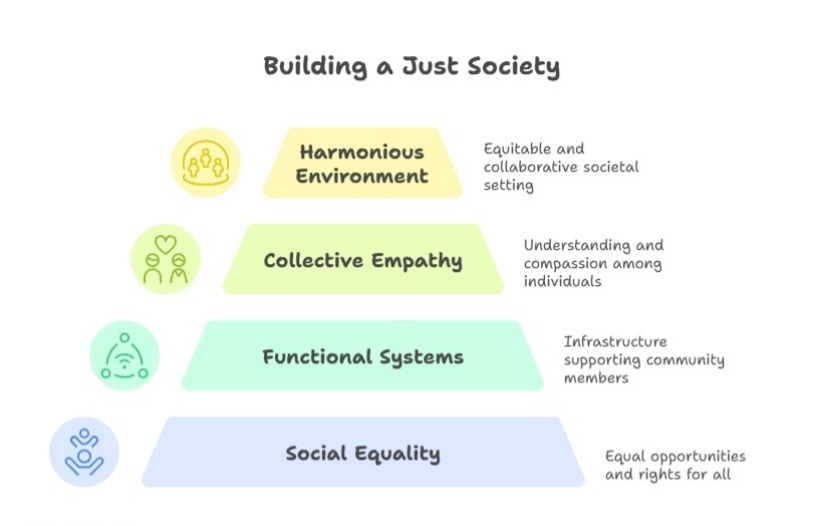
Civic sense emerges from three interlinked foundations:
- Social equality
- Functional systems and infrastructure
- Collective empathy
Where these are weak, public disorder follows.
(AI Generated)
Caste, Class, and the Moral Devaluation of Cleanliness
In societies where sanitation work is historically stigmatised, cleanliness becomes someone else’s responsibility. When waste collection and sewer cleaning are associated with marginalised communities, the act of cleaning itself becomes socially degraded.
This produces a psychological dissociation:
- “I create the waste.”
- “Someone inferior will clean it.”
Such a mindset corrodes moral accountability. When sanitation workers are treated as disposable, public hygiene becomes structurally fragile.
In contrast, countries like Denmark do not attach caste hierarchies to sanitation labour. Waste segregation is a personal duty. Households sort garbage into multiple categories—glass, metal, plastic, paper, food waste, textiles, hazardous waste, and residual waste—before municipal collection.
Civic responsibility is not outsourced to the socially vulnerable. It is internalised.
A civilisation that despises the act of cleaning cannot remain clean.
Infrastructure Precedes Behaviour
It is intellectually dishonest to demand civic discipline in the absence of systems.
If public toilets lack water, soap, and maintenance, open urination becomes predictable. If footpaths are absent, pedestrian discipline collapses. If lane markings are poorly designed, traffic chaos follows. If garbage bins are scarce, litter spreads. Behaviour responds to the environment.
In Copenhagen, bicycle lanes are protected and extensive. Over half the population commutes by cycle.
Five-minute neighbourhood planning ensures that workplaces, schools, and essential services are within a short distance. Pedestrian-first policies legally prioritise walkers over vehicles. Excessive honking is culturally unacceptable.
This is not moral superiority. It is a systemic design.
Similarly, Switzerland imposes a structured waste-disposal fee system: households must purchase official municipal garbage bags. Recycling facilities are free and widely accessible. The economic signal is clear—waste costs money; recycling does not.
In Denmark and Germany, reverse vending machines return deposits on plastic bottles and aluminium cans. You pay and purchase a soft drink. You can reclaim it when you return the bottle.
This is behavioural economics aligned with environmental ethics.
Civilisation advances when systems reduce the temptation to behave irresponsibly.
Also Read: Role of Teachers in Shaping Society | Importance of Teachers in Nation Building
Empathy: The Missing Psychological Infrastructure
Yet infrastructure alone is insufficient.
The third and most decisive variable is empathy—an awareness that one’s actions affect unseen others.
In Denmark, there exists a cultural principle known as samfundssind—placing society’s interest above personal convenience. During crises, this sentiment becomes visible: compliance emerges not merely from law but from shared responsibility.
Empathy transforms compliance into conscience.
In many developing urban contexts, a fragmentation of community undermines this awareness. Affluent neighbourhoods wall themselves off from surrounding informal settlements. Waste accumulates at the margins. Environmental degradation is externalised.
This is not merely an economic divide; it is a moral segmentation.
The wealthy may insulate themselves within gated complexes, but pollution, water scarcity, and climate instability ignore social boundaries. Environmental collapse is democratic in consequence.
The absence of empathy produces civic indifference. Civic indifference produces ecological decay.
The Environmental Feedback Loop
The consequences extend beyond aesthetics.
Plastic waste contaminates lakes and coastlines. Urban heat intensifies where trees are removed for concrete expansion. Noise pollution erodes psychological well-being. Poor sanitation increases disease burden.
In Copenhagen, climate-friendly asphalt, tree-lined streets, and integrated cycling infrastructure contribute to lower CO₂ emissions and improved public health. Waste-free initiatives—such as those pursued on Denmark’s Bornholm Island—aim to eliminate residual waste through systemic reuse and recycling.
These are not cosmetic improvements. They are civilisational decisions about sustainability.
A society that refuses to manage waste responsibly eventually becomes waste—morally, ecologically, and structurally.
Also Read: Wangari Maathai Biography: How One Woman Grew a Global Environmental Movement
Why Punishment Alone Fails
Calls for harsh penalties—fines, imprisonment, public shaming—often arise in frustration.
But punishment without probability is ineffective.
In well-functioning systems, even small fines work because enforcement is predictable. In dysfunctional systems, even large fines fail because enforcement is rare.
However, enforcement alone cannot cultivate civic virtue. It can restrain misconduct, but it cannot generate conscience.
Conscience must be cultivated through education, cultural messaging, and lived experience of order.
In countries like and , civic education begins early. Public cleanliness is not merely enforced; it is taught as shared dignity. In Singapore, even public restrooms are evaluated and rated through structured assessment systems, incentivising maintenance excellence.
System plus education plus empathy—this triad produces durable civic culture.
The Deeper Civilisational Question
Yet beneath infrastructure and policy lies a more profound question:
Why does a society permit inequality in dignity?
Why is sanitation labour stigmatised?
Why is waste management neglected?
Why is public space treated as expendable?
Because civilisation is not sustained by technology alone. It is sustained by values.
Modern crises—environmental collapse, hyper-consumerism, urban alienation—are symptoms of a philosophical failure. We have normalised extraction without responsibility, consumption without consequence, comfort without contribution.
Civic decay is the daily expression of metaphysical confusion.
If individuals view themselves as isolated competitors rather than interconnected participants, shared spaces deteriorate. If success is defined purely by private accumulation, public goods decay.
Civilisation cannot endure economic growth alone. It requires moral coherence.
Inner Reform Before Outer Reform
Policy reforms are necessary. Infrastructure investment is essential. Educational reform is urgent. But these remain incomplete without inner transformation.
Civic sense is ultimately a discipline of consciousness:
- Recognising that my litter becomes another’s labour.
- Understanding that my noise disturbs unseen strangers.
- Accepting that my convenience may harm collective well-being.
Empathy is not a sentimental weakness. It is structural intelligence.
When internal discipline aligns with systemic design, transformation accelerates. A positive feedback loop emerges: clean spaces encourage cleaner behaviour; responsible citizens demand better governance; effective governance reinforces responsible behaviour. This is civilisational synergy.
The Role of Ethical Leadership
However, history reveals that societies rarely achieve moral recalibration spontaneously. Periods of decline are often reversed by individuals who articulate a deeper ethical vision—figures who restore moral seriousness to public discourse.
A rare enlightened authority does not merely preach behavioural change. Such leadership redefines identity. It reminds individuals that dignity is universal, that labour is sacred, and that responsibility cannot be outsourced. This identity is backed by true spiritual knowledge and power of word, found only in a Tatvdarshi Sant as per the sacred scripture holy Gita ji.
True unity cannot be manufactured by policy. It must be grounded in shared moral understanding rooting in deep spiritual understanding.
When a society internalises the principle that every human being—sanitation worker, street vendor, executive, or minister—possesses equal inherent worth, civic sense ceases to be a forced compliance. It becomes an expression of reverence for collective life.
This is the turning point for civilisational renewal.
Also Read: Forever: The Memory We Were Forced to Forget
Toward a Holistic Model of Civic Culture
The Danish example is not about copying Europe. It is about recognising principles:
- Infrastructure must enable responsible behaviour.
- Economic incentives must reward sustainability.
- Education must cultivate empathy.
- Enforcement must be predictable.
- Social hierarchies that degrade labour must be dismantled.
- Leadership must articulate a morally coherent vision.
When these converge, civic sense becomes habitual rather than exceptional.
The question is not whether one nation can become like another. The question is whether any society is willing to confront its deeper moral assumptions.
Garbage mountains, traffic chaos, polluted lakes, and unusable toilets are not merely administrative failures. They are mirrors reflecting philosophical disorder.
To restore public order, we must restore inner order.
To build clean cities, we must build disciplined minds.
To achieve sustainable development, we must cultivate ethical development.
Civilisation is not measured by GDP alone. It is measured by how responsibly individuals inhabit shared space.
Until responsibility becomes sacred, no system will suffice.
But when responsibility is internalised—supported by just systems and guided by enlightened moral authority—civic sense ceases to be a slogan.
It becomes culture.
And culture, once transformed, reshapes destiny.
The Spiritual Root of Conscience: Beyond Systems and Empathy
The Limitation of Man-Made Morality
We often speak of empathy as the ‘missing infrastructure’, believing that better education or social equality will naturally birthed a sense of collective responsibility. But have we ever paused to ask: If humanity has been striving for ‘civilization’ for millennia, why does moral decay continue to resurface like an incurable shadow? We build smarter cities and more efficient recycling loops, yet the greed for personal convenience often overrides our best-laid systems.
This suggests that civic sense is not just a cultural byproduct; it is a spiritual one. When we view our neighbor—or the sanitation worker—merely through the lens of social equality, our respect is often conditional or intellectual. But what happens when we realize that the same divine spark, the soul, resides in every living being? This is where the wisdom of Jagatguru Tatvdarshi Sant Rampal Ji Maharaj provides the missing link. He explains that ‘Inner Order’ cannot be sustained by the human mind alone, which is inherently prone to ego, laziness, and selfishness.
Restoring the Original Human Character
The ‘samfundssind’ or collective conscience we admire in some cultures is actually a faint reflection of the soul’s original nature. Jagatguru Tatvdarshi Sant Rampal Ji Maharaj reveals that we are currently living under the influence of Kaal Brahm (the ruler of this mortal realm), who keeps our minds entangled in hierarchies and superficiality.
No amount of ‘civic training’ can permanently fix a mind that does not understand its origin or its ultimate purpose.
True discipline arises when a person connects with the Supreme God Kabir through authentic spiritual practice. As Sant Rampal Ji Maharaj teaches, when a soul recognizes its true home (Satlok) and understands the inescapable Law of Karma, ‘civic sense’ ceases to be a burden of law and becomes a natural expression of the soul. You no longer litter, not because of a fine, but because you realize that every action is an account before the Creator.
As the sacred verse (Vaani) of Saint Garibdas Ji Maharaj reminds us:
“Drishti pade so dhokha re. Khand pind brahmand chalenge thir nahi rahsi loka re. thir nahi rahsi loka re.”
This world is transient; our systems will eventually fade. The only lasting ‘Civilisational Renewal’ is the one that prepares the soul for its eternal journey. By adopting the true worship granted by the only Tatvdarshi Saint of our time, Sant Rampal Ji Maharaj, individuals experience a total transformation of character. Vices like pride and indifference vanish, replaced by a deep, unwavering reverence for all life. This is the ultimate ‘Culture’ that does more than just clean our streets—it saves our souls.
Would you like to discover the spiritual science that can truly transform human character and solve the world’s deepest crises?
Website:www.jagatgururampalji.org
YouTube: Sant Rampal Ji Maharaj
Facebook: Spiritual Leader Saint Rampal Ji
‘X’ handle: @SaintRampalJiM
Civic Sense FAQs
Why does civic sense ultimately decline in a society?
Because inner awareness and moral consciousness gradually weaken without the refuge of a Tatvdarshi Sant.
Can external reforms alone restore public discipline?
No, sustainable order arises when conscience is awakened within individuals through true spiritual knowledge by a Tatvdarshi Sant.
What is the lasting foundation of a harmonious civilisation?
A society guided by elevated inner values that shape outward conduct, as done by Sant Rampal Ji Maharaj through His devotees.