


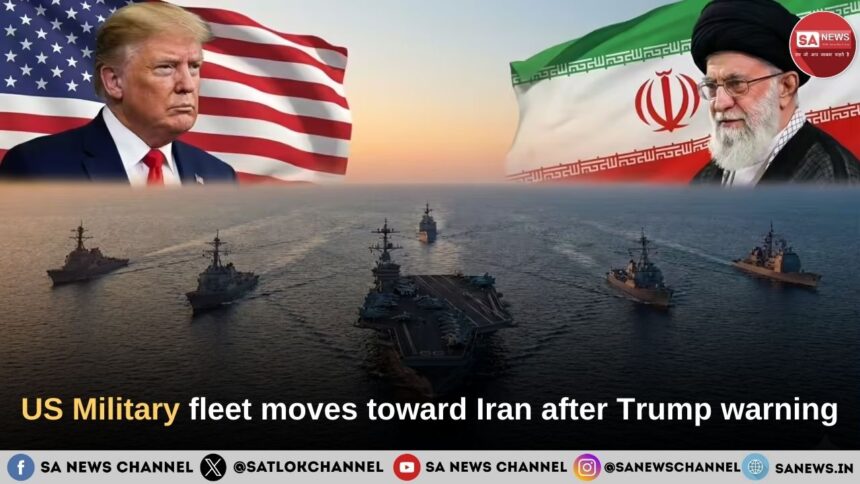
‘Massive’ US Military Fleet Heads Toward Iran as Tensions Escalate, Trump Says
- White House Signals Strategic Military Posture
- Composition of the US Naval Armada
- Iran’s Response: ‘Finger on the Trigger’
- Warnings Directed at the US and Israel
- Statements from Senior IRGC Leadership
- Controversy Over Execution Claims
- Nationwide Protests and Disputed Casualty Figures in Iran
- US Defensive Measures in the Region
- Diplomatic Door Remains Ajar
- Global Attention on a Volatile Region
Washington/Tehran | January 22–23, 2026 — Tensions in West Asia have intensified sharply after US President Donald Trump announced that a “massive” American military fleet is moving toward Iran and the Gulf region.
The announcement came amid escalating rhetoric from Tehran, where Iran’s Islamic Revolutionary Guard Corps (IRGC) warned that its forces have their “finger on the trigger.” The development, reported across multiple international outlets with timestamps ranging from January 22 to January 23, 2026, has placed the region on heightened alert.
White House Signals Strategic Military Posture
President Donald Trump publicly confirmed the deployment, describing it as a precautionary and strategic move in response to Iran’s recent actions.
According to Trump, the United States is positioning forces to ensure readiness and deterrence as tensions rise across the region. He emphasized that Washington is closely monitoring Tehran’s conduct and intends to safeguard American interests.
Timing of the Announcement
Reports indicate slight variation in the timing of Trump’s remarks, with some sources citing January 22, 2026, and others January 23, 2026.
Despite the discrepancy, the announcement clearly emerged in the third week of January 2026, coinciding with renewed instability and warnings exchanged between Washington and Tehran.
Composition of the US Naval Armada
The US military movement includes a significant naval armada led by the aircraft carrier USS Abraham Lincoln, accompanied by several guided-missile destroyers. In addition to these vessels, other warships and military assets are being redeployed from the Asia-Pacific region toward the Middle East.
The scale of the deployment underscores a substantial reinforcement of US naval and air capabilities in the region.
Purpose Behind the Deployment
Trump framed the deployment as a response to Iran’s behavior, including a crackdown on domestic protests and concerns over potential nuclear-related activities. He stated that the United States is “watching Iran closely” and that the military positioning is meant to deter escalation.
At the same time, Trump noted that military action could still be avoided, suggesting that the deployment does not automatically signal imminent conflict.
Iran’s Response: ‘Finger on the Trigger’
Iran reacted sharply to the US announcement. A commander of the Islamic Revolutionary Guard Corps declared that Iranian forces are fully prepared and have their “finger on the trigger.”
The statement warned against any miscalculations by adversaries, signaling that Iran is ready to respond swiftly to perceived threats.
Warnings Directed at the US and Israel
The Iranian warning was not limited to Washington alone. IRGC leadership explicitly extended the caution to both the United States and Israel, asserting readiness to carry out orders in the event of military action. The statements reinforced Tehran’s position that any attack would provoke a forceful response.
Statements from Senior IRGC Leadership
Senior figures within Iran’s Revolutionary Guards issued additional remarks. General Mohammad Pakpour stated that the IRGC and Iran’s armed forces are fully prepared, reiterating the phrase “finger on the trigger.”
Also Read: India Begins Evacuation of Citizens from Iran Amid Unrest; First Flight Departs Today
Another senior figure, General Ali Abdollahi Aliabadi, warned that if the United States were to attack Iran, Iranian forces would consider American interests, bases, and centers legitimate targets.
Controversy Over Execution Claims
Amid the escalating rhetoric, President Trump made a separate claim that Iran had canceled nearly 840 executions following US warnings. Iranian authorities rejected the claim outright, stating that no such number existed and denying that executions had been halted or that such figures were under consideration.
The dispute added another layer of tension to the already strained exchange between the two sides.
Nationwide Protests and Disputed Casualty Figures in Iran
The broader backdrop to the crisis includes widespread protests across Iran. These demonstrations have led to contested casualty and detention figures.
The Human Rights Activists News Agency reported that more than 5,000 people have been killed and over 26,800 detained nationwide. Iranian government sources, however, have reported significantly lower numbers, disputing the scale cited by independent monitors.
US Defensive Measures in the Region
US officials have indicated that Washington may further bolster regional air-defense systems to protect American assets from potential Iranian retaliation.
These measures are aimed at strengthening defenses for US bases and interests across West Asia as the situation remains volatile.
Diplomatic Door Remains Ajar
Despite the visible military buildup and sharp exchanges, Trump stressed that diplomacy remains an option. He stated that military action is not inevitable and noted indications that Tehran may still be interested in talks. The remarks suggested that Washington is attempting to balance deterrence with the possibility of dialogue.
Global Attention on a Volatile Region
With a major US naval deployment underway, firm warnings from Iran’s military leadership, ongoing domestic unrest inside Iran, and competing narratives over executions and casualties, West Asia has once again become a focal point of global concern.
As January 2026 unfolds, the trajectory of the crisis—whether toward confrontation or negotiation—remains uncertain, with international observers watching closely for the next move from Washington and Tehran.