


You’ve been doing excellent work for months—maybe years. You arrive early, stay late, and consistently deliver results. Yet when promotion time comes around, someone else gets the nod. Sound familiar?
- Understanding What Companies Actually Promote
- Build Your Promotion Foundation: The Prerequisites
- Master the Art of Strategic Visibility
- Have the Promotion Conversation Strategically
- Navigate Common Obstacles to Career Advancement
- Know When to Consider External Opportunities
- Take Action on Your Promotion Strategy Today
- Beyond Promotion: Aligning Career Growth with Higher Purpose
The harsh reality is that working hard isn’t enough. Promotion decisions aren’t made in a vacuum, and they’re rarely based solely on performance. They’re influenced by visibility, strategic positioning, timing, and your ability to demonstrate readiness for the next level. If you’re serious about career advancement, you need to approach getting a promotion with the same strategic mindset you’d bring to any major business initiative.
This guide breaks down the proven strategies that actually work when you’re ready to level up in your career.
Understanding What Companies Actually Promote
Before you can position yourself for a promotion, you need to understand what organizations are truly looking for when they elevate someone.
Companies don’t promote people for doing their current job well. They promote people who demonstrate they can already handle the responsibilities of the next level. This distinction is critical.
When managers evaluate promotion candidates, they’re assessing:
- Leadership potential and influence beyond your immediate role
- Strategic thinking that extends beyond day-to-day tasks
- Business impact that’s measurable and significant
- Readiness to handle increased responsibility without extensive hand-holding
- Cultural fit at the next organizational level
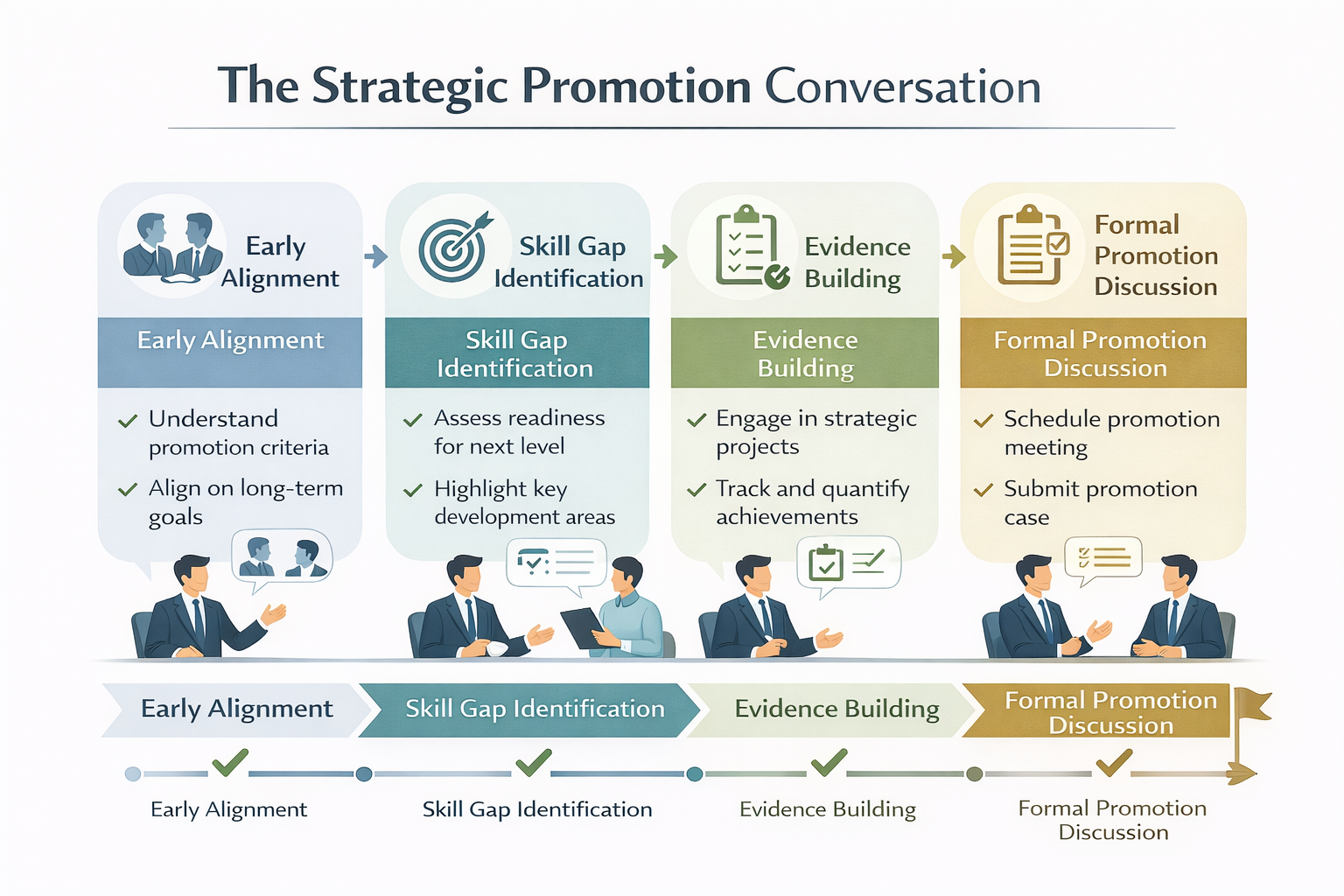
Understanding these criteria helps you build a targeted strategy rather than hoping your hard work eventually gets noticed.
Build Your Promotion Foundation: The Prerequisites
Document Your Wins Consistently
Most professionals dramatically underestimate the importance of self-documentation. Your manager is juggling multiple priorities and won’t remember every achievement when promotion discussions happen.
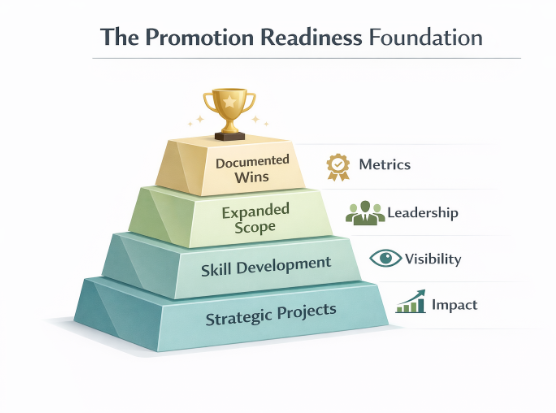
Create a running document that tracks:
- Quantifiable results and key performance metrics you’ve influenced
- Projects you’ve led or meaningfully contributed to
- Problems you’ve solved that had business impact
- Positive feedback from clients, stakeholders, or leadership
- Skills you’ve developed and certifications you’ve earned
Update this monthly, not when you’re preparing for your performance review. Recency bias is real, and promotion committees often focus on what you’ve done lately rather than your cumulative contribution.
Expand Your Scope Beyond Your Job Description
The clearest signal that you’re ready for advancement is already operating at the next level. This means strategically taking on responsibilities that stretch beyond your current role.
Look for opportunities to:
- Lead cross-functional initiatives that increase your visibility
- Mentor junior team members and support their development
- Contribute to strategic planning or problem-solving discussions
- Volunteer for high-stakes projects that showcase your capabilities
- Fill gaps that exist between your current level and the role you want
The key is being strategic about which additional responsibilities you take on. Choose projects that align with promotion criteria and allow you to demonstrate leadership, not just extra capacity.
Master the Art of Strategic Visibility
Visibility isn’t about self-promotion or taking credit for others’ work. It’s about ensuring decision-makers understand your value and impact.
Communicate Your Impact Effectively
When discussing your work, frame contributions in terms of business outcomes rather than activities. Compare these approaches:
Weak framing: “I’ve been managing the social media accounts and posting regularly.”
Strong framing: “I’ve developed and executed a content strategy that increased qualified leads from social channels by 47% over six months, contributing $230K in new pipeline.”
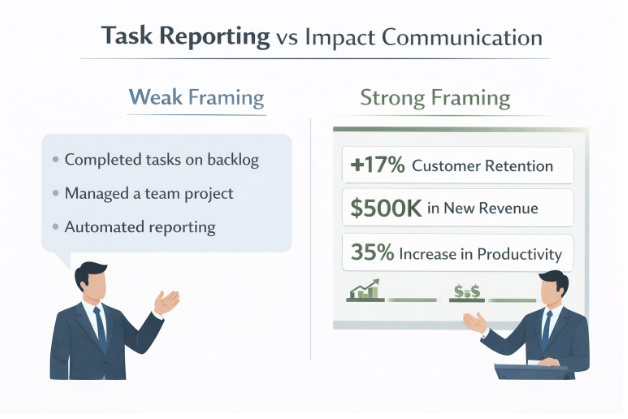
The difference is night and day. One describes tasks; the other demonstrates measurable business impact.
Build Relationships with Decision Makers
Promotions are decided by people, and people promote individuals they know, trust, and can envision in elevated roles. Building genuine professional relationships with leadership isn’t manipulative—it’s strategic career management.
Practical approaches include:
- Requesting informational meetings to understand business priorities
- Sharing insights or solutions to challenges leadership is facing
- Participating actively in meetings where executives are present
- Seeking mentorship from leaders at the level you’re targeting
- Contributing meaningfully to company-wide initiatives
These interactions should be authentic and value-driven, not performative networking.
Have the Promotion Conversation Strategically
Many professionals wait for their manager to bring up promotion opportunities. This passive approach often leads to disappointment. You need to initiate and guide the conversation.
Timing Your Request Appropriately
The best time to discuss promotion isn’t during your annual review—it’s several months before promotion decisions are made. This gives you time to address any gaps and allows your manager to advocate for you when it matters.
Ask questions like:
- “What would I need to demonstrate to be considered for [specific role] in the next promotion cycle?”
- “Are there specific skills or experiences I should develop to be competitive for advancement?”
- “What does success look like at the next level, and where do you see gaps in my readiness?”
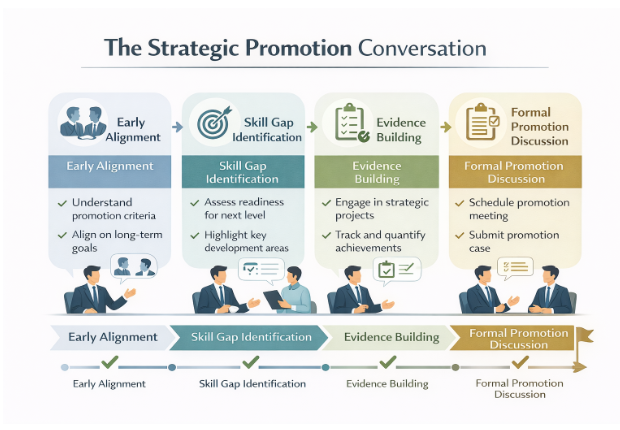
This positions you as someone who’s thinking strategically about career progression and gives you a concrete roadmap.
Making Your Case with Evidence
When you formally express interest in a promotion, come prepared with your documented achievements. Present your case as a business proposal, not a request based on tenure or effort.
Structure your conversation around:
- Specific accomplishments with quantifiable impact
- Evidence of operating at the next level through expanded responsibilities
- Demonstrated leadership and influence across the organization
- Alignment with business priorities and strategic objectives
- Your vision for how you’d add value in the elevated role
Also Read: https://sanews.in/sales-strategies/
This approach shifts the conversation from “I deserve this” to “Here’s why this makes business sense.”
Navigate Common Obstacles to Career Advancement
When You’re Told “You’re Not Ready Yet”
If your manager indicates you’re not ready for promotion, resist the urge to become defensive. Instead, treat it as information-gathering.
Ask specifically what’s missing: “Can you help me understand exactly what I need to demonstrate to be promotion-ready? What are the specific gaps you’re seeing?”
Request a clear development plan with milestones and a timeline. If these aren’t provided, you may need to assess whether growth opportunities actually exist in your current situation.
Addressing the Skills Gap
Sometimes the barrier to promotion is a genuine skills deficit. Perhaps the next level requires financial acumen you haven’t developed, or technical expertise you lack.
Take ownership of closing these gaps through:
- Formal training and professional certifications
- Stretch assignments that build required competencies
- Finding a mentor who excels in your development areas
- Self-directed learning with immediate application
The professionals who advance fastest are those who proactively address weaknesses rather than hoping they won’t matter.
Know When to Consider External Opportunities
Sometimes the fastest path to career advancement isn’t internal promotion—it’s strategic career movement. Consider looking externally when:
- You’ve been passed over multiple times despite strong performance
- Your company has limited growth opportunities or organizational layers
- The timeline for advancement is unreasonably long
- You’ve maximized learning in your current role
- Market rates for your next-level role significantly exceed internal promotion increases
Also Read : The Future of Work in the Age of AI: Risks, Opportunities, and Survival Skills
The job market often values external candidates differently than internal ones. Many professionals accelerate their careers by making strategic moves every few years rather than waiting for internal advancement.
Take Action on Your Promotion Strategy Today
Getting promoted isn’t about chance or politics—it’s about strategic positioning, documented impact, and proactive career management. The professionals who advance consistently are those who treat their career progression as a project requiring planning, execution, and measurement.
Start by clarifying exactly what role you’re targeting and when. Then reverse-engineer your path by identifying the gaps between where you are and where you need to be. Document your achievements, expand your visibility, build strategic relationships, and have explicit conversations about advancement.
Your career trajectory is ultimately your responsibility. The question isn’t whether you’re capable of advancement—it’s whether you’re willing to approach getting a promotion with the strategic thinking and decisive action it requires.
The next promotion cycle is already in motion. What will you do today to position yourself as the obvious choice?
Beyond Promotion: Aligning Career Growth with Higher Purpose
Achieving a promotion is not merely a professional milestone; it is a mirror reflecting discipline, intention, and inner clarity. When ambition is guided by awareness, career growth becomes more than status or reward. It becomes part of a deeper inquiry into purpose, responsibility, and one’s connection to something greater than the workplace.
True fulfilment emerges when success aligns with values that endure beyond titles and pay scales. For readers drawn to this wider horizon, spiritual wisdom offers grounding and direction. Books such as “Gyan Ganga” and “Way of Living” by Saint Rampal Ji Maharaj gently explore authentic worship, conscious living, and the meaning of human life, inviting reflection on how outer achievement and inner enlightenment can move forward together.