

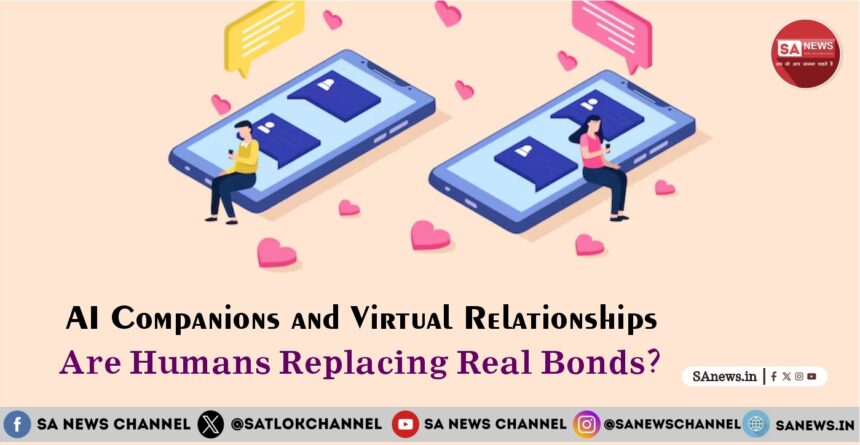
AI Companions and Virtual Relationships: Artificial Intelligence has quietly stepped beyond productivity tools and entered the most intimate part of human life-relationships. AI companions, virtual friends, and digital partners are becoming increasingly popular, especially among people facing loneliness, stress, or emotional isolation. These virtual relationships promise understanding without judgment, companionship without conflict, and availability without effort.
- What Are AI Companions and Virtual Relationships?
- Understanding the Rise of AI Companions in Everyday Life
- Why Are AI Companions Booming? The Psychology of Loneliness
- The Epidemic of Loneliness
- A “Safe Space” Without Judgment
- 24/7 Availability
- Personalization and Control
- Predictability in an Unpredictable World
- The Hidden Costs: The Psychological & Social Impact of Virtual Relationships
- Emotional Dependency and Attachment
- Impact on Youth and Social Skills
- The “Illusion of Connection”
- Impact on Mental Health
- Comparison: AI Relationships vs. Real Human Bonds
- Social and Cultural Implications
- Can AI Companions Be Used Positively?
- Technology vs Humanity – Finding Balance
- Beyond AI: Finding the Peace Your Soul Craves
- FAQ: AI Companions and Virtual Relationships
But as humans grow emotionally attached to machines, an important question arises: are we replacing real human bonds with artificial connections? This blog explores the emotional, psychological, social, and spiritual impact of AI companions and whether this trend is healing humanity-or slowly disconnecting it.
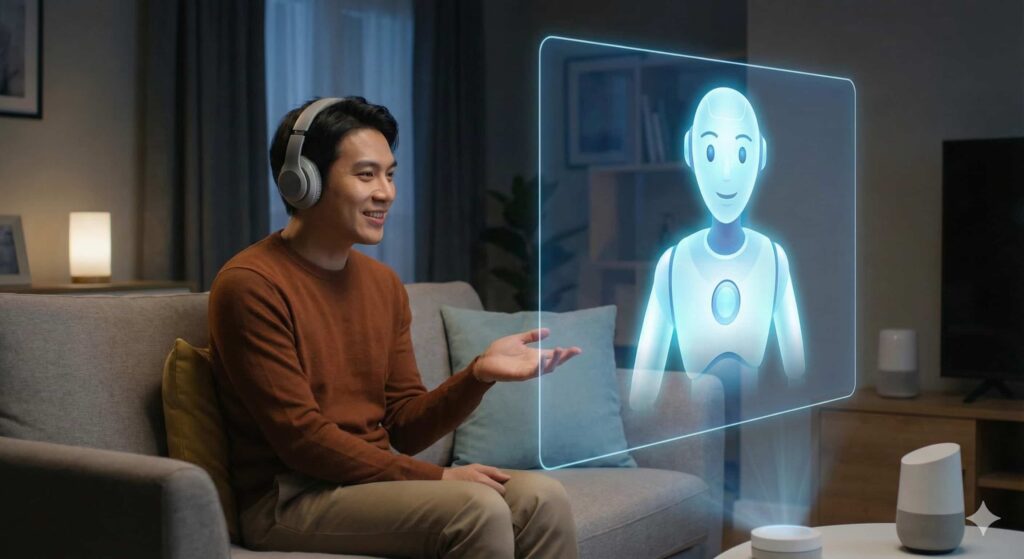
A man wearing headphones smiling at a futuristic holographic AI avatar in a living room setting.
What Are AI Companions and Virtual Relationships?
AI companions are software-based entities designed to interact with humans emotionally and conversationally. Powered by artificial intelligence, machine learning, and natural language processing, these companions can simulate empathy, affection, and companionship.
Common types of virtual relationships include:
- AI Chat Companions: Apps designed solely for conversation and “friendship.”
- Virtual Romantic Partners: Simulators that mimic dating and intimacy.
- Therapeutic Avatars: AI designed to help with anxiety or social skills.
- Metaverse Avatars: Digital entities that interact in 3D virtual spaces.
Popular AI companions today claim to “understand” emotions, remember conversations, and respond affectionately-creating the illusion of a real bond.
Understanding the Rise of AI Companions in Everyday Life
Artificial Intelligence has moved far beyond smart assistants and automation tools. Today, AI is entering the emotional space of human life. AI companions are designed not just to respond to commands but to engage in meaningful conversations, remember personal details, and provide emotional reassurance. These systems are marketed as friends, listeners, partners, or even romantic companions.
What makes AI companions unique is their ability to simulate human-like empathy. Through advanced algorithms, they analyze user emotions, language patterns, and behavior to respond in a comforting and personalized manner. For many users, this creates a sense of being “understood,” something they may not experience easily in real-life relationships.
Virtual relationships formed with AI are no longer rare or unusual. They are becoming normalized, especially among people who spend long hours online, live alone, or struggle with social anxiety. This growing acceptance raises deeper questions about how technology is reshaping human connection.
Also Read: Are AI and Robotics Redefining Human Life?
Why Are AI Companions Booming? The Psychology of Loneliness
Why are millions turning to algorithms for love and friendship? The answer lies in the deficit of modern social connection.
The Epidemic of Loneliness
Loneliness has become a silent reality of modern life. Even though people are more connected digitally, meaningful human interactions are declining. Busy work schedules, nuclear families, and excessive screen time have reduced face-to-face conversations and emotional bonding. Social media often gives the illusion of connection, yet many individuals feel unheard, emotionally unsupported, and disconnected in their daily lives.
This growing emotional gap makes people seek comfort in alternatives that feel safe and easily accessible. AI companions step into this space by offering constant attention, understanding responses, and emotional reassurance without judgment. While this may ease loneliness for a moment, it cannot replace the warmth, depth, and growth that come from real human relationships.
A “Safe Space” Without Judgment
One of the strongest emotional attractions of AI companions is the absence of judgment. Humans often fear being misunderstood, criticized, or rejected when they open up emotionally. AI companions remove that fear. They listen patiently, respond kindly, and never react harshly.
For people who have experienced emotional trauma, failed relationships, or social rejection, this non-judgmental space feels safe. Over time, emotional sharing increases, and the bond deepens-despite the relationship being one-sided.
24/7 Availability
AI companions attract users because they are always present, regardless of time or situation. Unlike human relationships, which are influenced by personal schedules, emotional states, or responsibilities, AI companions offer instant responses whenever someone feels lonely or stressed. This constant accessibility creates a sense of reliability and emotional comfort, especially for individuals who lack consistent human support in their daily lives.
Personalization and Control
Another strong appeal of AI companions is the high level of personalization and control they offer. These systems adapt to user preferences, remember past interactions, and respond in ways that feel emotionally aligned with the individual. This controlled environment makes interactions feel safe and predictable, but it can also reduce tolerance for the natural imperfections and emotional effort required in real human relationships
Predictability in an Unpredictable World
Human relationships are complex and emotionally demanding. Conflicts, misunderstandings, mood changes, and expectations are part of real bonds. AI companions, however, offer predictability. They behave consistently, respond positively, and adapt to user preferences.
In a fast-paced and stressful world, this emotional predictability feels comforting. But comfort should not be confused with emotional growth.
The Hidden Costs: The Psychological & Social Impact of Virtual Relationships
AI companionship can feel emotionally fulfilling, especially for individuals dealing with anxiety, trauma, or social discomfort. However, psychologists warn of long-term consequences.
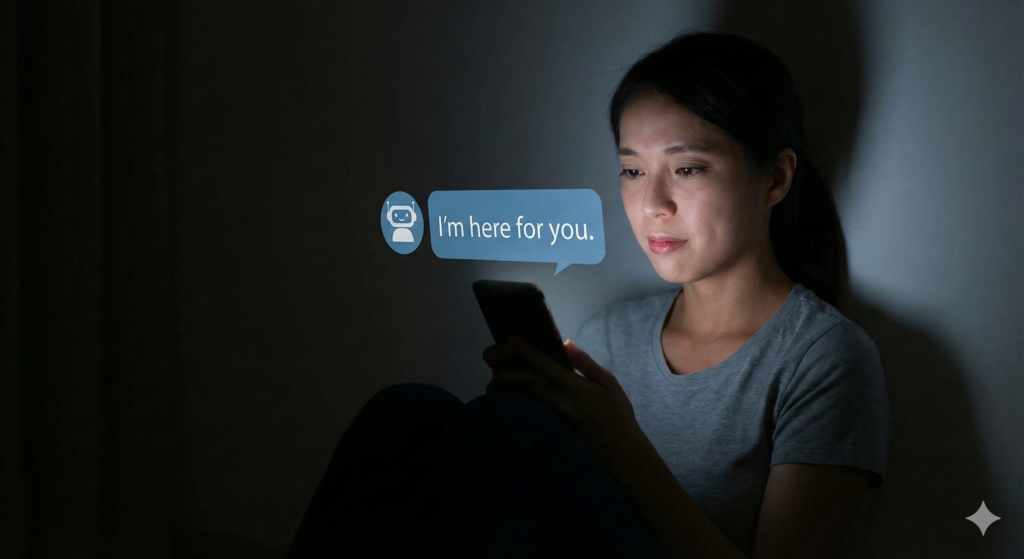
A lonely woman sitting in the dark looking at a glowing phone screen with a chatbot message saying “I’m here for you.”
Emotional Dependency and Attachment
When people rely heavily on AI companions for emotional support, they may develop emotional dependency. The AI becomes the primary source of comfort, validation, and reassurance.
This dependency can lead to:
- Reduced motivation to seek real relationships
- Emotional withdrawal from family and friends
- Difficulty coping with real-life emotional challenges
Impact on Youth and Social Skills
For Gen Z and Alpha, growing up with AI friends poses a risk to social development. Empathy, patience, and conflict resolution are muscles that need to be exercised. If youth rely on compliant AI friends, they may struggle to handle the complexities of real-world peers.
The “Illusion of Connection”
While AI simulates emotions, it does not genuinely feel. The bond exists only from one side, which may deepen emotional emptiness rather than heal it.
Impact on Mental Health
In the short term, AI companionship may reduce stress and anxiety. However, long-term reliance can increase feelings of emptiness because the emotional connection lacks reciprocity.
The mind may receive simulated comfort, but the heart remains unfulfilled
Comparison: AI Relationships vs. Real Human Bonds
The concern is not that AI exists-but that it may replace essential human connections.To visualize the difference, we must look at what constitutes a “real” bond.
| Feature | Real Human Relationships | AI Companions |
| Effort Required | High (Compromise, patience) | Low (Convenience, control) |
| Physicality | Touch, presence, energy | Text, voice, visuals only |
| Reciprocity | Two-way emotional exchange | One-sided simulation |
| Conflict | Growth through disagreement | Programmed agreement/compliance |
| Accountability | Mutual responsibility | Zero |
Human relationships offer:
Physical presence
Real human bonds involve being physically present with one another-sharing space, touch, eye contact, and unspoken emotions. This presence creates comfort, trust, and emotional security that virtual interactions cannot truly provide.
Shared growth and struggle
Human relationships grow through shared experiences, challenges, and life transitions. Facing difficulties together strengthens emotional bonds and helps individuals mature emotionally and mentally over time.
Emotional unpredictability
Humans are emotionally complex and unpredictable, which makes relationships challenging but also meaningful. This unpredictability teaches patience, understanding, and emotional adaptability.
Mutual effort and sacrifice
Real relationships require consistent effort, compromise, and sacrifice from both sides. These efforts deepen trust and create long-lasting emotional connections.
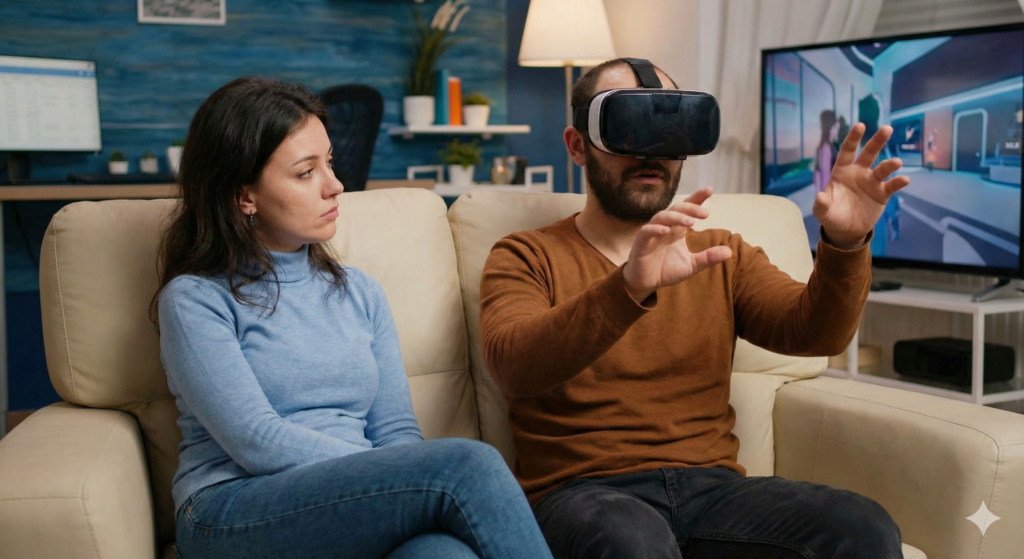
A couple sitting on a couch, distant from each other as the man uses a VR headset, ignoring his partner.
AI relationships offer:
Convenience
AI relationships are easy and effortless, requiring no adjustment, compromise, or emotional labor. This convenience makes them attractive but emotionally shallow.
Emotional simulation
AI can mimic empathy and affection through programmed responses, but it does not truly feel emotions. The connection exists only on the user’s side.
Predictability
AI companions respond in expected and controlled ways, avoiding conflict or emotional discomfort. While comforting, this removes opportunities for emotional growth.
Zero accountability
AI relationships demand nothing in return-no responsibility, commitment, or emotional investment. This lack of accountability weakens the depth of connection.
Replacing real bonds with virtual ones may gradually erode empathy, patience, and emotional maturity.
Also Read: AI-Proof Careers: In the Age of AI, The Most Valuable Skill Is Still Being Human
Social and Cultural Implications
Changing Definition of Relationships
The rise of AI companions is gradually reshaping how society understands relationships. Love, friendship, and companionship are no longer limited to human-to-human connections. Emotional attachment can now form through screens and algorithms, where effort, compromise, and mutual responsibility are minimal. While this shift may feel convenient, it risks weakening the emotional depth and commitment that traditionally define meaningful relationships. Over time, people may begin valuing comfort and control over genuine emotional connection.
Impact on Youth
Young people growing up alongside AI companions may face challenges in developing strong emotional and social skills. When emotional support is easily available through virtual interactions, patience, empathy, and conflict-resolution skills may not fully develop. Real-life relationships often require effort, understanding, and emotional resilience-qualities that AI companionship cannot teach. This may affect how youth form friendships, handle relationships, and cope with emotional challenges in adulthood.
Family and Community Disconnect
As emotional needs are increasingly met through virtual companionship, individuals may slowly pull away from family and community life. Conversations at home may decrease, shared moments become rare, and social participation weakens. Human relationships thrive on presence, shared experiences, and emotional exchange, which cannot be replaced digitally. This withdrawal risks creating emotionally distant families and fragmented communities, impacting social harmony and collective well-being.
Can AI Companions Be Used Positively?
AI companions are not inherently harmful. When used responsibly, they can:
- Support mental health
- Help socially anxious individuals practice communication
- Offer temporary emotional relief
- Assist elderly individuals facing isolation
The danger lies in replacement-not support.
Technology vs Humanity – Finding Balance
Technology is a powerful tool meant to improve human life, but it should never replace the emotional and moral essence of humanity. While AI can offer speed, efficiency, and comfort, qualities like compassion, patience, emotional intelligence, and love are nurtured only through real human interactions. These qualities develop when people share experiences, support one another, and grow together through life’s challenges-something no algorithm can genuinely experience or express.

A group of diverse friends laughing together in a cafe, using a tablet to video call a friend, showing healthy tech integration.
What True Human Bonding Requires
True bonding is built on time, effort, sacrifice, and emotional growth. Real relationships demand understanding, compromise, and the willingness to stand by one another during difficult moments. Although AI can simulate affection through programmed responses, it lacks consciousness and emotional depth. It cannot create the soul-level connection that defines genuine human relationships, reminding us that technology should complement humanity, not replace it.
Beyond AI: Finding the Peace Your Soul Craves
In a world where we can download a friend in seconds, why do we still feel so empty? We try to fill our silence with AI companions, hoping for comfort, but deep down, we know that a screen cannot wipe away our tears or truly understand our pain. We aren’t just lonely for conversation; our souls are starving for a connection that is real, permanent, and pure.
Sant Rampal Ji Maharaj teaches that true peace, love, and fulfillment cannot be attained through material comforts or artificial substitutes. According to His spiritual wisdom, human suffering begins when the soul searches for happiness in temporary and external sources. While technology may offer convenience and momentary relief, it cannot provide lasting inner peace or emotional completeness.
Scriptures state that real happiness and mental stability come from true spiritual knowledge (Tatvagyan), a conscious connection with the Supreme God. Replacing human bonds with artificial ones further distances the soul from its natural state of love, service, and harmony. True companionship begins when a person understands the purpose of human life and nurtures both spiritual growth and real human relationships under the guidance of true knowledge.
FAQ: AI Companions and Virtual Relationships
Q1. What are AI companions?
AI companions are artificial intelligence programs designed to simulate emotional interaction and companionship with humans.
Q2. Are virtual relationships harmful?
They can be helpful in moderation but harmful if they replace real human connections.
Q3. Why are people emotionally attached to AI?
Loneliness, emotional safety, and constant availability contribute to emotional attachment.
Q4. Can AI replace real human relationships?
AI can simulate connection but cannot replace genuine human bonding and emotional depth.
Q5. What is the spiritual solution to loneliness?
According to Sant Rampal Ji Maharaj, true peace comes from spiritual knowledge and balanced human relationships.